
Unbiased headlines. Facts, not spin.
Unbiased Headlines is an independently owned news organization. We bring you the facts, not opinions, written fresh from 110+ named sources. Sources linked so you can verify it yourself.
 tech
Major Story (7/10)
Event date: October 26, 2026 ·
OpenAI and Anthropic cut AI model prices by up to 80% since June
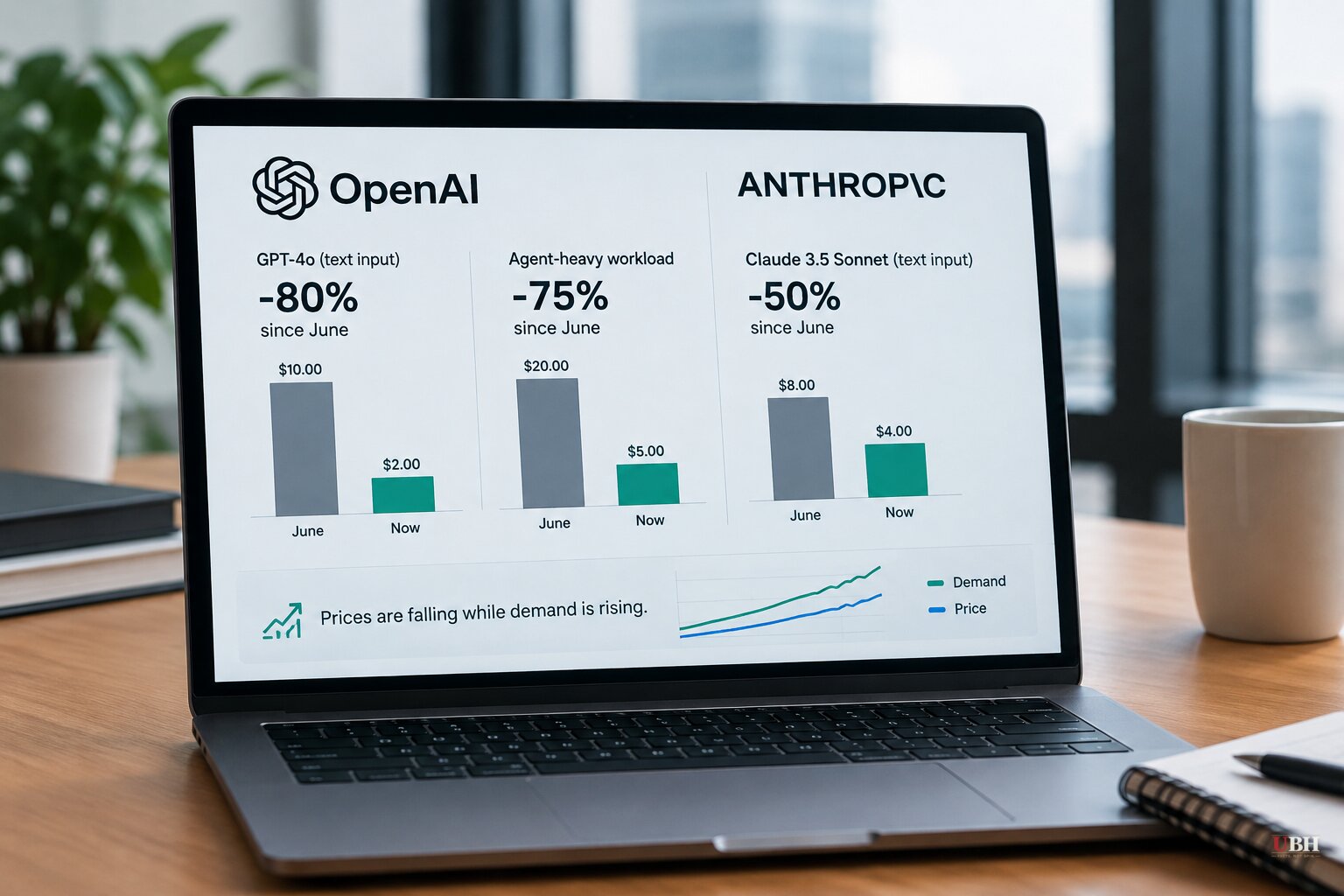
OpenAI and Anthropic have spent the past four months undercutting their own price sheets. The cuts run from about 20% on some models to 80% on one.
The prices are documented in the labs' launch announcements. The timeline below comes from developer Max Woolf, whose dated list was published Oct. 25 and whose figures match the launch pricing. All prices are per million tokens, listed as input / output / cache read.
How the prices fell
June 26: OpenAI launched GPT-5.6 Sol at $5 / $30 / $0.50 and the small GPT-5.6 Luna at $1 / $6 / $0.10.
July 24: Anthropic's Claude Opus 5 arrived at $5 / $25 / $0.50, matching Sol.
July 30: OpenAI cut Luna 80%, to $0.20 / $1.20 / $0.02.
Aug. 21: OpenAI cut Sol about 20%, to $4 / $20 / $0.40, for three months.
Sept. 1: Anthropic shipped Fable 5.1 at $10 / $50 / $0.25. Its cache read price fell 75% from the $1 charged for Fable 5.
Sept. 22: OpenAI released GPT-6 Sol at $2 / $10 / $0.20 and GPT-6 Luna at $0.10 / $0.50 / $0.01. Each is half the input and output price of the model it replaced. The same day, Anthropic announced Opus 5.5 at $4 / $20 / $0.20. Anthropic said Opus 5.5 "requires less compute to serve than Opus 5, and its pricing reflects that."
Sept. 29: OpenAI followed with GPT-6.1 Sol at $2 / $10 / $0.10. Axios reports OpenAI has also launched a GPT-6.1 Terra model costing up to half as much per token as the version before it.
Why cache prices matter most
The sticker price on input and output understates the change for anyone running coding agents. Woolf calculates that cache reads make up 96% to 99% of the token spend in agentic coding, because the cache holds the whole conversation and replays it every turn.
With cache hit rates around 90% to 100%, a 75% cut in cache pricing translates into roughly a 70% to 75% cut in total cost. By Woolf's math, that puts the effective drop at about 75% for an agent moving from GPT-5.6 Sol to GPT-6.1 Sol, and 40% to 60% for Opus 5.5 versus Opus 5.
Ramp, the corporate expense management firm, tracks this with an index built from actual corporate spending on Anthropic and OpenAI models. Its latest reading cited by Axios put token prices at roughly 59 cents per million tokens.
Competition, or something else
Woolf's explanation is his own analysis, not a statement from either lab. He sees tit-for-tat pricing between OpenAI and Anthropic, plus pressure from open-weight models. He points to Moonshot's Kimi K3.1 Pro, which he says scores 55 against Opus 5.5's 58 on the Artificial Analysis index at half the input and output price. DeepSeek's models are hosted by dozens of competing providers on OpenRouter, which pushes prices toward marginal cost.
Woolf also notes both labs are reportedly nearing IPOs. He says inference margins have been reported as high as 80% in some accounts, which leaves room to cut. He expects subscription allowances, not list prices, to be trimmed first if the labs need to claw anything back.
Anthropic's only stated reason for its cuts is the lower compute cost of Opus 5.5.
Usage is up, but is spending
This is an unusual pattern. Axios describes it as a price war breaking out during a period of soaring demand.
AI boosters argue that falling prices are what will drive adoption, and token usage has indeed surged. Their case is that cheaper compute produces the riches everyone is counting on.
The counterpoint Axios lays out is about the metric. Investors in the data center buildout care about token spending, not token usage. Spending is a matter of both usage and price, so a steep price drop only pays off if usage grows enough to offset it.
Buyers are pushing back
The Information reported that enterprise customers are resisting bigger spending commitments when their contracts with Anthropic and OpenAI come up for renewal. The shift is from "expand the commitment" to "prove the value."
The Information cited Replit as the sharpest example. The coding platform reportedly switched its main underlying model from Anthropic to OpenAI in a matter of hours.
Measuring returns remains a problem for buyers. Deloitte's 2026 survey found only 44% of firms track cost per unit of AI inference.
The Information also reported that Anthropic's IPO prospectus asks customers for more multiyear minimum-spend commitments. Some of those same customers are pushing the other way at renewal.
Whether the usage surge outruns the price decline remains an open question for investors.
Sources used for this briefing
7 links from 7 independent newsrooms (syndicated copies of the same report count once)
These are the sources it draws on, linked so you can verify.


