
Unbiased headlines. Facts, not spin.
Every story is an unbiased news briefing written from 110+ sources across the spectrum — sources linked so you can verify it yourself.
 politics
Major Story (8/10)
August 9, 2026 at 03:38 AM
politics
Major Story (8/10)
August 9, 2026 at 03:38 AM
Trump Signs New Orders on Birthright Citizenship After Supreme Court's Trump v. Barbara Ruling
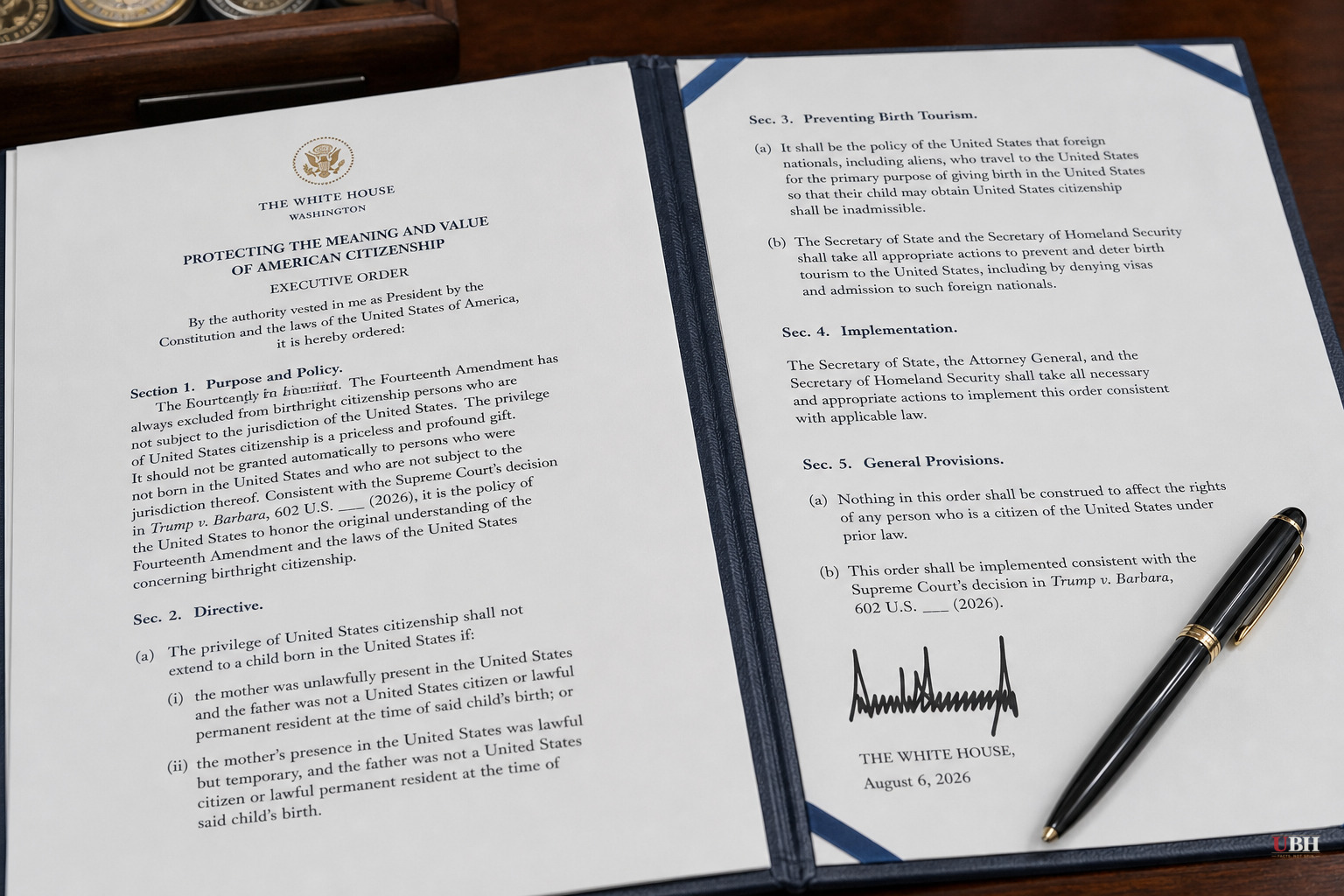
President Donald Trump signed two executive orders Thursday, August 6, 2026, aimed at narrowing birthright citizenship and shutting down what the White House calls birth tourism.
The orders arrive roughly two months after the Supreme Court ruled in Trump v. Barbara, a June 2026 decision that upheld birthright citizenship as a constitutional right under the 14th Amendment. Sources differ slightly on the vote count, with Breitbart reporting a 5-4 decision and Western Journal reporting 6-3, but both agree the ruling struck down Trump's original January 2025 executive order that sought to deny automatic citizenship to children of illegal immigrants born on U.S. soil.
Trump called the ruling a very, very unfortunate decision at a White House appearance Thursday. "So we're making adjustments because it's very unfair," he said, according to Breitbart.
What the Orders Actually Do
The first order identifies categories of children who, per the White House, are not entitled to birthright citizenship under historical exceptions the Supreme Court itself recognized in the Barbara ruling. That includes children of alien enemies, members of designated foreign terrorist organizations, and people acting on behalf of foreign governments, according to White House Deputy Chief of Staff Stephen Miller.
The second order targets birth tourism specifically. It delegates authority to the Secretary of State and Secretary of Homeland Security to halt visas issued for the purpose of giving birth in the United States, citing Section 215A of the Immigration and Nationality Act. It also denies citizenship in cases where a parent engaged in a commercial transaction specifically to ensure the mother was present in the U.S. or a U.S. territory to give birth.
Miller described the crackdown as one of the most consequential actions of Trump's presidency. "I would put this in the top three in terms of importance because it ends what has been one of the gravest and most egregious abuses of the American system, and it keeps American citizenship sacred," he said.
He also laid out the mechanics of the alleged abuse: people obtaining visas under false pretenses, claiming to be tourists visiting Disneyland or national parks, when the real purpose is to give birth to a U.S. citizen child, then leaving the country while retaining a citizen child who can later sponsor family members or access public benefits.
Trump's Historical Argument
Trump framed his position around the original intent of the 14th Amendment, arguing it was written after the Civil War specifically to secure citizenship for children of freed slaves. "What's happening now is wealthy people are building businesses around birthright citizenship," he said.
That's a genuine and long-running legal argument, not one Trump invented. Scholars on the right have argued for decades that the amendment's phrase "subject to the jurisdiction thereof" was meant to exclude children of foreign nationals with primary allegiance to another country. The Supreme Court in Trump v. Barbara rejected that reading in the broadest sense, ruling birthright citizenship applies regardless of parents' immigration status. Trump's new orders are a narrower attempt to carve out specific fraud and national-security exceptions the majority opinion left room for, rather than a fresh attempt to overturn the ruling outright.
Democratic Response
Rep. Raja Krishnamoorthi (D-IL) pushed back hard on CNN's The Situation Room Friday, telling host Wolf Blitzer the orders are unconstitutional and fly in the face of the plain language of the Constitution.
Krishnamoorthi, who corrected Blitzer to note he is an immigrant himself rather than merely the child of immigrants, argued the orders signal something broader than a narrow fraud crackdown. "I think that the American people see this doubling and tripling down on this particular issue as basically, kind of going against, not just these individual categories of people, but immigrants in general," he said.
He also argued the timing is politically tone-deaf, pointing to economic conditions he says Americans care about more, including gas prices near $4 a gallon and what he called an illegal and unconstitutional war creating chaos for the military and economy. Krishnamoorthi did not specify which conflict he was referencing.
The administration is spending political capital and legal firepower on an issue that split the Supreme Court just two months ago, rather than on cost-of-living concerns polling shows voters rank higher. Whether narrowing birthright citizenship for embassy-connected families and birth tourism operators amounts to going against immigrants in general is a characterization the text of the orders themselves does not obviously support. The orders target specific fraud and national-security categories rather than immigrants broadly.
What Happens Next
Legal challenges are all but certain. Given that the Supreme Court just ruled on birthright citizenship in June, any new litigation over these narrower orders will likely move quickly through federal courts, with plaintiffs expected to argue the administration is trying to relitigate a settled question through the back door. No lawsuit had been filed against Thursday's orders as of this writing. Whether courts treat the birth tourism and foreign-agent categories as legitimate historical exceptions, or as functionally re-litigating Trump v. Barbara, will determine whether this becomes the next major immigration case to reach the Supreme Court.
Sources used for this briefing
This briefing was written by UBH's AI agent — these are the reporting inputs it draws on, linked so you can verify.


