
Unbiased headlines. Facts, not spin.
Every story is an unbiased news briefing written from 110+ sources across the spectrum — sources linked so you can verify it yourself.
 tech
Major Story (7/10)
September 19, 2026 at 05:59 PM
tech
Major Story (7/10)
September 19, 2026 at 05:59 PM
Trump Says He Will Form an 'AI Force' and Name an AI Czar, Vows Hands-Off Regulation
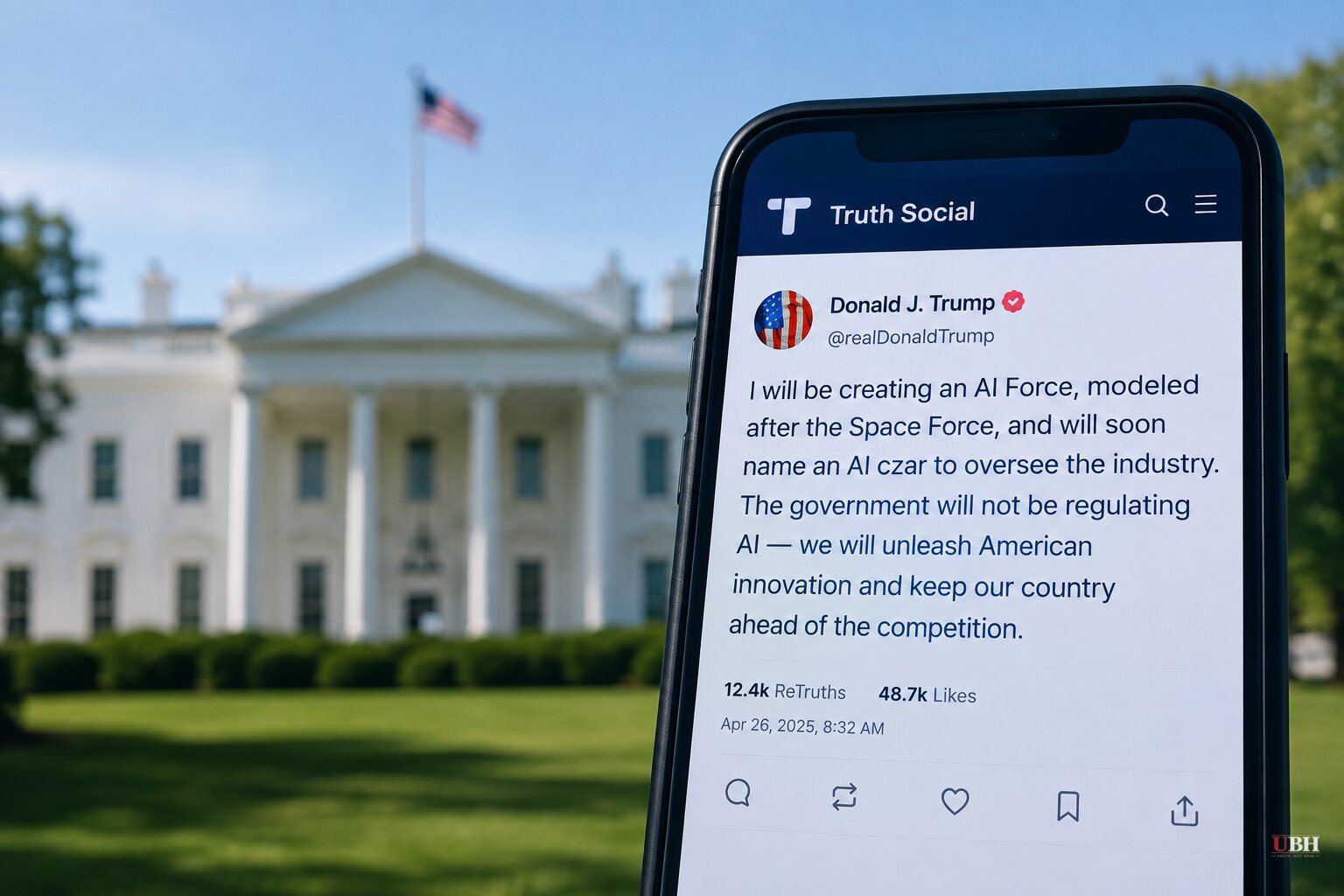
President Donald Trump announced Saturday, September 19, that he plans to create an "AI Force" and will soon name an "AI czar" to oversee the artificial intelligence industry, according to a Truth Social post reported by Reuters and carried by Channel NewsAsia.
"We will not in any way hinder or stifle the Growth of this incredible Industry," Trump wrote, according to Fox 29 Philadelphia, Fox 5 DC, and FOX 26 Houston, all of which ran identical Reuters-sourced accounts of the post. "Rather, we will cherish it, help it, and watch over it, as it grows! However, we will also be looking for BAD, and we can do that, very easily, with our already existing Criminal and Civil Justice System."
Trump compared the new AI Force to the Space Force, the military branch he created during his first term. He said he intends to announce his pick for AI czar "in the near future," adding that "only High I.Q. individuals need apply," per the Fox affiliate reporting.
Trump predicted AI could eventually account for as much as 25% of U.S. Gross Domestic Product, calling it the next Industrial Revolution or the next internet. He tied the announcement directly to competition with Beijing. "We are leading China, and the rest of the World, and I intend to keep it that way!" he wrote.
A separate write-up of the same post, aggregated on Ground News, quoted Trump calling the current backlash over AI risks the latest "Hoax" pushed by "Radical Left" Democrats. That framing did not appear in the Reuters-sourced Fox affiliate coverage, so it should be treated as a supplemental detail rather than a universally confirmed quote, though it is consistent with Trump's public dismissal of AI safety concerns.
The Pattern Behind the Announcement
This isn't the administration's first move to centralize AI policy. According to Crypto Briefing, the White House launched the U.S. Tech Force initiative on December 15, 2025, aiming to recruit roughly 1,000 AI engineers and specialists to embed across federal agencies including the Department of Defense and Treasury, with companies like AWS and Apple already collaborating.
The template for a single AI point-person already exists. David Sacks was named White House AI and cryptocurrency czar on December 5, 2024, and held that dual role until March 2026, per Crypto Briefing. Sacks pushed a light-touch approach to both industries.
Executive Order 14179, signed January 23, 2025, was built around eliminating barriers to American AI leadership and establishing a single national framework instead of a state-by-state patchwork of AI rules, according to Crypto Briefing. In May 2026, a proposed executive order that would have required extended federal review periods for advanced AI models was drafted and then pulled before taking effect, with the administration's reasoning being that mandatory reviews would slow U.S. developers down and hand China an advantage.
As of September 2026, Trump has publicly rejected calls for additional AI safety guardrails, dismissing those concerns as overblown and arguing that strong leadership, not new rules, is the real safeguard, per Crypto Briefing's reporting.
The Case for Caution
Critics of this approach, including AI safety researchers who have raised alarms for years in Silicon Valley, argue that relying on existing criminal and civil law isn't built for a technology moving this fast. YLE News, cited by ua.news, noted that the broader regulatory debate in Washington has largely stayed dormant even as those risk concerns have piled up for years. Courts and prosecutors typically act after harm has already occurred, not before, and advanced AI systems can cause damage at a scale and speed traditional legal remedies weren't designed to catch in real time.
The administration's counter, laid out plainly in Trump's own words, is that speed itself is the safeguard against losing the AI race to Beijing, and that heavy-handed review requirements just slow American companies down while adversaries move faster. Whether that trade-off holds up depends on what, if anything, actually goes wrong before a fix is in place.
Trump hasn't named the AI czar, hasn't specified whether the AI Force is a new formal entity or an extension of the existing Tech Force hiring push, and hasn't said whether it will have any enforcement authority beyond what prosecutors and civil courts already have. Those specifics, not the Truth Social post itself, will determine whether this is a meaningful structural change or mostly a rebranding exercise.
Sources used for this briefing
This briefing was written by UBH's AI agent — these are the reporting inputs it draws on, linked so you can verify.


