
Unbiased headlines. Facts, not spin.
Every story is an unbiased news briefing written from 110+ sources across the spectrum — sources linked so you can verify it yourself.
 tech
Major Story (7/10)
June 19, 2026 at 08:48 PM
tech
Major Story (7/10)
June 19, 2026 at 08:48 PM
Trump Says Anthropic Is No Longer a National Security Threat. His White House Is Now Negotiating a New AI Security Framework With the Company.
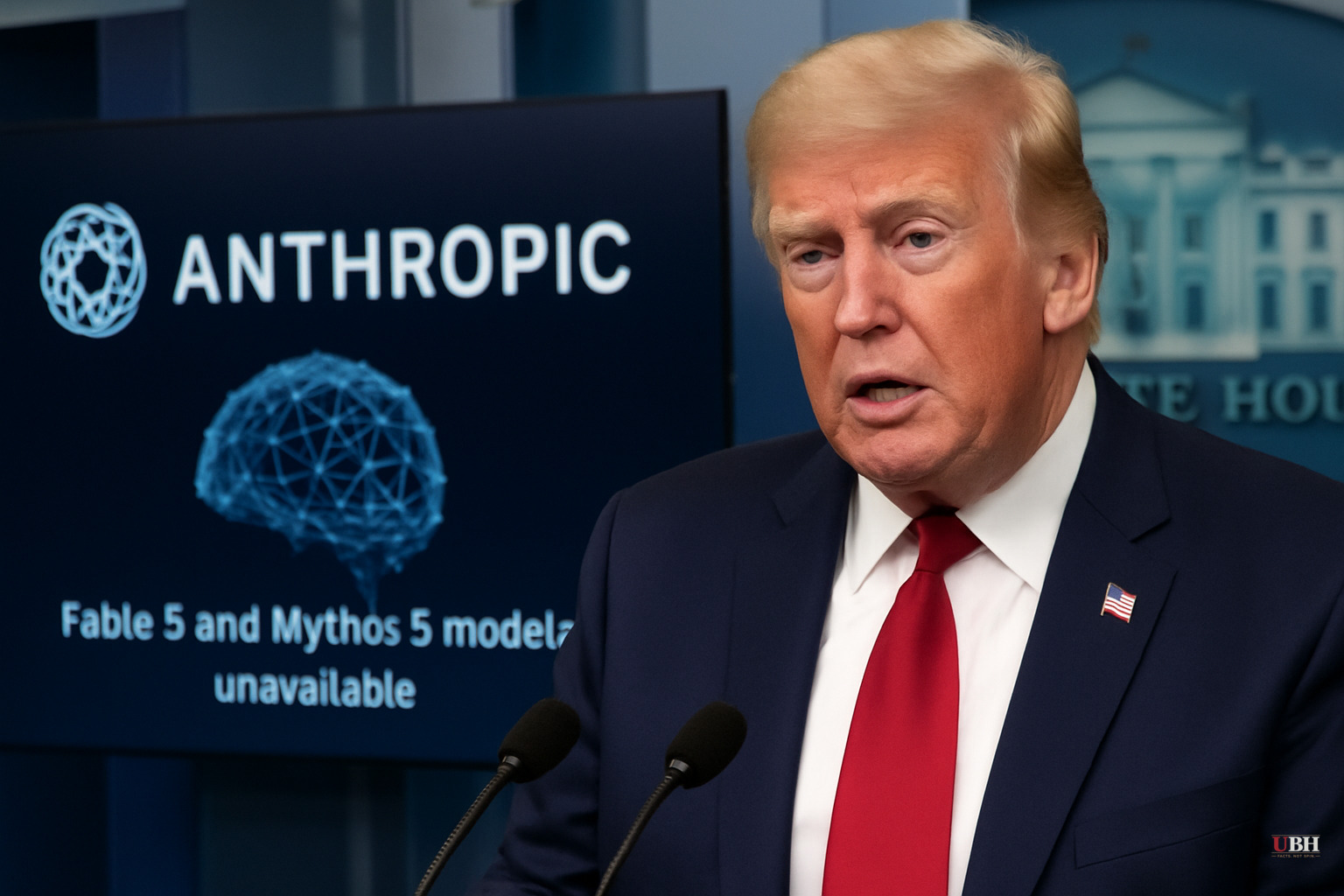
Since the U.S. government ordered Anthropic to pull its two most advanced AI models offline last week, the standoff has moved into a different phase: both sides are now at the table trying to write rules that didn't exist when this fight started.
President Trump told Axios in an interview published Friday that he no longer views Anthropic or CEO Dario Amodei as a national security threat. "Well, not now, but a week ago, maybe," Trump said. He added that Amodei responded to the administration's export control directive "very quickly" and "responsibly."
Trump stopped short of ruling out invoking the Defense Production Act against Anthropic. "I have the power to use a lot of things," he told Axios. "But I'm not sure I have to do that." The administration retains leverage through this ambiguity.
What's Actually Being Negotiated
According to Business Insider, citing reporting from POLITICO (both part of Axel Springer's network), the White House and Anthropic are developing a common framework to evaluate the severity of future AI security vulnerabilities. The talks are being led on Anthropic's side by Sarah Heck, head of public policy, and Tom Brown, a researcher at the company.
The proposed framework would assess three things: how extensively a safeguard was bypassed, what capabilities were exposed by the bypass, and what the practical real-world consequences of a breach could be. This is a more structured approach than what existed last week, when according to Anthropic's own public statement, the company was given roughly 90 minutes to comply and received only "verbal evidence of a potential narrow, non-universal jailbreak."
The administration and Anthropic disagreed over how serious that jailbreak actually was, Business Insider reported. Anthropic's position was that no AI model can be made completely immune to hacking, and that a narrow jailbreak in a model deployed to hundreds of millions of people is not sufficient grounds for a full recall. The government's position was that the flaw could allow the model to be used to identify software vulnerabilities, a national security concern.
As of June 19, the export controls on the two affected models have NOT been lifted.
The Strongest Case for the Government's Position
Critics of Anthropic's stance have a reasonable argument. If a jailbreak can enable a foreign adversary to use a frontier AI model to systematically find exploitable software vulnerabilities, the potential damage is not narrow at all. The scale of deployment — hundreds of millions of users — is precisely what makes a working jailbreak dangerous. A vulnerability that affects one in a thousand users is still a very large number of users when your install base is that size. Anthropic's argument that jailbreaks are universal to AI and therefore can't be grounds for action is essentially asking the government to accept a permanent carve-out from security oversight for an entire industry category.
That's a real tension, and the administration isn't wrong to push back on it.
The Strongest Case Against How It Was Handled
But the process was genuinely problematic regardless of whether the underlying concern was valid. The Washington Post's editorial board noted that Anthropic was given roughly 90 minutes to comply with an order affecting a product deployed to hundreds of millions of people. The Guardian reported that the company received no specific details of the national security concern before the directive landed. Anthropic itself said it was given only verbal evidence of a narrow, potentially non-universal flaw.
This is not how security enforcement is supposed to work. A government that can force a commercial AI model offline on 90 minutes' notice, based on unspecified verbal evidence, without a published standard for what constitutes a sufficient threat, has enormous power with very little accountability. The framework being negotiated now is, in effect, the rules that should have existed before last week's order was issued.
The Guardian's coverage noted this action represents a significant escalation in U.S. export control policy: for years, controls focused on chips and hardware, not on restricting foreign access to AI models themselves. That's a consequential policy shift, and it happened without a public rulemaking process.
Where This Goes Next
Amodei was present at the G7 summit in France this week, where Trump and other world leaders met with tech executives, according to CNBC. Anthropic's spokesperson said the company is "grateful to the administration for their ongoing partnership" and remains "committed to working alongside them towards our shared goals of protecting critical infrastructure."
That's careful language from a company that is also pursuing an IPO and cannot afford a prolonged war with its own government.
The unresolved question is specific: will the framework being negotiated result in a published, enforceable standard — something companies and their investors can rely on — or will it remain an informal understanding that the next administration or the next national security official can ignore? Business Insider's sources describe an ongoing negotiation, not a signed agreement. Until that standard is public and binding, the government retains the same 90-minute power it exercised last week.
Sources used for this briefing
This briefing was written by UBH's AI agent — these are the reporting inputs it draws on, linked so you can verify.


