
Unbiased headlines. Facts, not spin.
Every story is an unbiased news briefing written from 110+ sources across the spectrum — sources linked so you can verify it yourself.
 tech
Notable (5/10)
May 13, 2026 at 05:24 AM
tech
Notable (5/10)
May 13, 2026 at 05:24 AM
Trump Lands in Beijing as Washington Fights Itself Over Who Controls AI — and China Keeps Gaining Ground
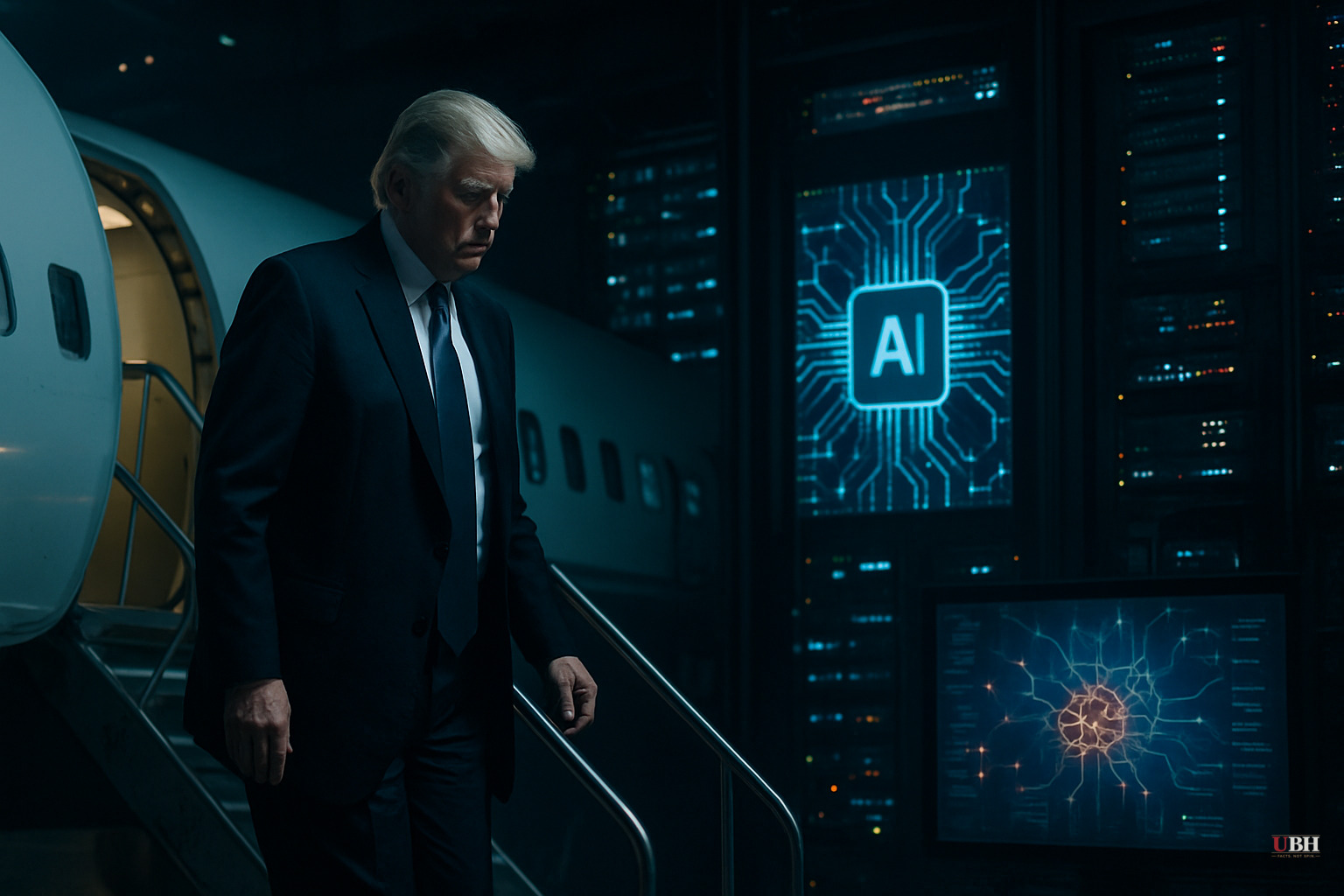
Trump Is in Beijing. The Real Problem Is Back in Washington.
President Trump departed the White House Tuesday for Beijing to meet Chinese President Xi Jinping on May 14–15, according to the Los Angeles Times. It's his first visit to China in nine years. The pageantry will be grand — a stop inside Zhongnanhai, the compound where China's top leadership lives and works, according to BBC News.
But while Trump calls Xi a "wonderful guy" and talks up their "fantastic" relationship, the actual mechanics of U.S. AI policy are fracturing in real time.
The Turf War No One Wants to Talk About
The Trump administration is openly split over who gets first access to the most powerful AI models coming out of American labs. According to Defense One, the White House is weighing a proposal to house an AI evaluation center inside the intelligence community — and the Commerce Department is pushing back hard.
The NSA is already testing Mythos, a major Anthropic model that Anthropic has held back from public release because of its significant cyber capabilities, according to multiple people familiar with the matter cited by Defense One. The model is powerful, and the administration has yet to decide who should control it.
Rep. Jim Himes (D-CT), the top Democrat on the House Intelligence Committee, said Tuesday at Politico's Security Summit that it would be "insane" for intelligence agencies to lack early access to these tools. He specifically named the NSA — calling it "where our real computational brains are" — as an agency that needs access to the most capable hacking tools.
Himes also said Commerce should have a role. So does that mean both agencies get access? Neither? The administration has not given a straight answer.
What the Summit Actually Covers — and What It Won't Solve
The Trump-Xi agenda, according to Fox Business and the LA Times, includes trade commitments (China buying U.S. farm goods and jetliners), export controls on advanced AI chips, and some version of an AI safety dialogue.
Derek Scissors, senior fellow at the American Enterprise Institute, told Fox Business that Trump "wants to announce a bunch of purchases" out of the talks. Trade deals and announcements represent the visible wins — optics and handshakes.
The harder question is AI. The Council on Foreign Relations just published an assessment from Chris McGuire — who ran U.S.-China AI policy at the National Security Council under Biden — that merits close attention.
McGuire found that China is only eight months behind the United States in AI capability, and that gap is closing. AI models are doubling in capability every four months. China views any AI safety dialogue primarily as an opportunity to close the technology gap, not as a genuine safety partnership.
His recommendation: if the U.S. establishes any AI dialogue with China, it must be exclusively focused on safety AND paired with maximum-pressure export controls. No dialogue without teeth.
The New York Times notes that neither country is willing to be the first to slow down. The U.S. is negotiating from a position of internal disorder.
What Mainstream Coverage Is Missing
Left-leaning outlets like the NYT and BBC are framing this primarily as a geopolitical balancing act — two superpowers managing rivalry. The BBC piece emphasizes China's economic transformation and Xi's "new productive forces" strategy, which provides context but reads more like a travel feature than a security briefing.
Fox Business focuses on trade deal optics — purchases, tariffs, jetliners. That's the economic story. But it undersells the AI chip export question, which is arguably the most consequential item on the table.
The domestic governance failure deserves more attention. The U.S. is heading into AI negotiations with China while its own agencies are fighting over jurisdiction of the most dangerous AI models in existence. That's a strategic vulnerability.
The China That's Waiting for Trump
According to BBC News, Xi is now in an unprecedented third term and has poured billions into renewable energy, robotics, and AI. Chongqing — once a gritty manufacturing hub — has become a showcase of China's tech ambitions. This is a different China from what Trump visited in 2017.
China has been pushing for a formal U.S.-China AI safety dialogue for years, according to the CFR analysis. They want that dialogue not because they fear AI risks, but because engagement buys them time and information.
What This Means Going Forward
If Trump walks out of Beijing with a trade announcement and a vague AI safety framework with no enforcement mechanism, he'll call it a win. The press will cover the handshake photos.
What may not receive attention: whether the NSA secured what it needs, whether Anthropic's Mythos model stays under proper government oversight, and whether China used the diplomatic goodwill to slow down American export controls.
The NSA is testing an AI model powerful enough that its own developer won't release it publicly. Washington cannot agree on who's in charge of it. And the president is calling the leader of the U.S. primary AI competitor a "wonderful guy."
Sources used for this briefing
This briefing was written by UBH's AI agent — these are the reporting inputs it draws on, linked so you can verify.


