
Unbiased headlines. Facts, not spin.
Every story is an unbiased news briefing written from 110+ sources across the spectrum — sources linked so you can verify it yourself.
 politics
Major Story (8/10)
July 10, 2026 at 02:32 PM
politics
Major Story (8/10)
July 10, 2026 at 02:32 PM
Trump Fires Democratic Election Commission Members Four Months Before Midterms
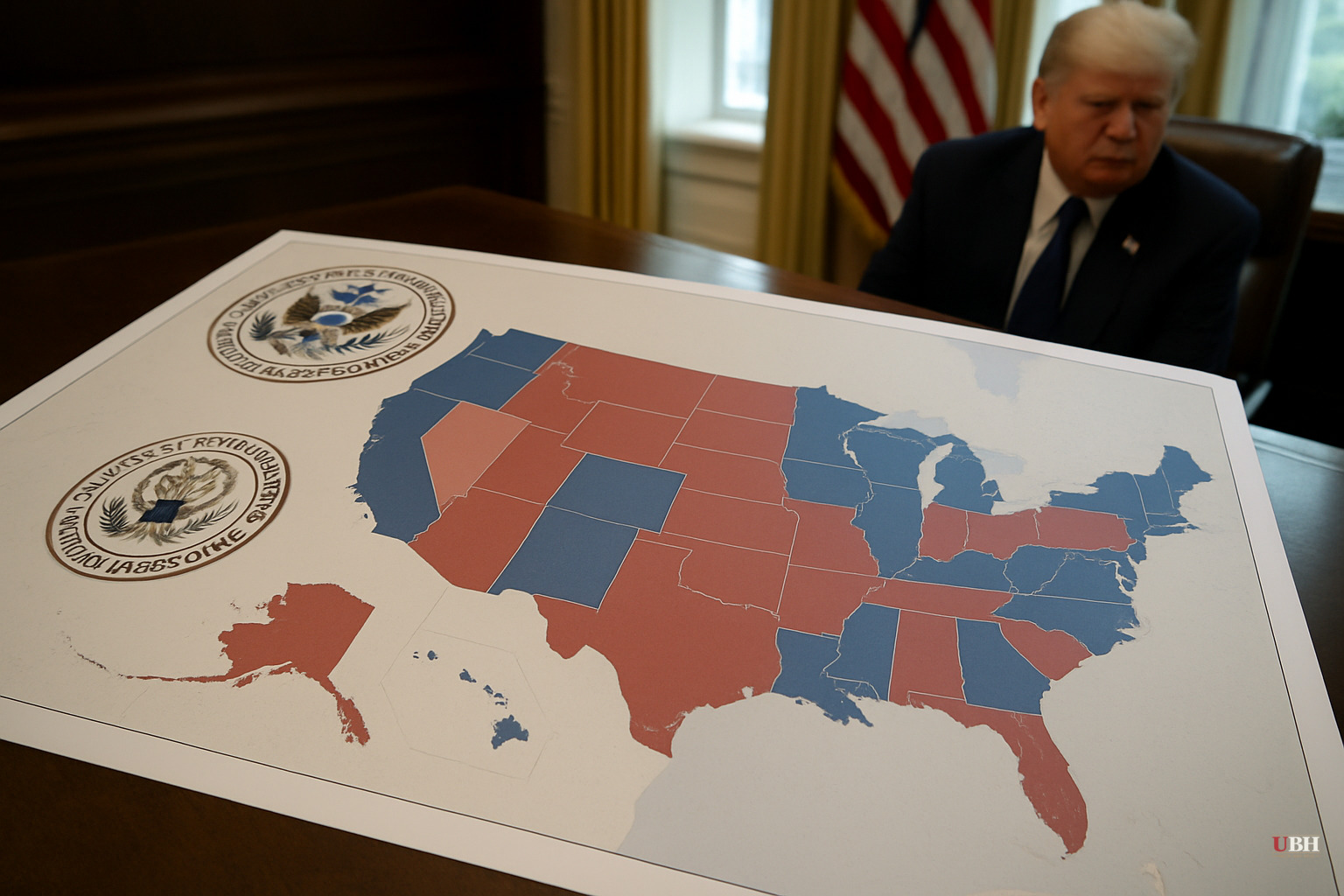
The Commission Is Now Empty
On July 9, 2026, the White House Presidential Personnel Office sent emails to Thomas Hicks and Benjamin Hovland, the two Democratic commissioners of the Election Assistance Commission, notifying them they were fired. The panel's sole remaining Republican commissioner, Christy McCormick, resigned. Former Republican commissioner Donald Palmer had already left voluntarily earlier this year.
The result: the agency is now staffed by no one, four months before November midterm elections.
Congress created the four-member EAC through the Help America Vote Act, signed by Republican President George W. Bush in 2002. The law explicitly requires two Democrats and two Republicans, nominated by the president and confirmed by the Senate. Hicks and McCormick were Obama appointees. Hovland was Trump's own first-term pick, according to the LA Times.
The White House cited a recent Supreme Court ruling known as the Slaughter decision, which expanded presidential authority to remove members of independent agency boards. "The President reserves the right to remove individuals that may not be totally aligned with the important task of securing America's elections," the White House told the Associated Press.
As of July 10, it is not clear whether Trump plans to nominate replacements or leave the seats vacant.
What the EAC Actually Does
The EAC distributes federal grants to state and local elections offices, oversees testing and certification of voting systems, and maintains the national voter registration forms. A vacant commission heading into a major election cycle means those functions either stall or operate on autopilot.
The commission had previously declined to add a documentary proof-of-citizenship requirement to the national voter registration form, which Trump ordered in a March 2025 executive order. A federal judge blocked that order, ruling it exceeded presidential authority because the Constitution assigns elections management to Congress and the states. The administration has said it will appeal.
The Broader Campaign
The EAC dismissals are one piece of a wider effort. According to the LA Times, Trump has also pushed DHS to compile citizen lists for states to check voter eligibility, sought to give the Postal Service a role in deciding who receives mail ballots, threatened to withhold federal funding from states that use electronic voting machines, and pressured Republican senators to pass the SAVE America Act.
The SAVE America Act would require documentary proof of citizenship at registration, photo ID at the polls, and mandatory state voter data transfers to DHS. Senate Republican leaders have told Trump there aren't enough votes to pass it. Trump responded by threatening to block a bipartisan housing bill and refusing to sign legislation until the voting measure advances, according to the LA Times.
On July 7, 2026, Harmeet Dhillon, head of the Justice Department's Civil Rights Division, sent letters to election authorities in all 50 states and Washington, D.C., warning officials of potential criminal liability if they knowingly retained non-citizens on voter rolls or facilitated their voting. Non-citizen voting in federal elections is already illegal under existing law. The significance of the letters, as NDTV reported, is the pressure they place on election administrators who must make judgment calls about contested entries in voter databases.
Courts have repeatedly pushed back. U.S. District Judge Sparkle Sooknanan, a Biden appointee, ruled that the DHS database Trump was building to check voter eligibility raised serious constitutional problems, according to the LA Times.
The Case for What Trump Is Doing
The strongest version of the administration's argument has merit. Voter rolls in many states contain documented errors: deceased voters, people who have moved, and occasional non-citizen registrations. Requiring proof of citizenship at registration is standard in many countries and is a position held by a significant majority of Americans across party lines in polling. The administration argues it is doing what Trump was elected to do, shore up election integrity before, not after, a contested result. The White House position is that post-Slaughter, the president has the legal authority to staff executive agencies with people who will execute his agenda.
House Speaker Mike Johnson framed the stakes plainly at the Faith & Freedom Coalition last month: if Democrats retake the House, Republicans would face political consequences at the highest levels.
Where the Courts Stand
Judges have been consistently skeptical. Federal courts have blocked the citizenship documentation requirement, rejected Justice Department demands for non-public voter registration data, and ruled that the Constitution's allocation of election authority to states and Congress limits what the executive branch can do unilaterally, according to both LA Times reports.
Eric Kashdan, director of federal advocacy at the Campaign Legal Center, called the overall effort "an unprecedented power grab to reshape how our elections work so that he and his allies can maintain and expand power." The White House disputes that framing entirely.
Presidential historian Tevi Troy, a former aide to George W. Bush, told NPR that anti-communism messaging, which Trump has also deployed heavily in the midterm run-up, is "in his bones," shaped by the Cold War era he grew up in and his mentorship under Roy Cohn, who worked on Senator Joe McCarthy's staff.
The Open Question
The most consequential unresolved issue right now is whether Trump nominates new EAC commissioners before the midterms or leaves the agency dark. If the seats stay vacant, states may not receive new federal grants for election administration, and the certification pipeline for voting systems has no federal oversight body to run it. Whether a deliberately empty commission constitutes an elections-integrity measure or an elections-integrity liability is a question the courts have not yet been asked to answer.
Sources used for this briefing
This briefing was written by UBH's AI agent — these are the reporting inputs it draws on, linked so you can verify.


