
Unbiased headlines. Facts, not spin.
Every story is an unbiased news briefing written from 110+ sources across the spectrum — sources linked so you can verify it yourself.
 politics
Major Story (8/10)
July 10, 2026 at 06:17 AM
politics
Major Story (8/10)
July 10, 2026 at 06:17 AM
Trump Fires All Three Remaining Election Assistance Commission Members, Leaving Agency Without Quorum
What Happened
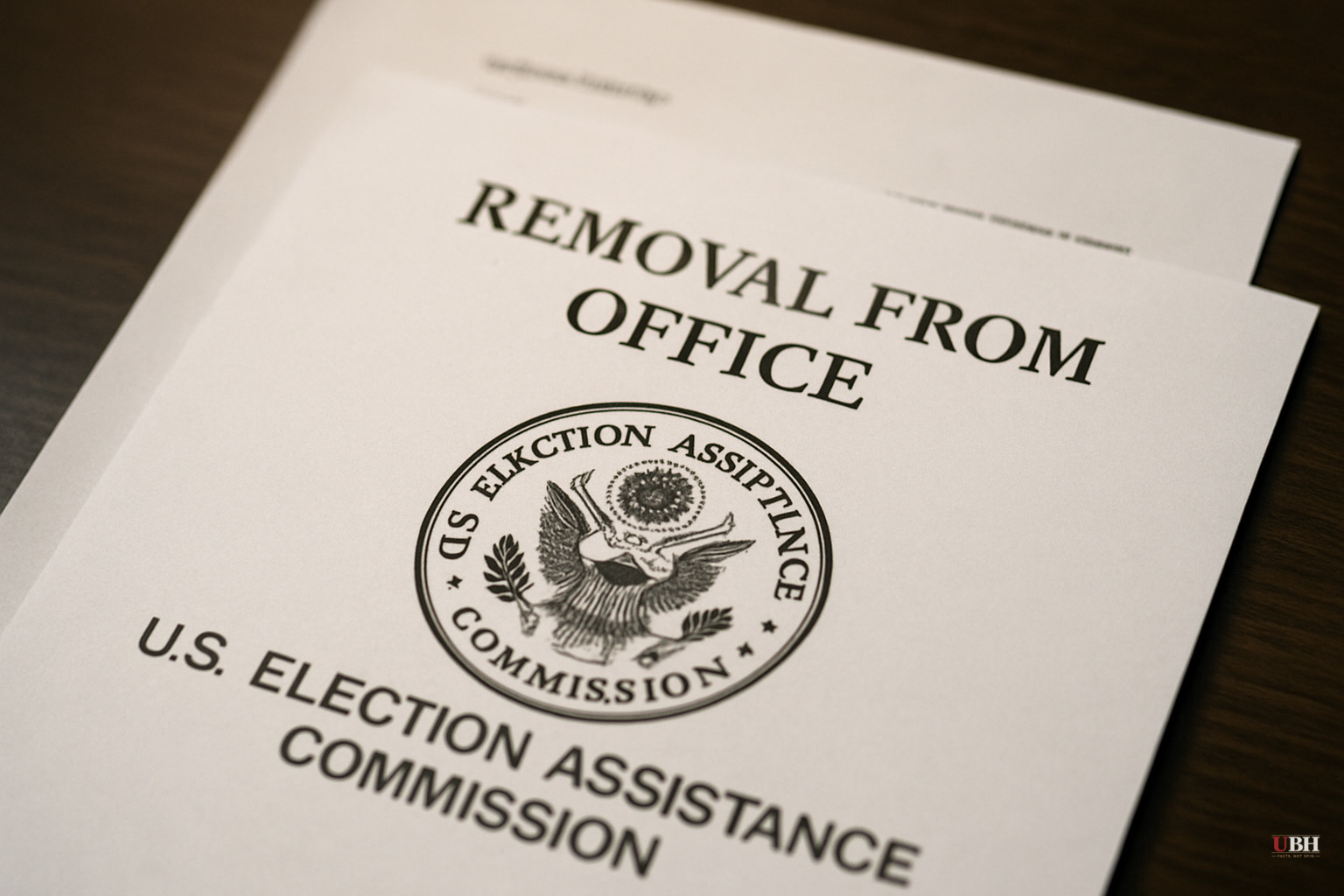
President Trump fired Thomas Hicks and Benjamin Hovland, the two Democratic commissioners of the U.S. Election Assistance Commission, by email on Thursday. The Republican commissioner, Christy McCormick, was allowed to resign rather than be terminated, according to three sources within the agency reported by Votebeat. The fourth commissioner, Republican Donald Palmer, had already voluntarily left earlier this year to join the Heritage Foundation.
The termination email, seen by Reuters and reported by The Guardian, was signed by Morgan DeWitt Snow, deputy director of presidential personnel in the Executive Office of the President. It read: "On behalf of President Donald J. Trump, I am writing to inform you that your position as Commissioner of the Election Assistance Commission is terminated, effective immediately. Thank you for your service."
All three departing commissioners had been confirmed unanimously by the Senate, according to NPR.
What the EAC Actually Does
The EAC is not a household name, but its work is concrete. Created by the Help America Vote Act of 2002 after the chaos of the 2000 presidential election, the agency distributes federal election funds to states, tests and certifies voting systems, maintains the national mail voter registration form, and publishes best-practice guidance for state and local election administrators. It was explicitly designed as a bipartisan body: federal law requires that no more than two of its four members come from the same party.
With zero commissioners as of Thursday, the agency cannot take any official action until new members are confirmed. Those replacements must be nominated by the president and confirmed by the Senate. No nominations have been announced.
The Legal Backdrop
The timing was deliberate. Days before the firings, the Supreme Court issued its ruling in Trump v. Wilcox, overturning decades of precedent and holding that the president can remove leaders of independent federal agencies, according to Votebeat. The White House cited that ruling directly. A White House official told NPR the president "reserves the right to remove individuals that may not be totally aligned with the important task of securing America's elections and ensuring every legal vote is counted," adding that "the Wilcox decision gives the President precedence to do so."
The court carved out a specific exception for Federal Reserve governors based on the long historical independence of central banking, but did not extend that protection to the EAC.
The Policy Motive
Trump's beef with the EAC predates Thursday. In March 2025, he issued an executive order directing the commission to add a proof-of-citizenship requirement to the federal voter registration form. Currently, voters in nearly all states attest to citizenship under penalty of perjury but are not required to document it. The EAC opened a public comment period, received hundreds of thousands of responses, and had not yet held a vote before the firings, according to ProPublica. Federal judges have blocked the executive order's main provisions, ruling they exceed presidential authority.
By clearing the board, Trump can nominate replacement commissioners who may be more willing to implement that change, or others aligned with his election priorities, if and when the Senate confirms them.
Concerns from Critics
The Bipartisan Policy Center, which is neither a Democratic nor Republican group, called the departures a "significant loss for one of the federal government's few institutions explicitly designed around bipartisan governance." Nevada Secretary of State Cisco Aguilar, chair of the Democratic Association of Secretaries of State, warned that "it will again fall on Secretaries of State and other election administrators to fill the gap" left by a nonfunctional EAC. Arizona Secretary of State Adrian Fontes called the move "irresponsible and dangerous." The core operational worry is practical: voting system certifications, federal funding disbursements, and guidance to local officials all flow through the EAC. With midterms months away and the commission unable to act, that infrastructure is on pause.
The Administration's Counter
The White House's stated position is not without logic. The Wilcox ruling gave Trump clear legal authority. The administration's broader argument, that commissioners who resisted the president's election security agenda were obstructing legitimate policy goals, tracks directly with the Supreme Court's reasoning that independent agency heads serve at the president's pleasure on policy matters. Proof-of-citizenship requirements for voter registration are not fringe: they have broad public support in polling and are legally required in several states. Whether the EAC specifically was the right vehicle for that fight, and whether clearing it before midterms was operationally reckless, are separate questions from whether Trump had the legal authority to act.
What Comes Next
Sen. Alex Padilla of California and Rep. Joe Morelle of New York, the ranking Democrats on committees with jurisdiction over elections, condemned the removals and framed them as deliberate pre-midterm sabotage. The more immediate unresolved question is structural: Trump cannot unilaterally staff the EAC. New commissioners require Senate confirmation, and HAVA's party-balance requirement still stands. Whether the Republican-led Senate moves quickly to confirm replacements, confirms nominees aligned with the proof-of-citizenship push, or simply lets the agency sit empty through the midterm cycle is the decision that will determine whether the EAC's functions get restored in time to matter.
Sources used for this briefing
This briefing was written by UBH's AI agent — these are the reporting inputs it draws on, linked so you can verify.


