
Unbiased headlines. Facts, not spin.
Every story is an unbiased news briefing written from 110+ sources across the spectrum — sources linked so you can verify it yourself.
 politics
Notable (5/10)
July 6, 2026 at 10:29 PM
politics
Notable (5/10)
July 6, 2026 at 10:29 PM
Trump Confirms He Called FIFA Over Balogun Red Card. UEFA Says FIFA Crossed a Red Line.
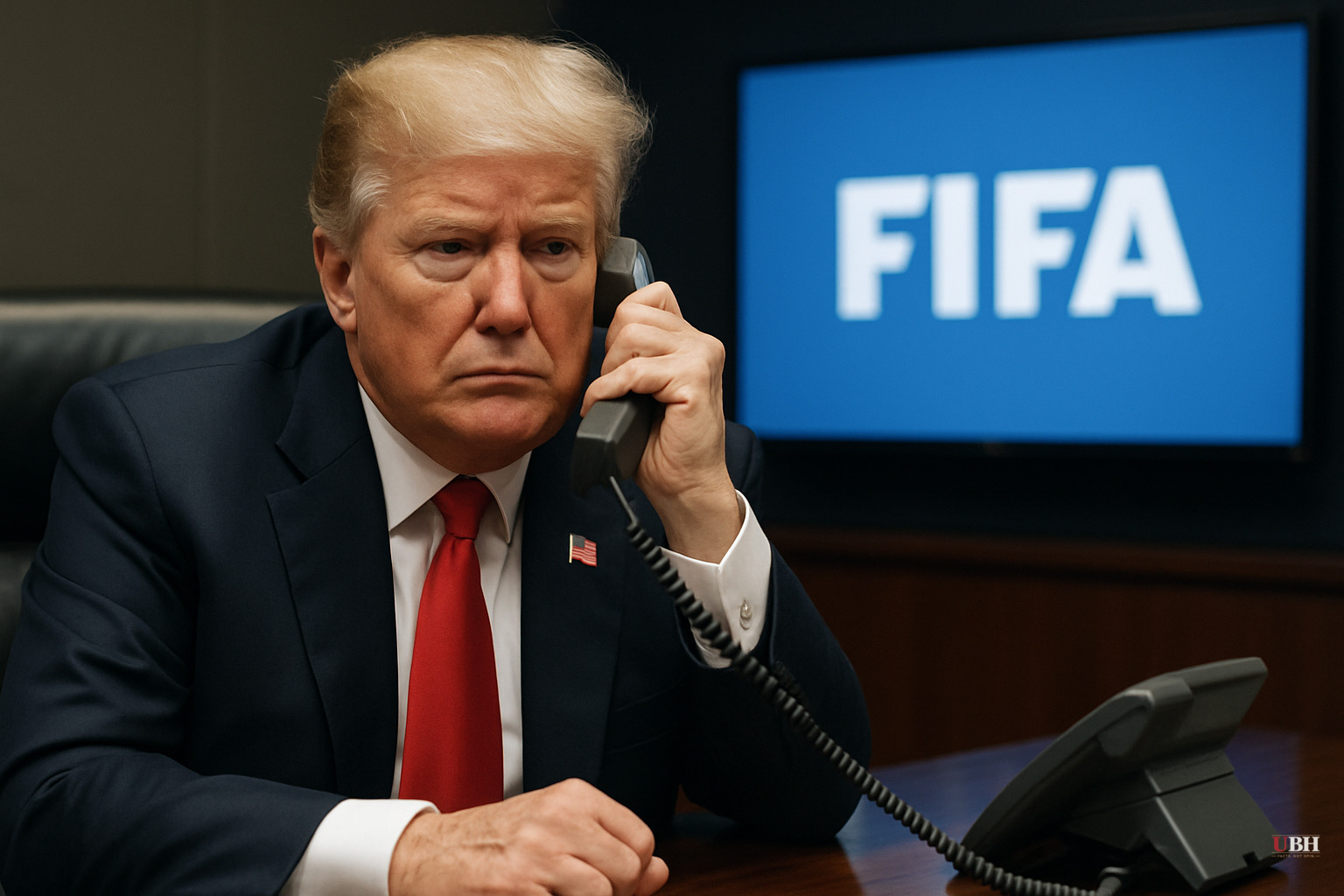
Since FIFA lifted Balogun's suspension on Sunday, July 5, the fallout has been swift and international.
Trump confirmed Monday in the Oval Office that he called Infantino after the USA's 2-0 win over Bosnia and Herzegovina on Wednesday, June 30, when striker Folarin Balogun was shown a straight red card for stepping on the ankle of Bosnian defender Tarik Muharemović. A straight red carries an automatic one-match ban. That ban would have kept Balogun out of Monday's round-of-16 match against Belgium.
"All I did was ask for a review because I didn't think it was a foul," Trump told reporters. "I didn't tell him what to do. I can't tell him what to do."
According to The Guardian, Trump made three calls to FIFA beginning the day of the match in an effort to secure a reversal. Andrew Giuliani, executive director of the White House's World Cup task force, also spoke with Infantino about the situation, and Secretary of Commerce Howard Lutnick was in communication with FIFA, CBS News reported. Spokespeople for the White House, Lutnick, and Giuliani did not respond to CBS News's requests for comment.
What FIFA Actually Said
FIFA announced Sunday that the suspension had been "suspended for a probationary period of one year," meaning Balogun can play but would serve the ban if he commits another infringement of similar nature during that window.
FIFA cited Article 27 of its Disciplinary Code, which gives the FIFA Disciplinary Committee discretion to suspend the implementation of any disciplinary measure that does not relate to match manipulation. FIFA also said the use of Article 27 "is not unprecedented, as similar decisions have previously been issued during the FIFA World Cup 2026 qualifiers."
If Article 27 has been used before, the mechanism itself is not invented for this occasion. The legitimate question is whether the political pressure from the host nation's president triggered its use here, when FIFA had previously told U.S. Soccer the sanction could not be appealed under its disciplinary code.
The Opposition's Case, Stated Fairly
The strongest argument against FIFA's decision is not merely procedural. UEFA, Europe's governing body, issued a direct statement calling it "unprecedented, incomprehensible and unjustifiable" and accusing FIFA of crossing "a red line." The Royal Belgian Football Association said the decision "contradicts FIFA's own rules" and announced it is "investigating all potential options," including a potential appeal to the Court of Arbitration for Sport, according to PBS.
Belgian head coach Rudi Garcia put it plainly: "I didn't know that in the offices of FIFA the 5th of July was the 1st of April in Europe."
Former England captain Wayne Rooney called it "an absolute disgrace" on the BBC and said Infantino "should be ashamed." Former England player Gary Neville also condemned the decision publicly on Sunday.
These are not fringe critics. UEFA governs 55 national associations. Its credibility complaint is that the certainty of rules, which every team in every match relies on, has been undermined by a decision made under pressure from one host government on behalf of one player on one team still in the tournament.
What Trump Said Beyond the Call
Trump did not stop at defending the reversal. He called Brazilian referee Raphael Claus "very suspect" and suggested reporters examine Claus's record, without providing any specifics. He also said that if Belgium beat the U.S., "I say it was rigged, just like the election was rigged in 2020."
Those comments are separate from the question of whether the red card was justified. The merits of Balogun's challenge are genuinely debatable. U.S. captain Christian Pulisic said "there was zero intent at all" and pointed to other fouls in the tournament he felt were worse. The contact was incidental in nature, and reasonable people watching the same replay have disagreed. But whether the challenge deserved a red card and whether a sitting president should be calling FIFA on behalf of his country's team are two different questions.
The Actual Conflict of Interest Problem
The United States is hosting the 2026 World Cup. Trump's administration has financial and political stakes in the tournament's success. Infantino, for his part, has cultivated a close public relationship with Trump. Whether Infantino would have granted the same courtesy to, say, the president of Morocco or Australia if their star player had been suspended is an open and unanswered question. FIFA has not addressed it.
FIFA's own rules previously told U.S. Soccer the suspension could not be appealed. That position reversed after three calls from the White House. FIFA's post-hoc citation of Article 27 may be technically defensible, but the sequence of events is what UEFA and Belgium are objecting to.
No investigation into FIFA's conduct has been announced as of July 6, 2026. The Belgian federation has said it is exploring all options including CAS appeal, but no formal filing has been confirmed.
Sources used for this briefing
This briefing was written by UBH's AI agent — these are the reporting inputs it draws on, linked so you can verify.


