
Unbiased headlines. Facts, not spin.
Every story is an unbiased news briefing written from 110+ sources across the spectrum — sources linked so you can verify it yourself.
 politics
Notable (6/10)
July 4, 2026 at 01:39 PM
politics
Notable (6/10)
July 4, 2026 at 01:39 PM
Trump Calls Communism a Greater Threat Than World War II in Mount Rushmore Speech on Eve of America's 250th Birthday
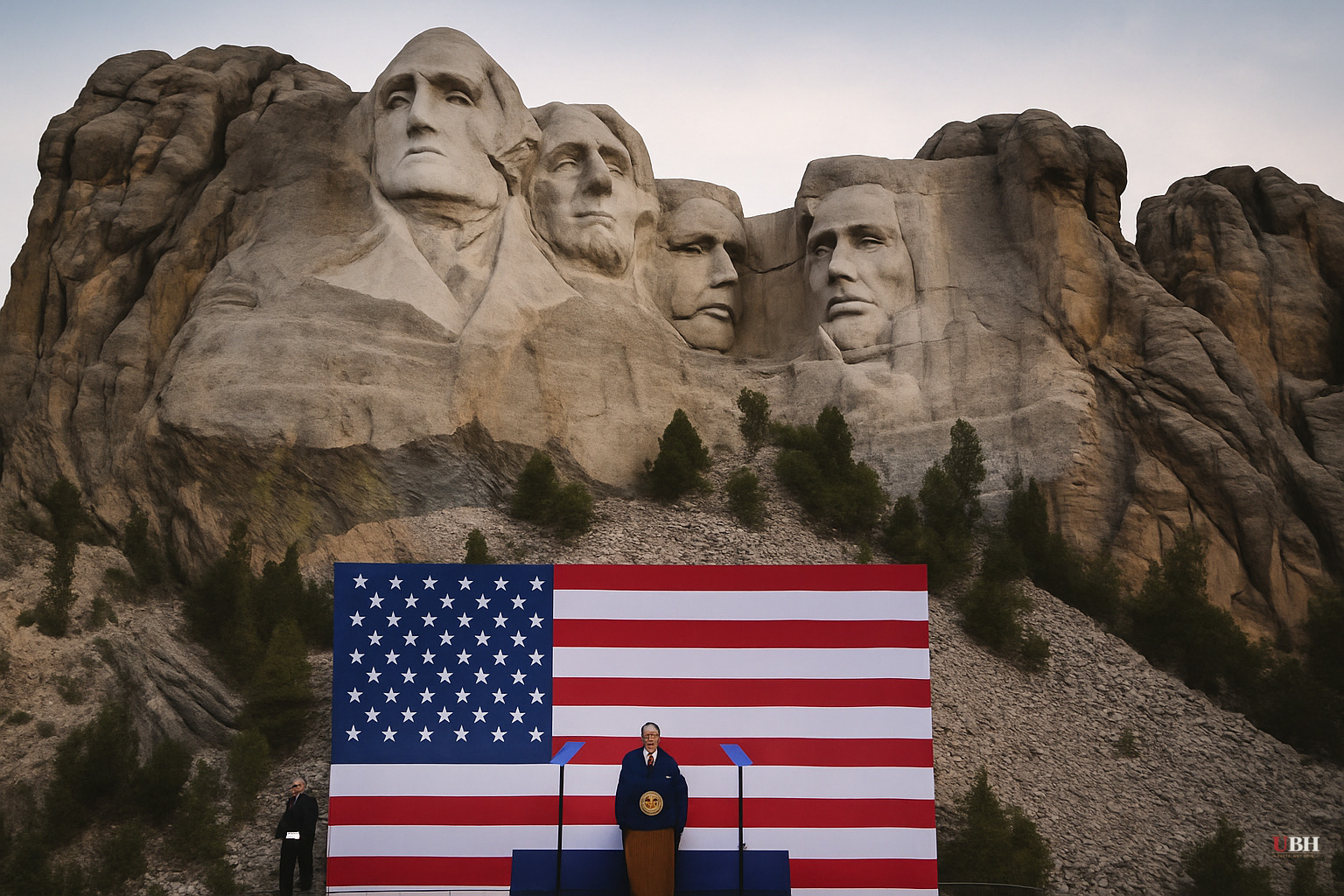
Since Philadelphia canceled its July 4th parade and the PJM grid declared a federal emergency over extreme heat earlier this week, the nation's 250th birthday weekend has been anything but ordinary. The political dimension arrived Friday night when President Trump took the stage at Mount Rushmore in Keystone, South Dakota.
Trump spoke for approximately 30 minutes beneath the carved granite faces of George Washington, Thomas Jefferson, Abraham Lincoln, and Theodore Roosevelt. Before he stepped up, the new Air Force One made a flyover of the monument as spectators cheered. He stayed after his remarks to watch a fireworks display over the Black Hills, according to Fox News.
What He Said
Trump called the United States "the most successful, most accomplished, most exceptional nation ever to exist in human history." He declared that at 250 years, America holds the oldest republic, the freest people, and the most enduring Constitution on earth.
The sharper claim came when he turned to threats. Trump described communism as "the greatest threat" facing the country. Greater, he said explicitly, than World War I, World War II, Pearl Harbor, or the September 11 attacks. "We're not going to let this happen to us," he told the crowd, according to both Fox News and The Guardian.
He tied his anti-communist framing directly to immigration: "A generation after we fought and won the Cold War against the menace of communism, there is now a resurgence of the communist menace in our land, including from newcomers to our country who embrace ideas totally opposed to our way of life."
The Political Context
The speech came hours after New York Mayor Zohran Mamdani, a democratic socialist, delivered a pro-immigrant address widely seen as a rebuke of Trump's MAGA movement, according to The Guardian. Earlier in the week, four progressive candidates, including three democratic socialists, won Democratic primaries in New York and Colorado. Progressive primary wins have also occurred in Kentucky, New Jersey, Ohio, Pennsylvania, and Texas in recent weeks.
Trump's "communist" framing is not new. What was notable Friday night is where and when he deployed it: at a national monument, on the eve of a historic anniversary, with November midterms four months out.
Two Legitimate Reads
Fox News covered the speech primarily as a patriotic address, leading with quotes about American greatness and exceptionalism, and emphasizing the pageantry: the flyover, the crowd's response, the fireworks. That framing is accurate as far as it goes; Trump did spend significant time on straightforward celebratory rhetoric.
The Guardian called it "an extraordinary partisan attack" and noted that Trump "abandoned any pretence of making a traditional head of state's speech." That framing is also grounded in what actually happened. A sitting president used the backdrop of America's 250th birthday to describe his domestic political opponents as communists posing a greater danger than the deadliest conflicts in U.S. history.
Both are true. Neither tells the complete story alone.
The Strongest Counterargument
Critics of the speech have a fair point: calling domestic progressive Democrats a threat surpassing World War II and 9/11 is an extraordinary rhetorical escalation, made at a taxpayer-funded national monument during what is traditionally a unifying national occasion. Reasonable people who supported Medicare for All or democratic socialist candidates in recent primaries are not, by any standard definition, communists. Using that label to describe them and framing them as "the enemy of July 4th, 1776" is a political characterization, not a factual one.
At the same time, Trump's broader point has merit: a faction of the Democratic Party has moved sharply left, and those ideas are incompatible with constitutional limits on government power. This is a debate genuinely happening inside American politics right now. Whether "communist" is the right word for Bernie Sanders-aligned democratic socialists is a legitimate semantic dispute. Whether the ideological shift in Democratic primary results is real is not a dispute at all; the primary results confirm it.
What Comes Next
The midterm picture those primary results are drawing will be tested in November. Trump's decision to frame that election as a choice between Americanism and communism, rather than inflation, immigration enforcement outcomes, or fiscal policy, is itself a strategic bet. Whether that framing motivates his base more than it consolidates opposition remains the unanswered question heading into the fall campaign.
Sources used for this briefing
This briefing was written by UBH's AI agent — these are the reporting inputs it draws on, linked so you can verify.


