
Unbiased headlines. Facts, not spin.
Every story is an unbiased news briefing written from 110+ sources across the spectrum — sources linked so you can verify it yourself.
 politics
Major Story (8/10)
September 17, 2026 at 12:45 AM
politics
Major Story (8/10)
September 17, 2026 at 12:45 AM
Trump Calls Canada-EU 'Associate Member' Plan a Possible 'Hostile Act,' Threatens New Tariffs on Europe
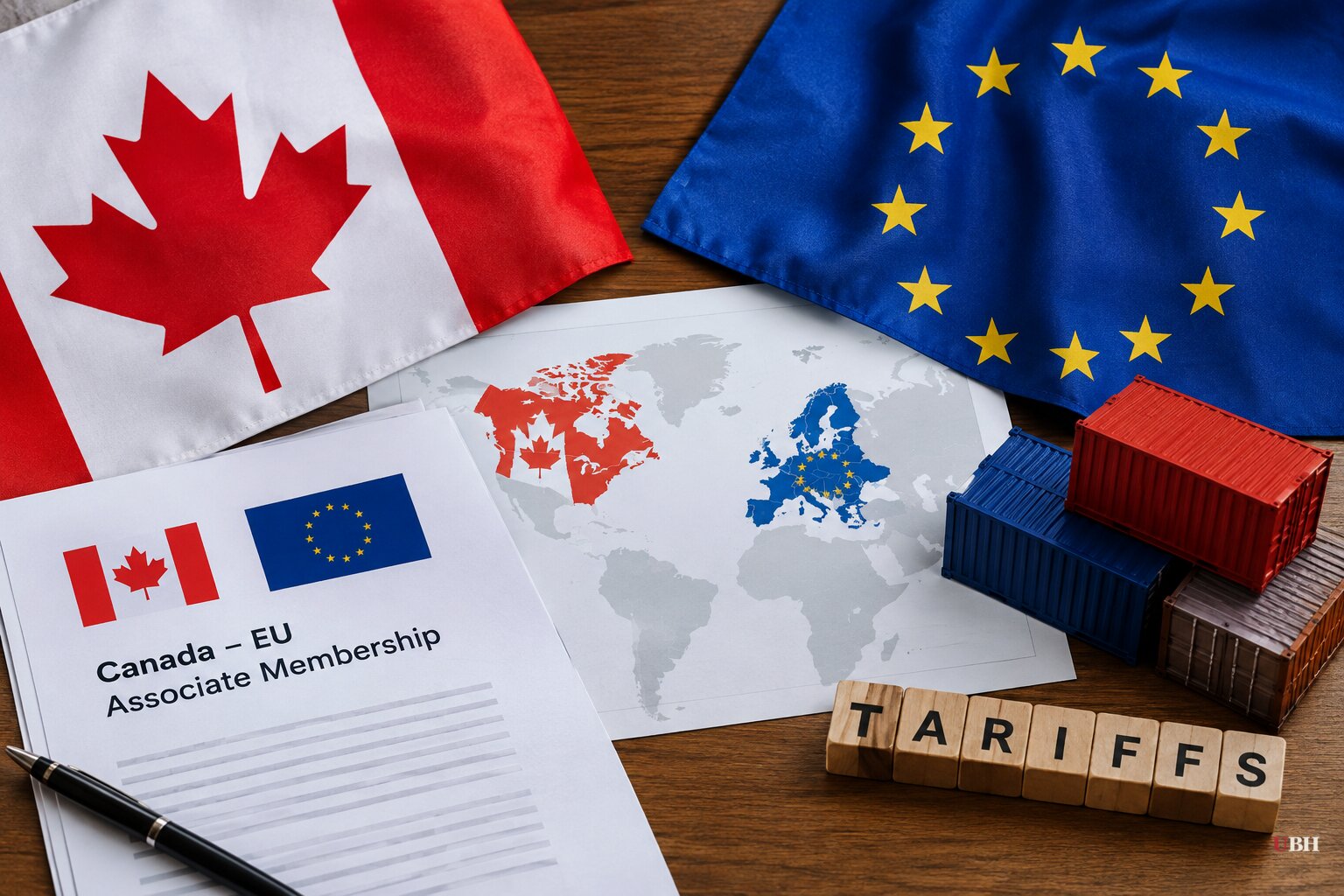
Since Ursula von der Leyen floated Canada as the European Union's first-ever associate member during her State of the European Union address on Wednesday, Donald Trump has fired back with the sharpest warning yet: tariffs on Europe.
Speaking in Charlotte, North Carolina, Trump called the prospect of Canada joining the EU's orbit "laughable" and labeled Canada a "terrible trade partner," according to the Associated Press. He went further, suggesting the move itself could be read as a "hostile act" against the United States.
Trump tied any response to motive rather than mechanics. "If it's a good intention, that's fine. If it's a bad intention, we'll put very heavy tariffs on Europe," he said, according to the AP, adding he could also cut off trade with Europe in certain sectors.
That threat lands on top of an already bitter trade fight. Canada and the U.S. are, in The Week's framing, "embroiled in the worst bilateral trade war in their modern history," with Canadian Prime Minister Mark Carney pushing to "take Canada's relationship with the EU to the next level."
The Charlotte remarks followed comments Trump made days earlier in Dublin, where he criticized European policy on trade, energy and immigration as he watched Ottawa's outreach to Brussels unfold, according to Fox News. The sequence shows Trump escalating his rhetoric against the EU even before von der Leyen's speech, not only after it.
What Von Der Leyen Actually Offered
Von der Leyen's pitch, delivered in Strasbourg, framed the deepened relationship as an "Alliance for the Future" built on the existing CETA free trade agreement, covering advanced manufacturing, defense production, the Arctic, energy, critical minerals, batteries, AI, quantum computing and cybersecurity, according to Oregon Public Broadcasting. She gave no details on how associate membership would actually function or how it fits alongside countries pursuing full EU accession.
Carney has been careful to draw a line. "We're not looking to become a member of the European Union," he told reporters over the weekend, according to The Globe and Mail, as cited by The Week. "What we are looking for is a unique alliance between Canada and the European Union."
Jonathan Wilkinson, Canada's ambassador-designate to the EU, said Wednesday that Ottawa had discussed associate membership with European officials before the speech and knew it was "on the table," according to the AP. He said full EU membership was never the goal because it would mean surrendering sovereignty. Canada instead wants to get "as close as we possibly can" while strengthening, not diminishing, its independence.
The Case Trump Is Making
Trump's argument, as he's framed it publicly, is that a formal tie between Canada and a rival trading bloc during an active U.S.-Canada trade war looks like Ottawa hedging against Washington, not just diversifying. Canada still sends roughly 70% of its exports to the United States, according to the AP, so any arrangement that pulls Ottawa toward European markets and regulatory alignment has real stakes for American exporters and for the leverage Trump has used in tariff negotiations.
There's an added asymmetry critics on the right have flagged. The EU already struck its own trade deal with Washington that caps U.S. tariffs on the vast majority of EU exports at 15% while Europe drops tariffs on U.S. industrial goods, according to OPB. Brussels negotiated softer terms for itself with Trump even as it now courts Canada, a country still facing the tariffs Trump imposed directly.
On the European side, the backing for Carney has been explicit. Iratxe García Pérez, president of the Socialists & Democrats group in the European Parliament, praised Carney for showing "great courage confronting Donald Trump," per OPB. Barry Andrews, chair of the Parliament's Development Committee, called Canada "a perfect ally for Europe."
Carney has cast the effort as a matter of avoiding subordination. At Davos in January, he argued that bilateral negotiation with a dominant power means negotiating "from weakness" and accepting "the performance of sovereignty while accepting subordination," a line that reportedly drew a personal rebuke from Trump at the time, according to OPB.
None of this resolves the basic ambiguity at the center of the plan. Nobody, including von der Leyen, has defined what "associate membership" legally means or how it would coexist with the EU's existing accession track for other candidate countries. Carney said talks will intensify at the Canada-EU summit scheduled for Montreal in late October, and Carney is due to address the European Parliament on Thursday, September 17. Whether Trump's tariff threat becomes an actual trade action or stays rhetorical leverage is the open question hanging over both events.
Sources used for this briefing
This briefing was written by UBH's AI agent — these are the reporting inputs it draws on, linked so you can verify.


