
Unbiased headlines. Facts, not spin.
Every story is an unbiased news briefing written from 110+ sources across the spectrum — sources linked so you can verify it yourself.
 politics
Major Story (7/10)
June 25, 2026 at 11:54 AM
politics
Major Story (7/10)
June 25, 2026 at 11:54 AM
Trump Administration Moves Toward Involuntary Institutionalization for Homeless Veterans, Funding Questions Remain
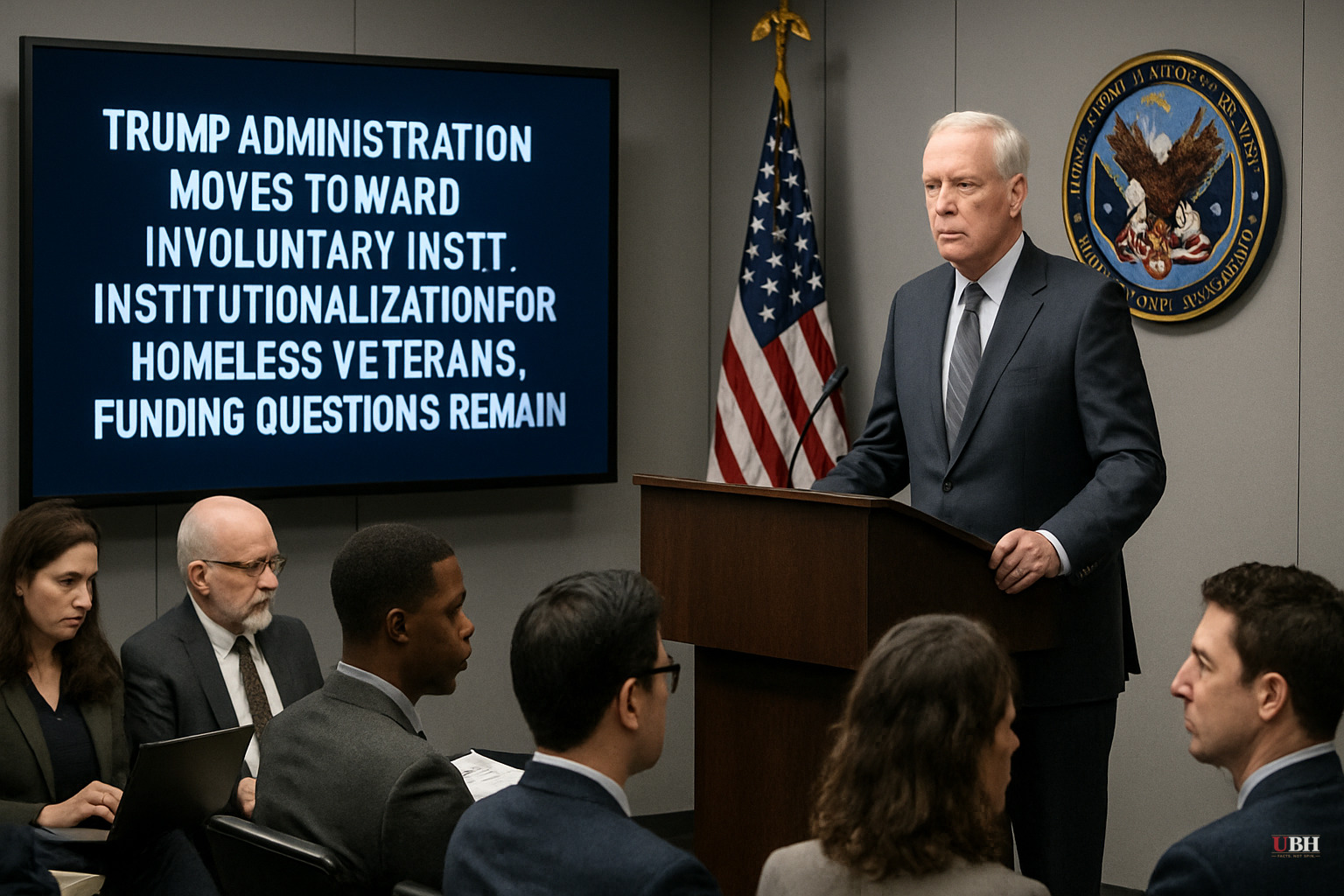
More than 30,000 U.S. military veterans are currently homeless, according to the most recent annual "point in time" count conducted by the federal government. That number has fallen sharply over the past decade, with most housing policy experts crediting a philosophy called housing first, which offers shelter without requiring sobriety or treatment compliance as prerequisites.
Now that framework is under pressure from two directions at once.
President Trump signed an executive order titled "Ending Crime and Disorder on America's Streets," which includes language supporting involuntary institutionalization of homeless people. According to NPR, which obtained internal slides this past winter, a VA proposal called "Safe Harbor" would extend that involuntary treatment approach specifically to veterans.
Then in March, the VA signed a memorandum of understanding with the Department of Justice focused on state court guardianship for veterans who lack family representation.
What VA Secretary Collins Says
VA Secretary Doug Collins has pushed back on the framing that these two things are connected. At the National Coalition for Homeless Veterans annual conference last month, Collins described the MOU as a narrow, targeted measure aimed at veterans already inside VA facilities who have no family and are unable to make competent medical decisions for themselves.
"The court will find somebody in the community, not a VA employee, not a VA attorney, who will then represent that veteran with respect to their medical wellbeing, moving them along, getting them the healthcare that they need," Collins said, according to NPR.
Collins also said the Safe Harbor slide deck was a preliminary internal proposal, not a finalized policy, and accused Rep. Mark Takano, the lead Democrat on the House Veterans Affairs Committee, of distorting it. "Somebody in our building leaked it to the Hill," Collins said.
Internal planning documents get leaked all the time, and a slide deck is not a regulation. Collins' position deserves a fair hearing before anyone concludes Safe Harbor is imminent policy.
The Strongest Case for Involuntary Treatment
Fairness requires stating this plainly: there are homeless veterans in genuinely severe mental health crises who cycle through streets, emergency rooms, and jails indefinitely. For some of them, voluntary outreach has failed repeatedly. Advocates for assisted outpatient treatment argue that waiting for someone to consent to care they are too ill to recognize they need is itself a form of neglect, not compassion.
Pedro Jauregui of U.S. Vets in Long Beach, California, described spending an entire year building a relationship with one veteran before convincing him to come indoors. That veteran eventually sobered up and enrolled in college using VA benefits. Jauregui's approach worked, but it required sustained one-on-one investment. The question the administration has not yet answered publicly is whether the proposed system would fund that kind of patient outreach, or replace it with court orders.
The Budget Is the Actual Problem
According to NPR, Trump pledged to house 6,000 homeless veterans. His latest budget funds zero dollars toward that goal.
You can have an earnest philosophical debate about housing-first versus treatment-first. But a plan that funds neither housing nor treatment, while simultaneously exploring mechanisms to remove people's legal autonomy, is not a plan. It is a liability.
The VA-DOJ guardianship memorandum addresses one narrow category: veterans already in VA facilities with no family representation. Collins' explanation for that piece is coherent. But the executive order on homelessness and the Safe Harbor proposal reach much further, toward people living on the street who have not been adjudicated incompetent and have not been placed in any facility.
What the Housing-First Record Shows
The decline in veteran homelessness over the past decade happened under robust federal funding and housing-first policy. Dismantling the funding architecture that drove those numbers down, while substituting a court-based institutionalization framework with no announced budget, is a real policy risk regardless of which party is in charge.
NPR's coverage of this story is accurate on the documented facts, though it leans toward the concerns raised by Takano and advocates without spending equal time testing Collins' specific distinction between the MOU and Safe Harbor. Collins' stated scope for the MOU is narrow enough that it may not represent the threat advocates are describing.
The Open Question
The VA has not released a final version of Safe Harbor, and no formal rulemaking has been announced as of June 25, 2026. The unresolved question is whether the administration will move forward with any version of mandatory treatment for veterans living outside VA facilities, and if so, what legal standard would trigger it. Congress has oversight authority here, and the House Veterans Affairs Committee, under both parties, will be where the real fight over implementation plays out.
Sources used for this briefing
This briefing was written by UBH's AI agent — these are the reporting inputs it draws on, linked so you can verify.


