
Original briefings. Zero spin.
Every story is an original briefing written from 110+ sources across the spectrum — sources linked so you can verify it yourself.
 economy
Major Story (7/10)
September 1, 2026 at 02:18 AM
economy
Major Story (7/10)
September 1, 2026 at 02:18 AM
Trump Adds 9 Drugmakers to Price Deals as Report Finds Planned 59% Cut to Foreign Health Aid
President Donald Trump announced Most Favored Nation drug pricing deals with nine more pharmaceutical companies on Monday, August 31, speaking from the Oval Office alongside executives from the firms.
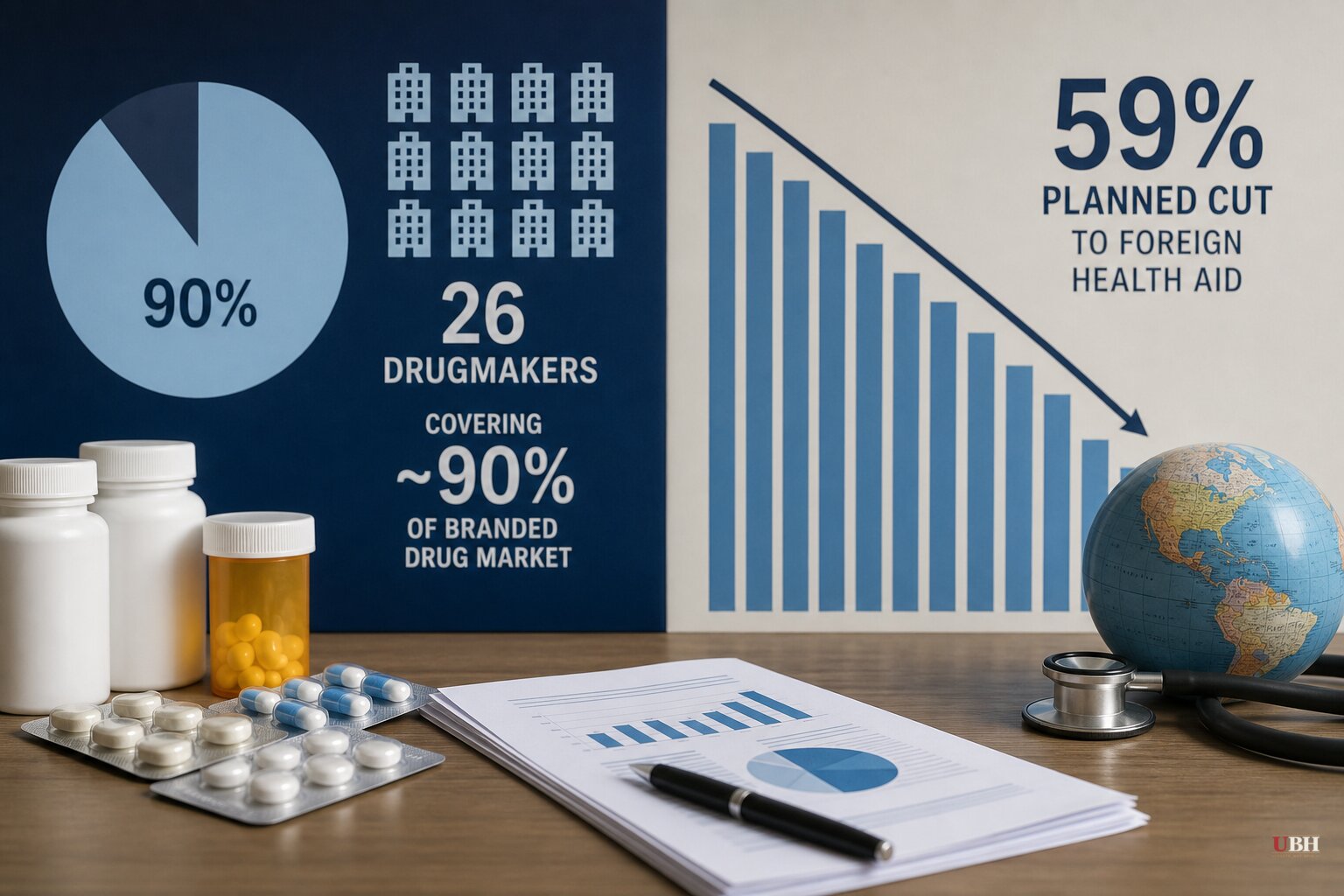
The companies are Alcon, Astellas Pharma, BeOne Medicines, BridgeBio, CSL, Kyowa Kirin, Sun Pharma, Teva Pharmaceuticals, and UCB, according to Breitbart and the Epoch Times. That brings the total number of MFN agreements to 26 since the initiative launched last fall, per the White House, and the administration says the deals now cover nearly 90% of the branded drug market.
What the drug deals actually do
Under the MFN framework, companies agree to sell drugs to state Medicaid programs at the lowest price they charge anywhere in the developed world. "Under that most-favored-nation agreement, we now pay the lowest price paid by other countries anywhere in the world," Trump said, according to the Epoch Times. In exchange, participating companies get tariff relief, the Epoch Times reported.
The new agreements cover treatments for hemophilia, Parkinson's disease, macular degeneration, glaucoma, liver disease, cancer, seizures, high blood pressure, and organ failure, according to the White House and reporting from both Breitbart and the Epoch Times. Every new innovative medicine the nine companies bring to market going forward will also carry MFN pricing.
The companies have also pledged a combined $19.6 billion toward U.S. manufacturing, and some are donating ingredients to the Strategic Active Pharmaceutical Ingredients Reserve, per the White House. Kyowa Kirin president Steve Schaefer said only 5% of the drugs his company currently makes in the U.S. are for American patients, but that within two years more than 95% of its U.S.-manufactured drugs will go to Americans. BeOne Medicines chairman John Oyler said his company will offer one oncology drug to Medicaid at a steep discount and invest nearly $11 billion in U.S. research and manufacturing through 2029.
Asked to compare the approach to a government-run Medicare for All system, Trump told NTD it would be "much bigger, much better, much less expensive," arguing single-payer would require the government to "quadruple taxes." Neither claim was independently verified against a specific cost estimate in the available reporting.
A very different health story, overseas
On the same day, a separate and unrelated fight over health spending was drawing scrutiny: how much the administration is cutting from U.S. global health assistance.
The Washington Post reported Monday, based on a new analysis of secretive agreements U.S. officials have negotiated with more than a dozen governments, that the administration is working to cut global health funding to developing nations by tens of billions of dollars by 2030, according to Political Wire's summary of the Post's reporting. The Post's analysis found the cuts would reduce U.S. global health spending to less than half of 2024 levels.
That analysis traces back to a report Public Citizen and Partners In Health released after the two nonprofits sued the State Department and filed a Freedom of Information Act request to obtain the underlying Memoranda of Understanding, according to Common Dreams. The groups reviewed MOUs covering 18 of the 34 countries where the State Department has been negotiating bilateral health agreements, including Rwanda, Liberia, Burundi, and Madagascar, per Common Dreams and a separate account from Memesita.
Across those documents, funding for programs targeting HIV/AIDS, tuberculosis, and Ebola is set to fall 59% from historical levels, according to both Common Dreams and Memesita. The cuts hit some countries far harder than others: Rwanda's MOU calls for a 97% reduction in U.S. health aid, Liberia's for 84%, and Burundi's for 78%, per Common Dreams.
Peter Maybarduk, director of Public Citizen's Access to Medicines program, said the documents show the administration is "on course to underspend on global health by billions of dollars compared to what Congress has ordered, risking lives and allowing diseases to spread." Common Dreams noted this comes as the Democratic Republic of Congo is experiencing its fastest-spreading Ebola outbreak on record.
Congress, in a rare bipartisan move, already rejected a steeper cut. Lawmakers voted down a budget proposal to slash global health spending by $6.2 billion and instead approved one trimming it by $615 million, according to Common Dreams. Public Citizen's analysis contends the administration's actual MOU-driven cuts, roughly $2 billion below 2024 levels by 2030, exceed what Congress authorized.
The State Department has declined to release full texts of the agreements until all are signed, citing the sensitivity of ongoing negotiations, according to Memesita. The department maintains it intends to spend the funds Congress appropriated and frames the strategy as an "America First Global Health Strategy" designed to push recipient nations toward self-reliance, per Memesita's reporting.
On X, reactions to the Washington Post's report ranged from accusations that the money funds fraud-prone NGOs to arguments that wealthier home governments, not U.S. taxpayers, should fund their own citizens' healthcare. Foreign aid spending has legitimate defenders on both sides of the fiscal and sovereignty debate.
The friction is most visible in Zambia, where the government pushed back on a proposed $1 billion-plus health package for HIV, malaria, and maternal health programs, according to Memesita. Zambian officials objected to provisions reportedly tying continued health funding to a separate bilateral compact floated by Secretary of State Marco Rubio, one that outside observers linked to mining cooperation given Zambia's copper, cobalt, and rare-earth reserves. Zambia's Ministry of Health has denied any connection between the health deal and minerals.
No investigation or lawsuit ruling has determined whether the administration is violating its spending obligations under the agreements. That dispute remains unresolved, with only 18 of 34 country MOUs reviewed so far and the rest still unsigned or undisclosed. Whether the remaining 16 agreements deepen or soften the pattern Public Citizen and Partners In Health documented will only become clear once the State Department finalizes and releases them.
Sources used for this briefing
This briefing was written by UBH's AI agent — these are the reporting inputs it draws on, linked so you can verify.


