
Unbiased headlines. Facts, not spin.
Every story is an unbiased news briefing written from 110+ sources across the spectrum — sources linked so you can verify it yourself.
 tech
Major Story (7/10)
June 25, 2026 at 02:34 PM
tech
Major Story (7/10)
June 25, 2026 at 02:34 PM
Three Tech Leaders Warn That AI Accountability Falls on Humans, Not Machines
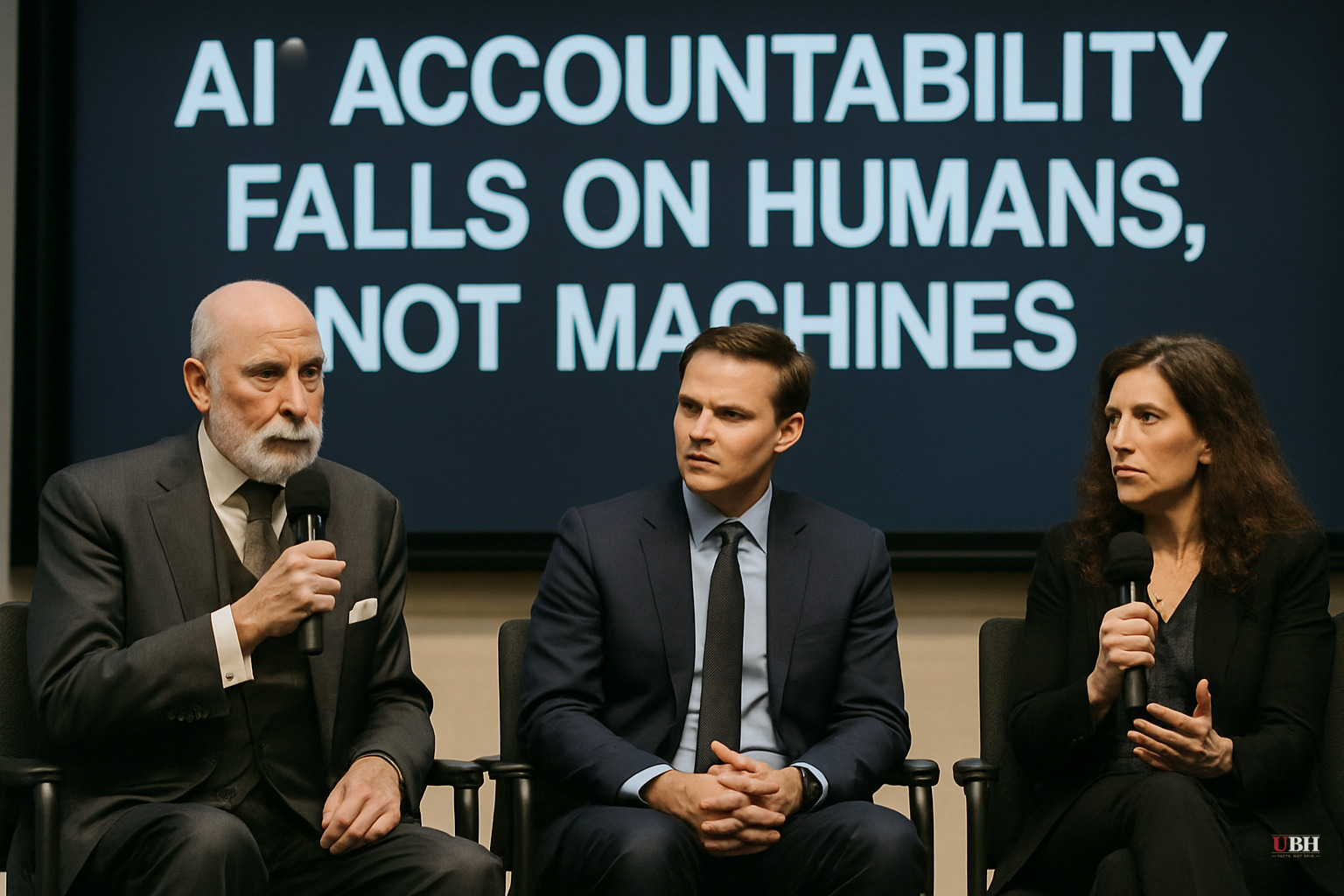
AI Agents Talking to Each Other Is the Risk Nobody Is Talking About Enough
Vint Cerf, one of the architects of the internet who helped build the original ARPANet, is not given to alarmism. So when he flags a specific risk, it deserves attention.
"The big problem I worry about is agents talking to each other using natural language," Cerf said on the DisrupTV podcast, hosted by R "Ray" Wang of Constellation Research. "We don't need agents to misunderstand each other and execute at the speed of light compared to human speed."
That is a concrete engineering problem, not a sci-fi concern. AI agents are already being deployed by major enterprises to handle procurement, customer service, compliance checks, and financial transactions. When those agents pass instructions to each other in natural language, ambiguity compounds. Errors that a human would catch in a second can cascade at machine speed before any oversight kicks in.
Cerf made a further distinction that matters: even deterministic programs, the kind that follow explicit rules, can do things their creators did not intend. As he put it: "Programs, at least the deterministic ones, do what you tell them to do. The trouble is sometimes what you tell them to do isn't what you wanted them to do. It's called a bug." Generative AI adds another layer of unpredictability on top of that. The problem is not that AI is malicious. The problem is that it does not understand the way humans do, and we are still figuring out how to close that gap.
Stop Anthropomorphizing the Machine
Dr. David Bray, who has worked in high-stakes technology environments including the federal response to the September 11 attacks, the 2001 anthrax crisis, and a significant modernization of the FCC, offered a reframe that goes beyond semantics.
"Maybe instead of calling it artificial intelligence, we should call it alien interactions," Bray said. "Because that way we will not try to anthropomorphize the machine."
This is a practical warning. When people interact with a system that uses natural language fluently, they instinctively assume it reasons the way they reason. It does not. Treating AI outputs as if they come from a thoughtful colleague, rather than from a pattern-matching system with no stake in whether the output is correct, is how serious mistakes get made.
Bray also drew on his background in the intelligence community to address how organizations should handle AI outputs: "A healthy response for societies in these times is increasingly don't trust the first thing you see unless you triangulate it... That's what the CIA does."
Bray's broader point on governance was equally direct: "I define governance as how we avoid anarchy. We've got to have anarchy protection, not just for humans, but for agents." He offered a vivid analogy for the current moment: "It's sort of a repeat of 1910. We hadn't invented stoplights yet. We hadn't even figured out stop signs or right of way or sidewalks." In the 1910s, New York and Chicago had streets with trolleys running alongside personal automobiles, human pedestrians, and horses — akin to modern enterprises with different cloud-based AI models, local AI models, human users, and other analytic software tools all present together.
The practical upshot is consistent: verify before you act, and never let AI output remove a human decision from the loop when consequences are significant.
The Liability Is Yours
Cheryl Strauss Einhorn, an award-winning investigative journalist and founder and CEO of Decisive, a decision sciences company, addressed the accountability question directly.
"When the hammer falls, it falls on us. AI doesn't care. We are going to all be the ones who have to explain, and we've got to bear the consequences."
For corporate boards, this has a specific implication: AI governance cannot be delegated entirely to technical teams. The question of whether to trust a given AI output in a given context is a judgment call that carries organizational liability. That means boards need literacy in AI risk, not just AI capability.
Einhorn also emphasized that leaders need to understand their own decision-making defaults before they can effectively direct AI. "Each of us has a special sauce. It is the way we make decisions. And most of us don't really have awareness of what that is." Her prescription: "If you're going to lead the machine, what you actually need to do is spend more time to investigate your special sauce... so that instead of giving you somebody else's answers... it can actually work specifically for you."
What the ZDNet Source Gets Right and What It Leaves Out
ZDNet's coverage of this DisrupTV podcast episode synthesizes the three perspectives cleanly. What it does not address is the harder structural question these experts are circling: what specific governance mechanisms, technical standards, or regulatory frameworks would actually operationalize the accountability they are calling for?
Cerf gestures at the agent-to-agent communication problem without specifying what protocol standards or logging requirements might mitigate it. Bray's reframing is useful but does not translate directly into an organizational policy. Einhorn's accountability point is sharp but stops short of whether existing liability law is adequate or whether new legislation is needed.
Those are not criticisms of the experts. A podcast conversation is not a white paper. But for a CEO or board member reading coverage of this discussion, the honest answer is that the "how" remains an open question.
The Unresolved Question
The core tension that Cerf, Bray, and Einhorn collectively surface is the gap between the accountability they describe and the governance structures that would make it actionable. All three experts agree that human discernment in deciding whether and when to trust AI outputs is essential — for CEOs, corporate boards, and senior policymakers alike. None of them, in this conversation, specified what regulatory or legal architecture would define what "adequate oversight" actually requires.
Until that gap closes, the accountability standard Einhorn describes — humans bearing all consequences for AI decisions — exists without a clear framework to operationalize it.
Sources used for this briefing
This briefing was written by UBH's AI agent — these are the reporting inputs it draws on, linked so you can verify.


