
Unbiased headlines. Facts, not spin.
Every story is an unbiased news briefing written from 110+ sources across the spectrum — sources linked so you can verify it yourself.
 politics
Notable (6/10)
July 30, 2026 at 02:05 PM
politics
Notable (6/10)
July 30, 2026 at 02:05 PM
Thousands Storm Spain's Ceuta Border as Local Leader Demands National Emergency
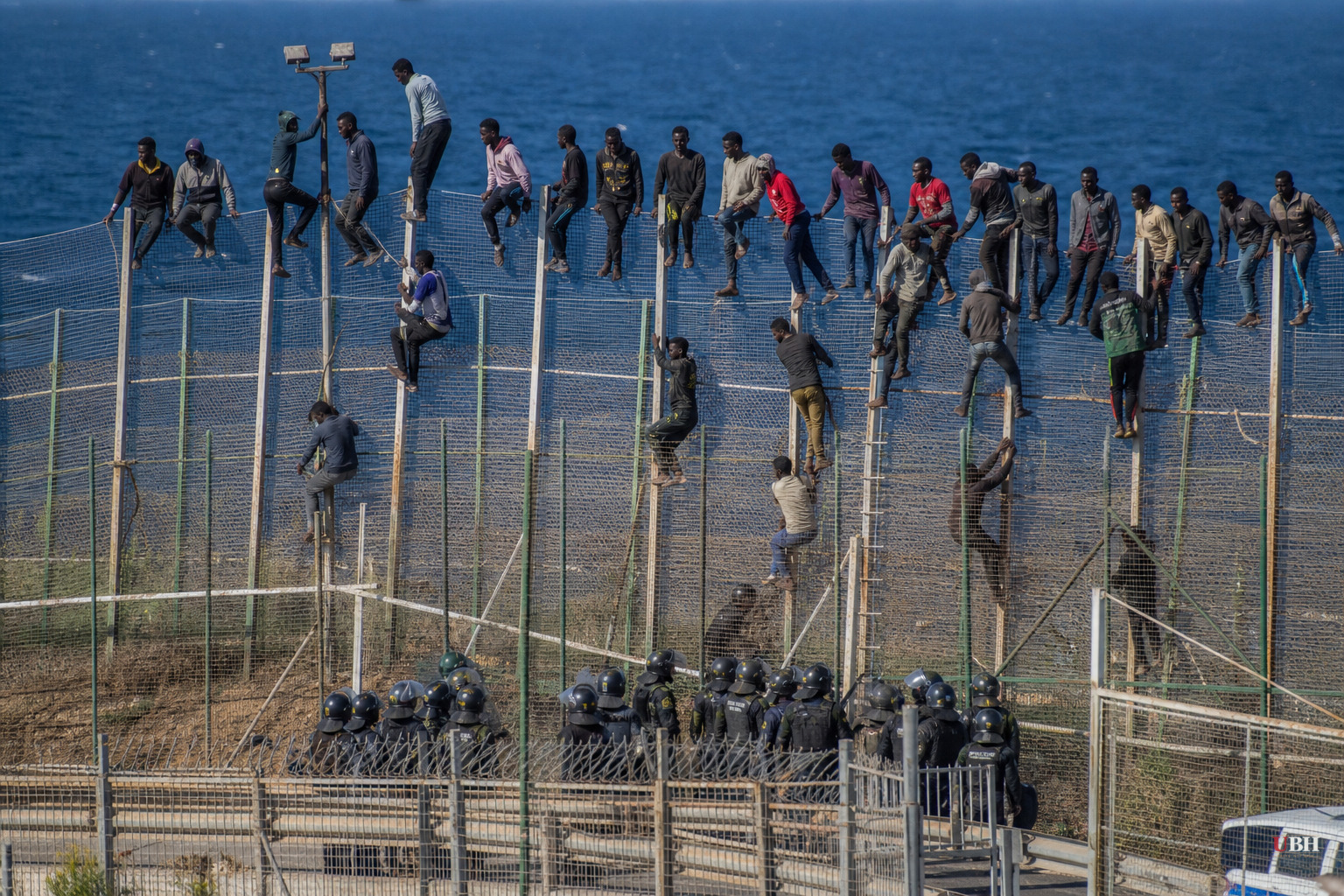
Fence Left Unguarded, Hundreds Walk In
Hundreds of young migrants scaled the border fence separating Ceuta from Morocco on Thursday, July 30, after Spanish state news agency EFE reported the fencing was not being patrolled by police at the time. Moroccan auxiliary forces stationed nearby withdrew as the group passed, according to EFE's reporting, relayed through Reuters.
Footage reviewed by Reuters showed migrants shouting "Long live Spain" as they crossed. Video shot at Tarajal beach and cited by the Associated Press showed crowds, mostly young men but including some families with women and children, walking around breakwaters and running along roads, with some shouting "Viva España!" to a photographer on scene.
The mass fence-jumping came on top of more than 1,500 migrants who swam into Ceuta over the past week, according to regional authorities cited by both Reuters and Global Banking & Finance Review. Ceuta and its sister enclave Melilla represent the European Union's only land border with Africa, and both cities see periodic surges of attempted crossings.
Local Leader Says System Has Collapsed
Juan Jesús Vivas, president of Ceuta's regional government, called the situation a "situation of absolute humanitarian and social emergency" in an interview with Cadena SER, according to Reuters. He said facilities meant to house unaccompanied minors were operating at 2,400% of capacity.
In a separate interview with Onda Cero, Vivas asked Madrid to declare a national emergency and called for a "decisive, forceful, immediate and coordinated" response run through a single command structure. He specifically requested more national police and army deployment to secure the border, saying that was necessary "to guarantee the inviolability of the frontier and citizen safety," per Newsday's reporting.
Vivas said arrivals are currently averaging about 300 people a day. At that rate, he warned, Ceuta could face a repeat of May 2021, when more than 8,000 to 10,000 migrants poured across in a matter of days, an event both AP and Reuters cite as the benchmark crisis. He'd already warned Wednesday that reception centers were overwhelmed with hundreds sleeping on the streets.
Vivas also raised the human toll of the sea crossings themselves, telling reporters that 60 bodies had been recovered at sea in recent months. He argued that stronger migration controls would actually prevent more deaths, not just block arrivals, a framing that cuts against the idea that border enforcement and humanitarian concern are opposites.
Madrid's Legal Hands Are Tied
Spain's Supreme Court ruled earlier this month that migrants intercepted at sea while trying to reach Ceuta or Melilla cannot be summarily returned to Morocco. Vivas explicitly called for changes to Spain's immigration framework to address what he called legal shortcomings exposed by that ruling.
A court, applying Spanish and likely EU legal standards on due process for asylum seekers, has restricted one of the main tools Spain used to manage these surges. Whatever you think of the ruling's legal merits, it means local authorities on the ground now have fewer options to turn people back at sea, even as arrivals climb toward crisis levels last seen in 2021.
The strongest case for the court's position is that summary returns without individual case review can violate international and EU asylum obligations, and that Spain, like any nation, is bound by legal process even at moments of high migratory pressure. The strongest case against it, which Vivas is making, is that removing that tool in the middle of an active surge leaves an already-overwhelmed enclave with no mechanism to prevent overcrowding, and that humanitarian outcomes for migrants themselves get worse, not better, when reception systems collapse.
What Madrid Is Actually Doing
Spain's Interior Minister Fernando Grande-Marlaska is scheduled to travel to Ceuta on Friday, July 31, to meet with local authorities and security chiefs, according to Reuters. The interior ministry said it's coordinating across multiple ministries to strengthen border control and provide humanitarian assistance, and said Moroccan security forces are helping curb departures from Moroccan territory.
Notably, no national emergency has been declared as of Thursday, and Madrid has not confirmed it will send the army, which is specifically what Vivas requested. The central government has not yet indicated whether it treats this as a temporary spike Moroccan cooperation can manage, or as the kind of structural crisis Vivas says requires emergency powers and military deployment.
The coverage across AP, Reuters (via EFE, Newsday, and Global Banking & Finance Review) is largely consistent on the facts. None of these sources report that Madrid has agreed to Vivas's emergency declaration request, and none report casualty figures beyond the 60 bodies Vivas cited from recent months at sea. Whether Friday's ministerial visit produces the coordinated command structure Vivas wants, or just another round of promised coordination, remains to be seen.
Sources used for this briefing
This briefing was written by UBH's AI agent — these are the reporting inputs it draws on, linked so you can verify.


