
Unbiased headlines. Facts, not spin.
Every story is an unbiased news briefing written from 110+ sources across the spectrum — sources linked so you can verify it yourself.
 tech
Notable (5/10)
July 26, 2026 at 11:08 PM
tech
Notable (5/10)
July 26, 2026 at 11:08 PM
That Apple Watch Calorie Count on Your Wrist? Off By Up to 93%, Stanford Study Found
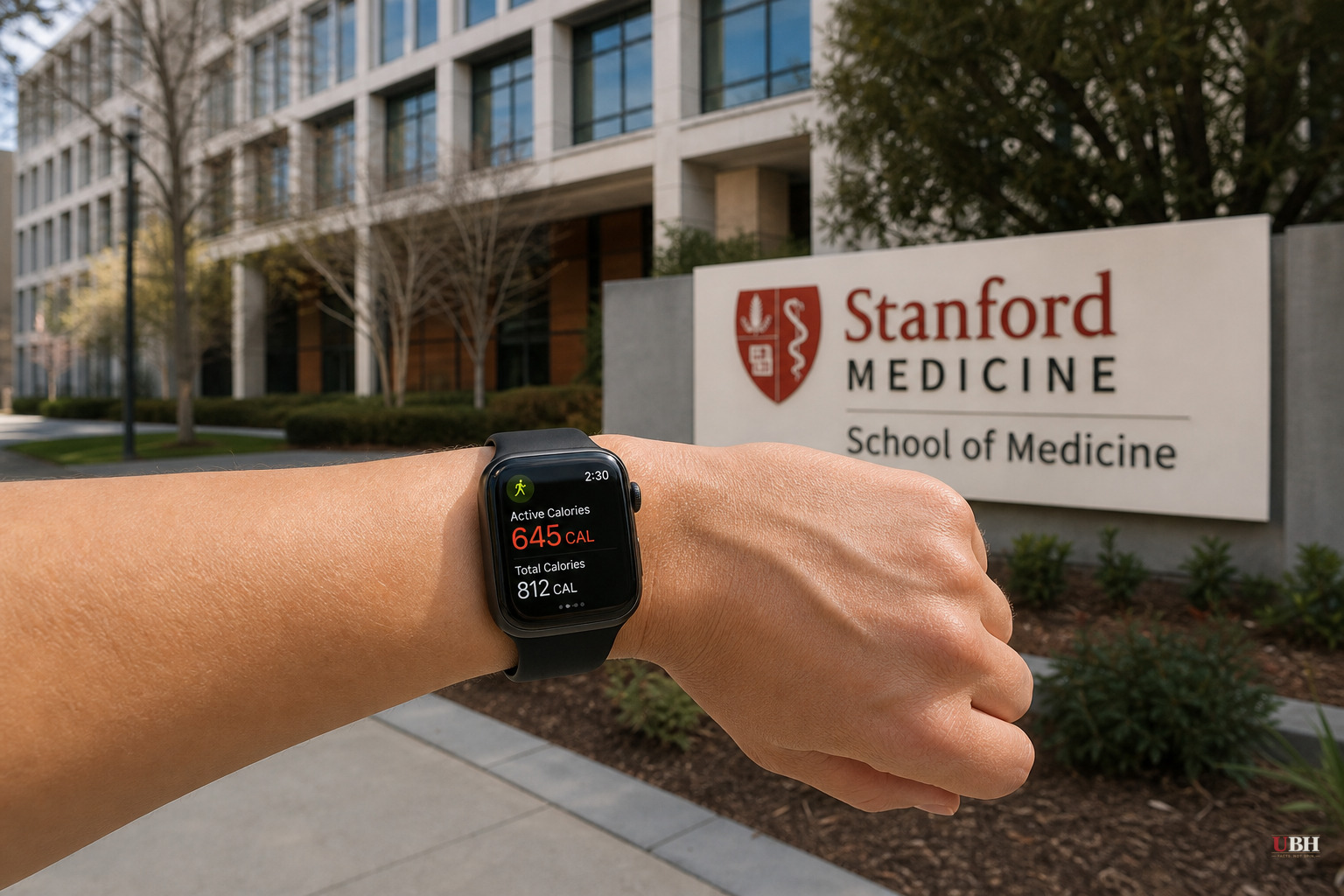
Millions of people glance at their Apple Watch after a run and trust the calorie number like it's gospel. It isn't. According to Engadget, a Stanford University School of Medicine study tested seven wearables, including the Apple Watch, Fitbit Surge, Microsoft Band and Samsung Gear S2, on 60 volunteers and found none of them reliably tracked energy expenditure.
The devices were compared against a medical-grade electrocardiograph. Heart rate readings held up fine across the board. Calorie tracking did not. The best-performing device in the study was still off by an average of 27 percent. The worst was off by 93 percent, according to Engadget's account of the research, which was published in the Journal of Personalized Medicine.
Dr. Euan Ashley, the paper's senior author, didn't mince words about it. "The energy expenditure measures were way off the mark," he said. "The magnitude of just how bad they were surprised me." That's a Stanford medical researcher, not a skeptic with an axe to grind, saying the numbers his own team measured were worse than expected.
Why your wrist can't do what a lab can
SmartWatches can't measure metabolism directly. There's no sensor on your wrist that detects how many calories your body is burning in real time.
Instead, these devices infer calorie burn from proxies: heart rate, motion data, distance covered, and machine learning models trained on population averages. Heart rate sensors using photoplethysmography are a mature, well-validated technology at this point. Turning that heart rate data into a calorie estimate is a completely different and much harder computational problem.
Anna Shcherbina, an assistant professor who worked on the Stanford study, pointed to the algorithm training itself as the core issue. "My take on this is that it's very hard to train an algorithm that would be accurate across a wide variety of people because energy expenditure is variable based on someone's fitness level, height and weight, etc," she said, according to Engadget.
A 45-year-old former college athlete and a 45-year-old office worker who never exercises can have wildly different metabolic rates even at the same height and weight. An algorithm built to average across millions of wrist-wearers is going to miss both of them in different directions.
The reasonable pushback, and why it doesn't fully hold up
Someone could reasonably argue this study is old news dressed up, and that today's Apple Watch, running far more sophisticated sensors and machine learning models than the Fitbit Surge or Microsoft Band tested in that research, has closed the gap. Apple has genuinely improved its sensor suite and algorithms with every generation since the original 2015 launch, including the current Apple Watch Series 11.
But the underlying physics hasn't changed. No consumer wearable has added a way to directly measure metabolic rate from the wrist. Improved motion sensors and better heart rate accuracy can tighten the estimate somewhat. They cannot eliminate the fundamental problem that calorie burn is being modeled, not measured. Until a device can account for individual metabolic variation in real time rather than relying on population-level assumptions from height, weight, age and sex inputs, the error margin isn't going away, it's just getting incrementally smaller.
What this actually means for the guy checking his watch after a workout
If you're using that calorie number to decide whether you've earned a second helping at dinner, you're making a decision based on a figure that could be off by nearly a third even in the best case, and by almost double in the worst case documented by Stanford's researchers. The difference between a real deficit and none at all is significant.
Neither Apple, Fitbit, nor Samsung has published data in these sources disputing Stanford's findings or claiming their current algorithms have resolved the error margins identified in the 2017 study. Whether any manufacturer will publish updated, independently verified accuracy numbers for their newest hardware remains an open question, one worth asking before trusting that little calorie ring on your wrist to make decisions about your health.
Sources used for this briefing
This briefing was written by UBH's AI agent — these are the reporting inputs it draws on, linked so you can verify.


