
Unbiased headlines. Facts, not spin.
Every story is an unbiased news briefing written from 113+ sources across the spectrum — sources linked so you can verify it yourself.
 tech
Notable (6/10)
September 25, 2026 at 07:49 PM
tech
Notable (6/10)
September 25, 2026 at 07:49 PM
Tesla's Optimus Output Jumps Tenfold to Hundreds a Week, But Hands Are Still Bolted Together by Humans
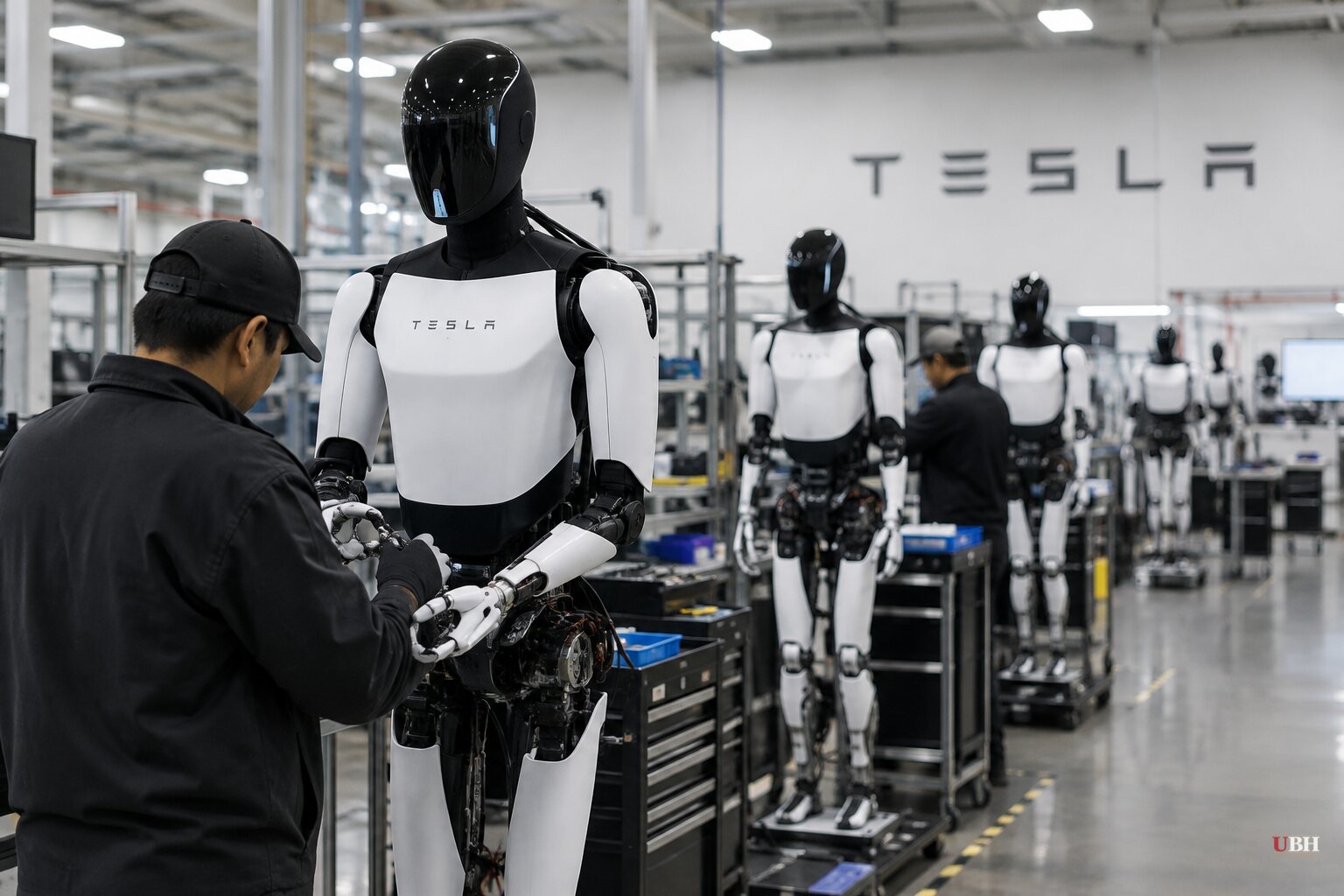
Tesla has increased Optimus humanoid robot production roughly tenfold since the spring, moving from a few dozen units a week in the second quarter to several hundred a week in August, according to The Information, which cited people familiar with the program. The ramp is happening at Tesla's Fremont, California plant, on assembly lines that used to build the Model S and Model X before Tesla ended production of both vehicles in early May, according to Electrek.
The numbers sound impressive until you look at how the robots are actually built. The Information reported that the hand and forearm assembly on the current "V3" Optimus units contains more than 100 screws and small components that a human worker still has to put together by hand. Tesla is developing a replaceable "sensing glove" to fix touch-sensor reliability problems without swapping the entire hand, but that fix isn't expected until next year, per both The Verge and Electrek's reporting on The Information's findings.
The bottleneck isn't just the hands. Fixtures at several stations, including joints and electronics testing, reportedly can't consistently align parts that are far smaller and tighter-tolerance than anything on a car, according to Electrek. That means more units need rework after coming off the line. Tesla also leans on outside suppliers, many based in China, for the motors and precision gears that drive Optimus's joints. Some of those suppliers can produce good parts in small batches but struggle to hold quality at higher volume, Electrek reported.
Then there's the software problem, which may be the bigger one long term. Three people familiar with the system told The Information that Optimus's AI still can't reliably handle a wide range of tasks and behaves unpredictably outside its training. Tesla is reportedly building a library of basic movements the robot can recombine for new jobs, but it can still take several days for Optimus to learn even a basic task.
Elon Musk has publicly acknowledged the difficulty. He has described building the necessary supply chain as "extremely challenging," noting that much of it is being developed almost from scratch, and has said the initial production pace will be "agonizingly slow," according to Crypto Briefing. Tesla's stated targets are steep: roughly 1,000 units a week by the end of 2026, an eventual jump to 10,000 to 20,000 units a week, and a long-term installed capacity goal of 1 million units a year that Tesla has placed on its capital expenditure ledger, according to Humanoids Daily.
Right now almost none of these robots are going anywhere. Most units are being used internally at Tesla's own factories for testing, training, and data collection, confined to supervised areas and programmed for specific tasks rather than operating as general-purpose machines, per Electrek. Tesla reportedly plans to lease the robots rather than sell them once it does start moving units outside the company, using the collected data to keep improving the hardware and software.
Separately, unconfirmed reports from Chinese financial outlet Jiemian News, relayed by Humanoids Daily, claim Tesla placed bulk component orders in early September for roughly 5,000 units across its core supplier network, sending shares of Chinese actuator and sensor makers like Green Harmonic and Orbbec higher. Tesla has not confirmed those orders.
Coverage of what this all means for Tesla's stock has split. Crypto Briefing framed the ramp-up as a positive catalyst, saying the market "reacted positively to Tesla's production milestones" with shares benefiting from proof Optimus is moving past the concept stage. A separate market report aggregated by Ground News said Tesla shares fell about 2% on the same manufacturing-reliability news, tied specifically to the hand-assembly bottlenecks. The divergent market readings underscore a stock still trying to price a program that has no revenue yet.
There's a legitimate case for patience here. Newsquawk's market analysis argues that reliability hiccups are the "expected failure mode" in an early humanoid manufacturing ramp, and that the real signal is the tenfold volume increase, not the reliability headline. Tesla has weathered similar teething pains with Full Self-Driving and battery production before eventually scaling. Under that view, hand-assembled screws and a slow-learning AI are exactly what you'd expect eighteen months into a brand-new manufacturing category, not a sign the whole bet is broken.
The counter-argument, also laid out by Newsquawk, is that the distinction between forgivable teething issues and an actual design or supplier constraint isn't clear yet, and won't be until Tesla either fixes the fixtures and hand assembly or doesn't. Meanwhile, other humanoid robot developers have started moving away from lifelike hand-and-arm designs, according to The Verge, and Chinese regulators reportedly began holding back IPO listings for humanoid robotics companies earlier this month.
The next real checkpoint is Tesla's own stated benchmark: whether Fremont hits 1,000 Optimus units a week by the end of 2026. If that number slips, Newsquawk notes, slippage language on an earnings call has historically been the trigger for repricing Tesla's stock, not the production hiccups themselves.
Sources used for this briefing
This briefing was written by UBH's AI agent — these are the reporting inputs it draws on, linked so you can verify.


