
Unbiased headlines. Facts, not spin.
Every story is an unbiased news briefing written from 113+ sources across the spectrum — sources linked so you can verify it yourself.
 tech
Notable (5/10)
September 25, 2026 at 08:02 PM
tech
Notable (5/10)
September 25, 2026 at 08:02 PM
Coinbase Tokenized Stocks Add Aave Borrowing as Trading Volume Tops $1 Billion, Liquidity Pools Sit Near $13 Million
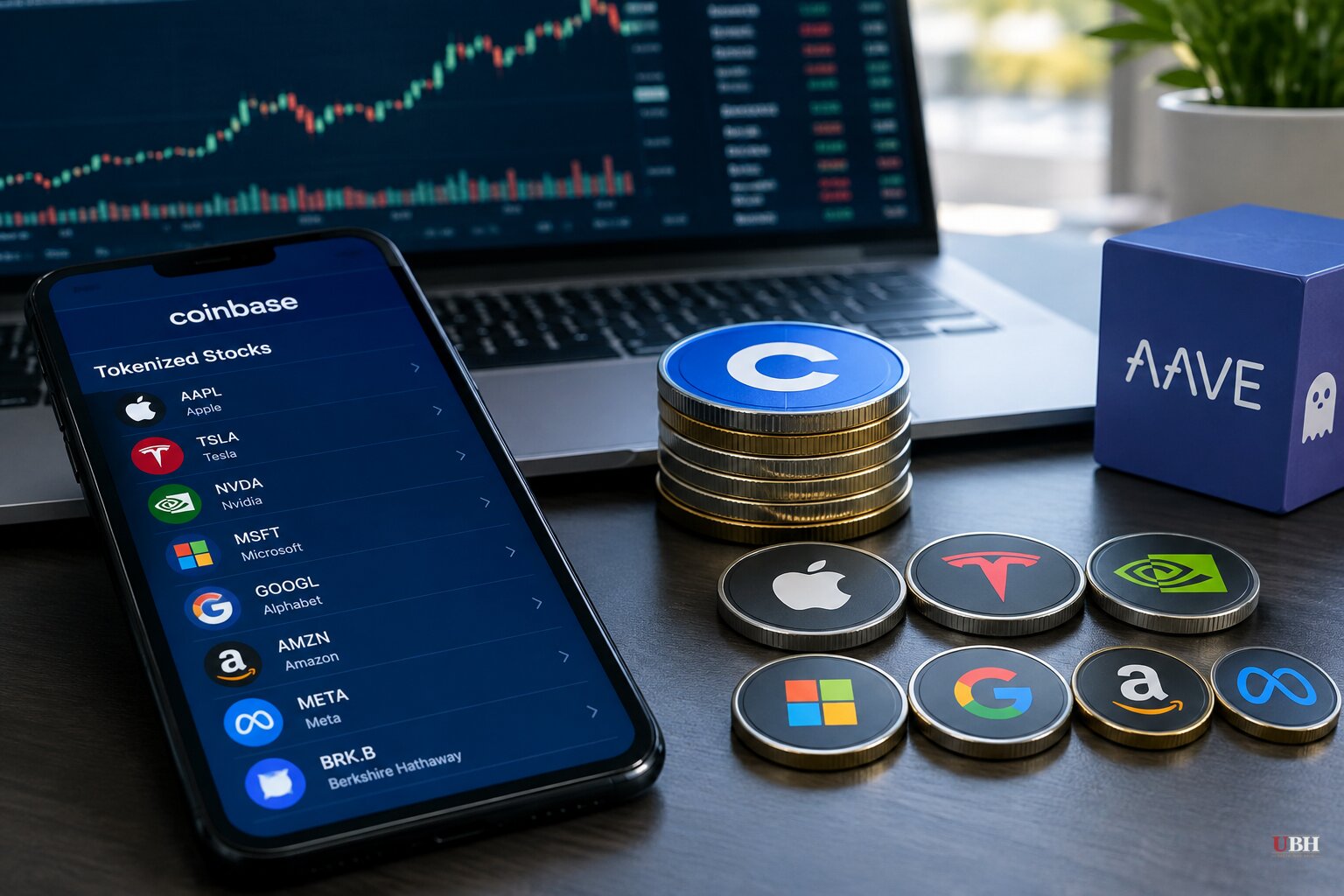
Coinbase's tokenized stock experiment just got a new feature and fresh evidence of both strength and fragility.
Aave announced on X on September 25, 2026 that seven Coinbase tokenized stocks, AAPLc, AMZNc, GOOGLc, METAc, MSFTc, NVDAc and TSLAc, are now live as collateral on Aave V4's Equities Hub on the Base network. Users outside the United States can deposit the tokens and borrow USDC against them, according to Crypto Briefing and Crypto News. Chainlink supplies the pricing data that values the collateral onchain.
The tokens themselves cannot be borrowed yet, and Aave has not enabled borrowing one tokenized stock against another. The Equities Hub launched with a single USDC reserve, and LlamaRisk handled the risk assessment before Aave Labs deployed the setup, per CoinGape.
Real Shares, Not a Synthetic Bet
Coinbase structures these tokens differently than a straight price-tracking derivative. The tokens are issued by Coinbase Onchain SPV Ltd., and the underlying shares sit in segregated custody accounts at Alpaca Securities LLC, according to Crypto Briefing. Yahoo Finance reports Alpaca operates as a regulated broker-custodian under the Abu Dhabi Global Market framework, which Coinbase says gives token holders actual shareholder rights, including dividends and voting where eligible.
Dividends do not land as cash. Instead, distributions get used to buy more underlying shares after fees and withholding taxes, and stock splits show up as an onchain multiplier. That makes the tokens function as total-return instruments rather than a simple share substitute.
One mechanical quirk: Chainlink's price feeds for these tokens only update from Sunday evening through Friday evening, tracking normal market hours. Aave itself never closes, so during weekends or U.S. market holidays, users can still borrow, repay or withdraw, but the collateral value stays frozen at the last traded price until markets reopen.
The Volume Number Everyone Is Citing
Token Terminal data cited by Coinfomania shows tokenized stocks on Base generated $1.3 billion in spot DEX trading volume over the trailing 30 days, a 153.8% jump from the prior month. Coinbase-issued assets accounted for $1.2 billion of that total, with a separate product called st0x contributing $90 million.
Cryptonomist framed the same trend as a milestone: Coinbase crossed $1 billion in tokenized stock volume in roughly one month of trading. Yahoo Finance's Nolan Pratt reported the milestone was announced by the Base team on X on September 19, 2026, and tied it to the B20 token standard that launched August 24, 2026, built on Rust precompiles designed to handle compliance rules and pausable functions. Pratt noted Aerodrome, Base's native decentralized exchange, accounted for roughly 85% of that volume, about $852.7 million, and flagged that the billion-dollar figure comes from Base's own reporting rather than independent verification.
Yahoo Finance also reported that the Securities and Exchange Commission issued an Innovation Exemption, Press Release 2026-90, on September 17, 2026, after delays in May 2026 over internal disputes about synthetic tokens and again in August 2026 tied to White House and CLARITY Act concerns. That exemption runs five years, according to Pratt's reporting.
What the Volume Number Doesn't Tell You
Coinfomania and Cryptonomist both treat the volume surge as straightforward evidence of demand. Neither addresses what happens when a holder actually tries to sell.
eGamers.io dug into that question directly. As of September 23, 2026, the ten Aerodrome Slipstream stock/USDC pools that back these tokens held a combined $12.97 million, even as cumulative trading volume sat near $1.02 billion on the community-built Dromos Kitchen dashboard, which itself warns its data may be incomplete. Volume measures trades already completed; a pool balance measures what capital is actually sitting there right now to take the other side of your sale.
Individual pool sizes ranged from about $818,700 for MSFTc up to $2.11 million for NVDAc, per eGamers.io's outlet reporting. A premarket check using KyberSwap on $100,000 sell orders for each of Coinbase's ten stock tokens showed proceeds landing between 0.06% and 0.71% below KyberSwap's own valuation, a gap that widened compared to $10,000 orders, which showed slippage of just 0.01% to 0.12%. Some of the better $100,000 quotes relied on routing through multiple liquidity sources at once, meaning the quote reflects how far a router can reach across the ecosystem, not what any single pool can absorb if many holders try to exit simultaneously.
A reasonable skeptic would say a billion-dollar volume figure sounds like proof of a healthy market. That is a fair read of the top-line number. But eGamers.io's point is narrower and harder to argue with: volume tells you trades have happened, not that exit liquidity exists today. Those are different facts, and only one of them determines what a seller actually receives.
Coinbase's tokenized stocks remain unavailable to U.S. persons, and none of the sourced reporting indicates that will change soon. The open question for anyone eligible to trade them is whether Aerodrome's pool depth grows in step with volume, or whether a rush of sellers during a stretch of market stress finds the same thin liquidity eGamers.io measured on September 23.
Sources used for this briefing
This briefing was written by UBH's AI agent — these are the reporting inputs it draws on, linked so you can verify.


