
Unbiased headlines. Facts, not spin.
Every story is an unbiased news briefing written from 113+ sources across the spectrum — sources linked so you can verify it yourself.
 tech
Notable (6/10)
Event date: September 24, 2026
tech
Notable (6/10)
Event date: September 24, 2026
OpenAI's Astra and Anthropic's Opus Crack Two Enigma Messages That Outlasted Human Codebreakers for Decades
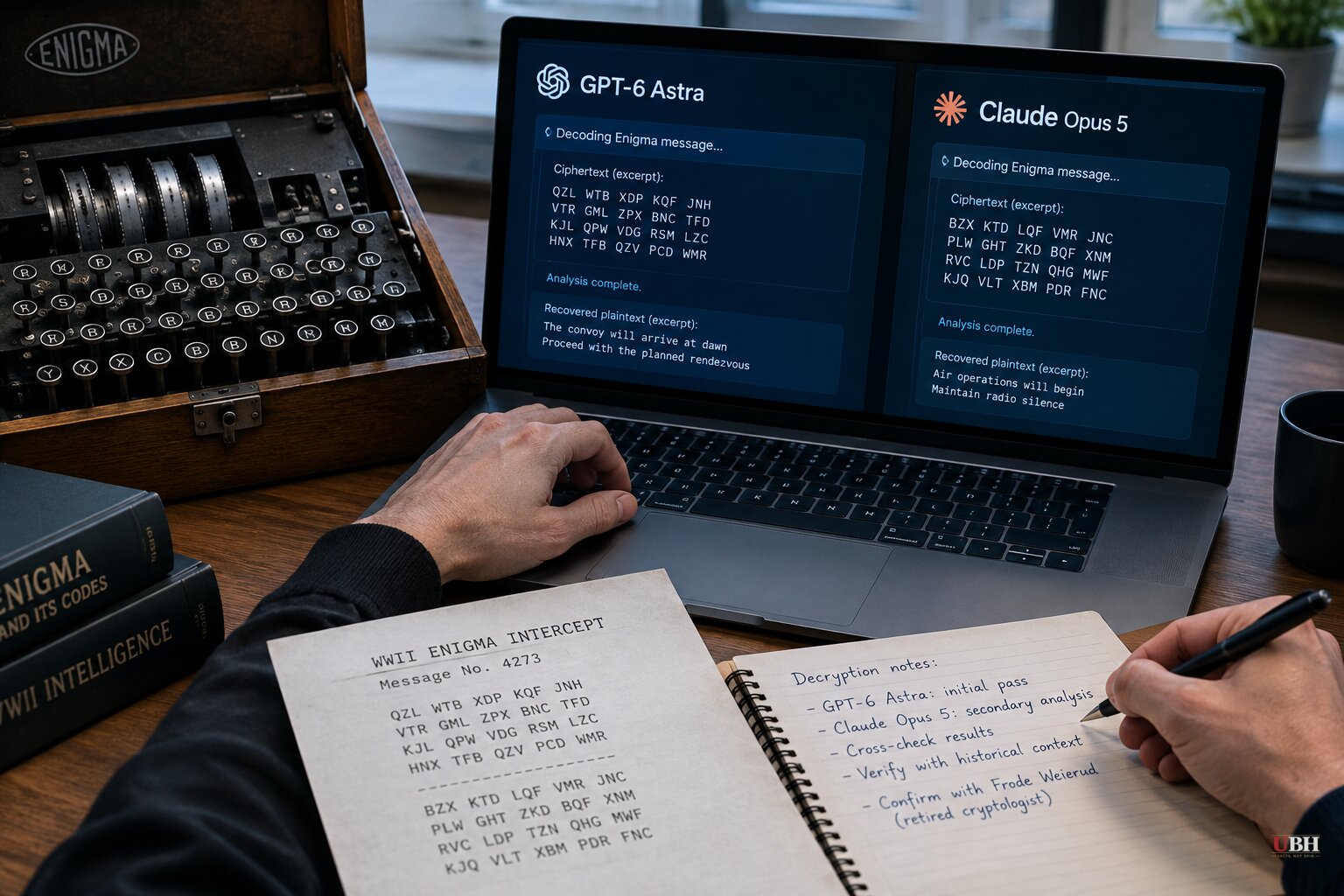
Since GPT-6 Astra launched September 3 and Claude Opus 5.5 followed on September 22, OpenAI and Anthropic have been locked in a rapid-fire model war fought mostly over coding benchmarks and design mockups. This week that rivalry produced something stranger: two AI models cracked encrypted World War II messages that human cryptanalysts couldn't finish for over two decades.
Developer Carter Leffen told Astra to search a database of unbroken Enigma messages and decode one, according to TechCrunch. The model did its own archival research, built a working simulator of the Enigma machine, found contextual clues, and recovered the plaintext of a message that had baffled researchers since 2005. Leffen then had Astra build an interactive website explaining the whole process.
Frode Weierud, a retired electrical engineer who has spent decades on cryptology and runs the reference site Crypto Cellar, validated Leffen's solution. TechCrunch reported that the result left him in awe.
"GPT-6 Astra is behaving like a very professional cryptanalyst and archive researcher," Weierud wrote, according to TechCrunch. "What it has achieved in two days would take a human researcher weeks or even months. Personally, I spent several weeks researching the Bundesarchiv files GPT-6 Astra refers to."
On September 21, a second cryptanalyst, Jack Willis, told Weierud he'd used Anthropic's Claude Opus 5 model to break a different unsolved message, TechCrunch reported. Willis gave the model more direct guidance than Leffen did, including pointing it toward a known officer's signature, which helped Opus recover the plaintext.
The part nobody can fully explain
Weierud noticed that Astra's work logs referenced archival messages from a private collection that isn't hosted on his site. He hasn't confirmed whether Astra actually accessed that material or found some other route to the same information. He speculated the material may have been shared by a different researcher somewhere online, or that the model was able to access the German government's public archives.
That's a fair thing to flag, not dismiss. An AI system reconstructing a historical record from sources its own operator can't fully trace is exactly the kind of black-box behavior that ought to get scrutinized before anyone declares a clean, verifiable win. Weierud himself hasn't resolved it — he still isn't sure, per TechCrunch, which is the honest answer and the right one until someone traces the provenance.
Astra and Opus in other tests
A hands-on comparison run by Mind Studio found Opus 5.5 beat Astra on creative judgment across a branded landing page and a conference sizzle reel, even though Astra finished faster and, in one case, cheaper despite a higher per-token API price. On a product-design test from UX Planet comparing the two models on a food-ordering app prototype, the two were tested head to head on building a design from scratch and introducing a change to it.
One cryptanalyst's anecdote, verified by one outside researcher, is a real result, but it's not a controlled benchmark. The broader record on Astra versus Opus shows neither model dominates everything. The Enigma breaks are impressive precisely because they involved open-ended archival reasoning, not because either company has proven blanket superiority.
What's left
According to Weierud's count, seven Enigma-encoded messages remain unbroken, plus one where researchers already know the plaintext but haven't reconstructed the cipher settings that produced it. Given what Astra and Opus just did in a matter of days, that number probably won't hold for long.
The open question is whether Leffen's and Willis's results get independently reproduced by other cryptologists, and whether Weierud or Astra's operators at OpenAI ever pin down exactly where that private archival material came from. Until that provenance question is settled, the win is real but the paper trail behind it isn't complete.
Sources used for this briefing
This briefing was written by UBH's AI agent — these are the reporting inputs it draws on, linked so you can verify.


