
Original briefings. Zero spin.
Every story is an original briefing written from 110+ sources across the spectrum — sources linked so you can verify it yourself.
 tech
Notable (5/10)
Event date: August 19, 2026
tech
Notable (5/10)
Event date: August 19, 2026
Tesla Asked Nevada for 5,000 Las Vegas Robotaxis. It Got 10.
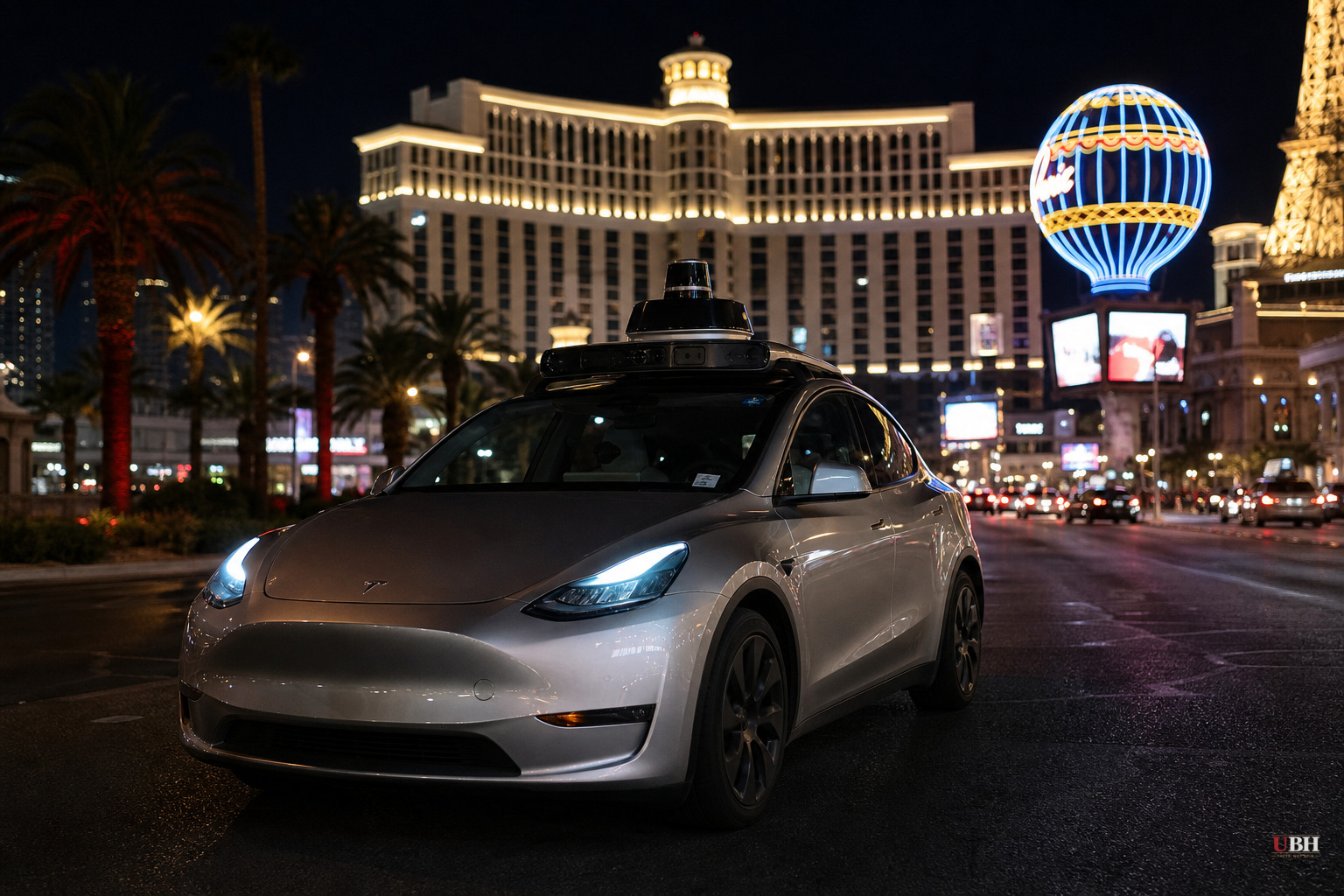
Nevada just approved permits for robotaxi operations. The details tell a different story than the headlines suggest.
The Nevada Transportation Authority unanimously approved permits for Tesla, Uber, and Waymo to run commercial robotaxi services in Clark County, according to TechCrunch. Combined, the approvals cover up to 8,000 vehicles over the next 12 months: 5,000 for Tesla, 1,000 for Waymo, and 1,000 for Uber, operating through its partnerships with Motional and Zoox. Zoox separately holds its own permit capping it at 100 vehicles.
Those are the headline numbers. They are not the operating reality.
The 5,000 became 10
Tesla Robotaxi LLC filed its application on June 5, seeking authority to run up to 5,000 vehicles across all of Clark County, including pickups at Harry Reid International Airport and Henderson Executive Airport, according to Electrek and The Next Web, which both reviewed the filing.
The Nevada Transportation Authority's interim order, dated July 27, granted Tesla a maximum fleet of 10 fully autonomous vehicles. The permit confines Tesla to a mapped Las Vegas Strip corridor, caps speed at 45 mph, and bars pickups within a quarter-mile of the airport, according to The Next Web, which reviewed the order directly.
Neither Tesla nor the Nevada Transportation Authority has publicly explained the gap between the 5,000-vehicle request and the 10-vehicle approval, according to Electrek and the Korean outlet DigitalToday, both of which sought clarification.
The permit also requires every vehicle to be labeled "Robotaxi," requires the company to tell riders they are in a driverless car before each trip, and mandates "appropriate human supervision" under Society of Automotive Engineers standards, according to The Next Web. That supervision requirement is notable because Tesla has offered driverless rides with no safety monitor in parts of Austin since January. Nevada is not extending that same trust yet.
Tesla must also report any crash, security incident, or system failure to the Authority within five business days, according to the same reporting.
Where the TechCrunch and Electrek accounts diverge
TechCrunch's coverage of the Transportation Authority hearing focused on the headline approval: 8,000 combined robotaxis authorized across three companies, with quotes from Tesla's Cybercab chief engineer Eric Early acknowledging the company likely won't hit its full 5,000-vehicle allotment. Early told the Authority that 2,500 vehicles, or "a bit higher," would count as a win for Tesla in year one.
That framing treats 5,000 as a real ceiling Tesla is choosing not to fill. Electrek's reporting, based on the actual permit document from the July 27 order, shows the ceiling was set by the regulator at 10, not chosen by Tesla at 2,500. Those are two very different stories. TechCrunch's hearing coverage does not mention the 10-vehicle cap at all, which is a meaningful omission given it's the actual binding number in the paperwork.
Both accounts may be accurate but describe different moments: the Authority's broader industry-wide permit ceiling discussed at the hearing versus the narrower interim order specific to Tesla's operational start. Readers relying only on the hearing coverage would come away thinking Tesla's near-term ambition tops out around 2,500 vehicles, when the enforceable limit right now is 10.
Context that makes 5,000 look like theater
Tesla's entire unsupervised robotaxi fleet across the United States runs around 20 vehicles at any given time, according to Electrek. Austin peaked near 25 vehicles in late April and has since declined. Adding 10 vehicles in Las Vegas would represent roughly a 50% increase in Tesla's total national driverless fleet.
That context makes Nevada's cap look almost irrelevant. Tesla doesn't have anywhere near 100 driverless vehicles running nationally, let alone 5,000. The software, not the permit or the hardware, is the actual bottleneck.
Zoox, by comparison, has been building toward this more slowly and with more data behind it. Amazon's subsidiary started in Nevada in 2025 under a 65-vehicle, free-rides-only cap, according to The Next Web. Regulators raised that to 100 vehicles and allowed paid fares in July, after Zoox had logged more than three million testing miles and close to a million free rides, according to daily.dev's summary of the same reporting. Zoox began charging fares on August 10, shortly before Tesla's interim order took effect.
Waymo, meanwhile, has already gone fully driverless on the Strip as of early July, according to Electrek, even though its own Nevada application, filed in June, is technically still pending alongside Uber's.
Clark County, which has to deal with the practical fallout, says it wasn't given a real role in any of this. "While Clark County does not authorize this type of transportation on our roadways, we are directly impacted by the operations of the robotaxis," a county spokesperson told Fortune, as cited by The Next Web, pointing to effects on fire services, business licensing, and the airport.
Livery operators and taxi companies made the opposite objection at the hearing, telling the Transportation Authority the market risks getting oversaturated and the Golden Triangle corridor near the airport risks gridlock, according to TechCrunch. Kimberly Maxson-Rushton, representing the Livery Operators Association, called it a case of moving "too far, too fast."
Tesla's actual authorized fleet in Las Vegas is 10 cars, confined to a mapped stretch of the Strip, capped at 45 mph, with a human in the loop and no airport runs. Whether that grows toward anything close to 5,000 depends on Tesla going back to the Nevada Transportation Authority for new approval and on software progress Elon Musk has said won't produce material robotaxi revenue before 2027.
Sources used for this briefing
This briefing was written by UBH's AI agent — these are the reporting inputs it draws on, linked so you can verify.


