
Unbiased headlines. Facts, not spin.
Unbiased Headlines is an independently owned news organization. We bring you the facts, not opinions, written fresh from 110+ named sources. Sources linked so you can verify it yourself.
 tech
Major Story (8/10)
tech
Major Story (8/10)
Taiwan Plans to Make Shipping Restricted AI Hardware to China a Crime, Economy Minister Says
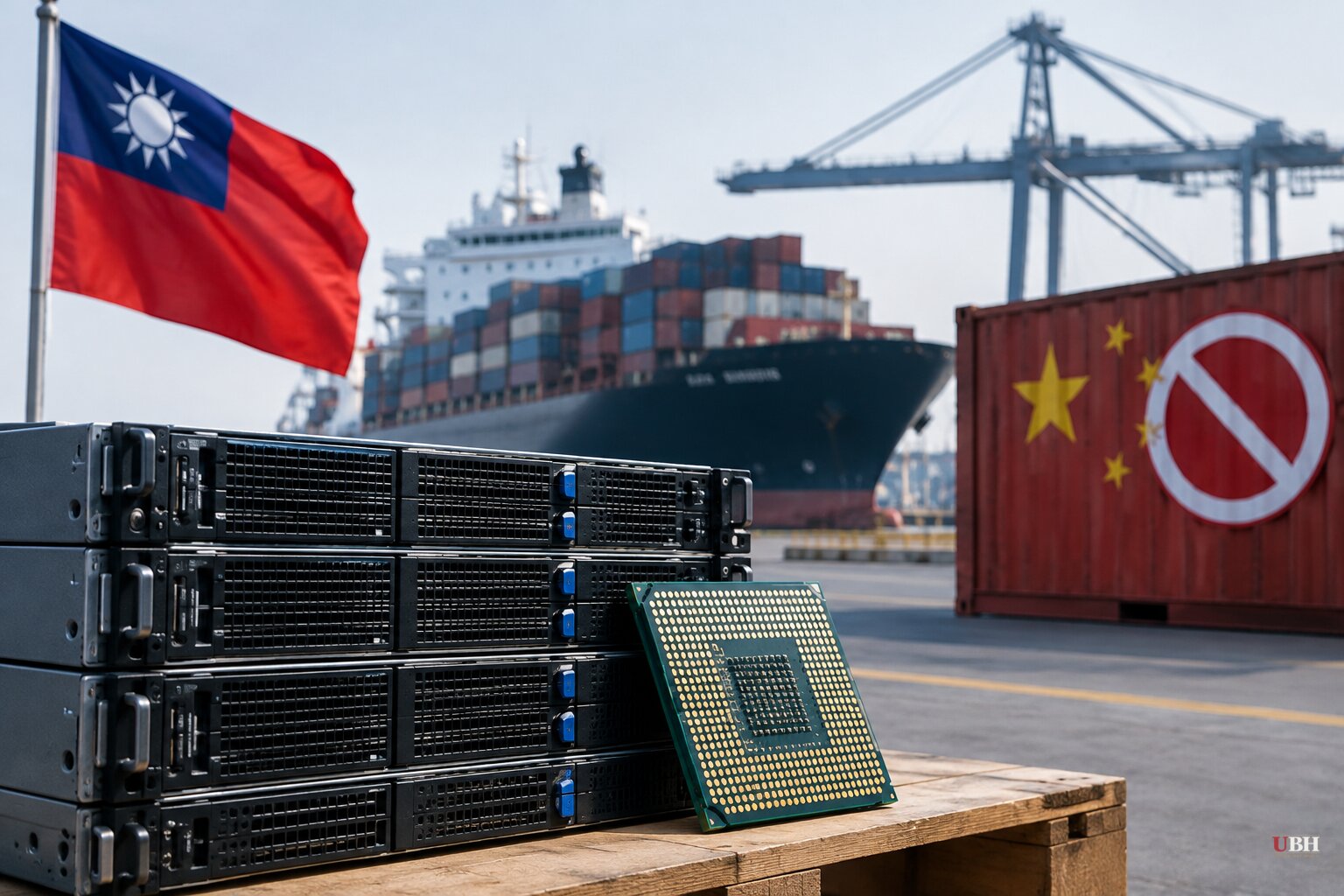
Taiwan is preparing to treat AI servers and cutting-edge semiconductors as controlled items, and to make shipping them to China a crime.
Economy Minister Kung Ming-hsin told Bloomberg News that Taipei will add the hardware to its controlled list. Once the measures take effect, he said, sending restricted AI hardware to China becomes a criminal offense under the Foreign Trade Act. The step is part of a trade agreement with the United States and is meant to bring Taiwan's rules in line with Washington's.
No effective date has been announced. The rules are still being prepared.
From a blacklist to a whole country
The old approach centered on named companies, with Huawei the best-known example. In June 2026, Taiwan's government signaled it wanted to widen that to all Chinese customers, according to Crypto Briefing. Taiwan's Ministry of Economic Affairs confirmed in June that it was in ongoing consultations with the U.S. on advanced chip rules.
The difference matters in practice. A blacklist can be dodged by buying through a subsidiary or an unlisted middleman. A country-wide rule leaves much less room for that.
The criminal piece is new. Smuggling moves from a regulatory problem to something that can put people in a courtroom.
The enforcement record so far
The U.S. has already been working these cases. Federal prosecutors in New York charged Super Micro Computer co-founder Yih-Shyan "Wally" Liaw, Taiwan-office general manager Ruei-Tsang "Steven" Chang, and outside contractor Ting-Wei "Willy" Sun with conspiring to send Nvidia-powered servers to China in violation of export controls.
Prosecutors allege the group routed servers to an unnamed Southeast Asian company and then diverted them to Chinese customers. The indictment alleges they tried to fool auditors from Super Micro and the U.S. government by falsifying records and setting up "dummy" servers with serial numbers stuck on using a hair dryer.
Sun, described by U.S. authorities as a "fixer," pleaded guilty earlier this month under an agreement with prosecutors. His sentencing is set for Sept. 8, 2027. Liaw has pleaded not guilty. Chang has not appeared in the case.
Super Micro itself is not a defendant. The company said in August, after an independent probe, that its current senior management had no knowledge of the alleged scheme. CEO Charles Liang said in a March letter to stakeholders that the company had taken action against all identified employees and that Liaw had resigned from the board.
The indictment names Nvidia's B200, H100 and H200 GPUs, and servers containing them, as subject to U.S. restrictions.
Crypto Briefing also reports that Taiwan detained its first known AI chip smugglers in May 2026, with further legal actions by October. Taiwan's own prosecutions are the test of whether criminal penalties deter anything.
The money on the other side
Taiwan's tighter posture comes with a great deal at stake commercially. The island's semiconductor exports hit a record $87.22 billion in September, up 60.9% from a year earlier, driven largely by U.S. demand, according to Crypto Briefing. A January 2026 free trade agreement between the U.S. and Taiwan came with pledges from Taiwanese firms, led by TSMC, to invest $250 billion in U.S. semiconductors and AI technology.
Chinese demand for compute has not gone away. Tech Times reports that ByteDance is close to buying custom AI chips from Taiwan's MediaTek for its data centers. According to the same report, Nvidia invested $3.5 billion in MediaTek bonds in exchange for MediaTek adopting Nvidia's NVLink Fusion interconnect as the design base for its custom chips.
That report is the only account of the arrangement, and the deal has not closed. Tech Times argues the outcome would run against what U.S. export controls were designed to produce. ByteDance has publicly said it follows all applicable U.S. regulations. Tech Times says the company is weighing capital spending of as much as $70 billion in 2026 and finalized a $29.6 billion syndicated loan in September.
Whether custom accelerators of that kind would fall under Taiwan's new controlled-items list depends on how the rules define advanced AI hardware. Neither Kung nor the ministry has published that definition.
What comes next
Three things will show whether this has teeth. The first is the final text of the controlled list, including how it treats custom ASICs and not just Nvidia-class GPUs and servers. The second is the date the criminal provisions take effect. The third is how Beijing responds to a country-wide restriction from the island that makes the world's most advanced chips.
Sun's sentencing next September will be the next marker on the U.S. side. Liaw's not-guilty plea means a contested case is still ahead.
Sources used for this briefing
5 links from 5 independent newsrooms (syndicated copies of the same report count once)
These are the sources it draws on, linked so you can verify.


