
Unbiased headlines. Facts, not spin.
Unbiased Headlines is an independently owned news organization. We bring you the facts, not opinions, written fresh from 110+ named sources. Sources linked so you can verify it yourself.
 tech
Notable (6/10)
tech
Notable (6/10)
Anthropic Will Put Official Voting Info and Live Election Results Inside Claude Before Nov. 3 Midterms
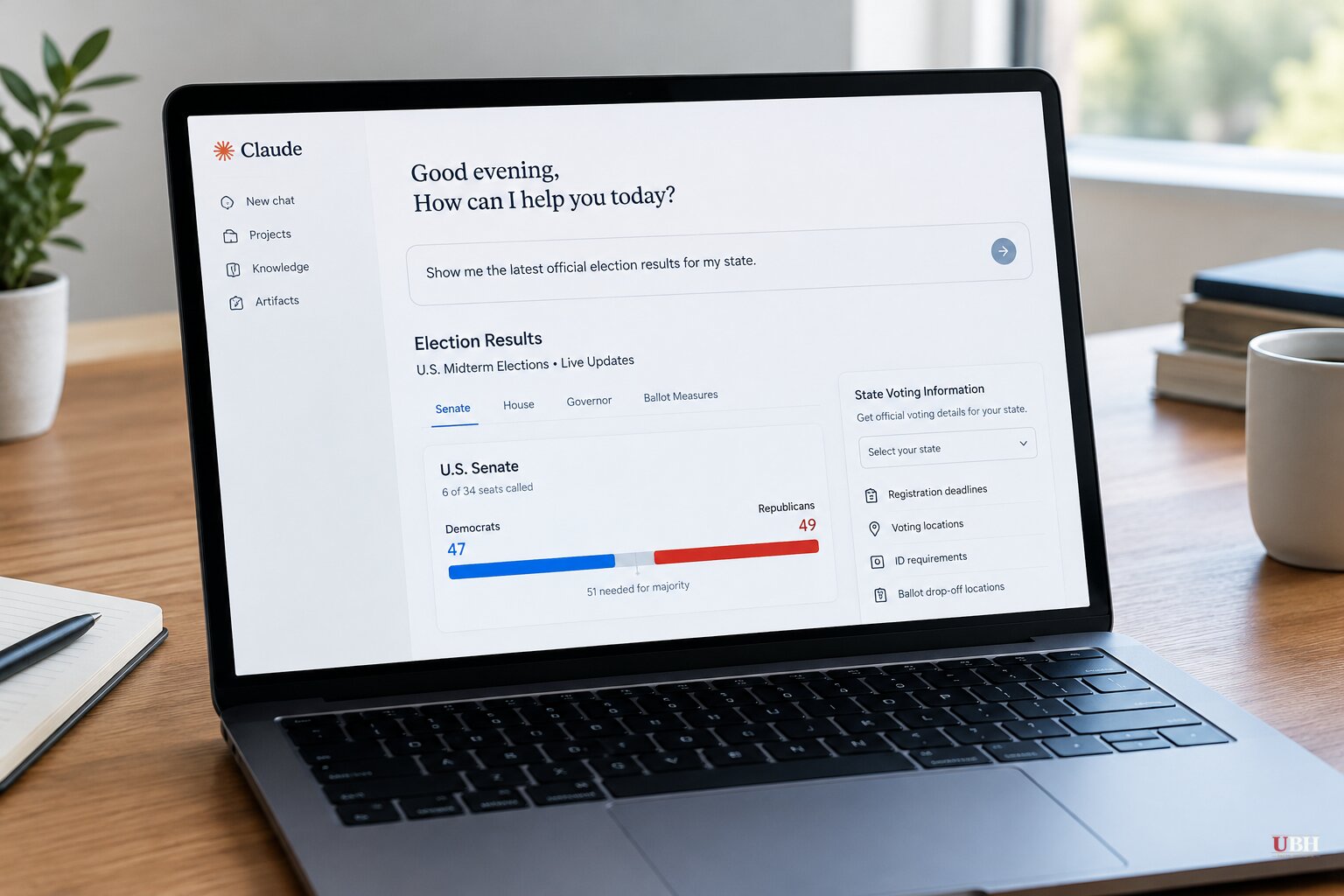
Anthropic said Wednesday, Oct. 14, that it will build official U.S. voting information and election results into its Claude chatbot ahead of the Nov. 3 midterm elections. The data comes from Democracy Works, a nonprofit that compiles voting information from state and local election sources.
The feature has not launched yet. Anthropic said it arrives later this month on Claude.ai for U.S. users.
What changes inside the chat
Since April 2026, Claude has shown a banner linking to TurboVote, Democracy Works' voter tool, whenever someone asks about registration, polling places, or election dates. That banner stays.
The new piece moves the answer into the conversation itself. "Someone asking where to vote or what ID to bring to their polling place will now get an answer specific to their state, without leaving the conversation," Anthropic said. The company said the responses draw on public information Democracy Works collects from state and local election sources.
Claude will also display results on election night and in the following days. "When people ask for current vote counts or election results, they'll be shown the latest official numbers directly in their conversation," Anthropic said.
Anthropic has not said which official feed supplies those results, or how often they will refresh. It also has not said whether Claude can check an individual voter's own registration record, or only general registration rules.
Democracy Works first partnered with Anthropic in 2024.
The usage numbers
Anthropic ran an analysis of 250,000 U.S. Claude.ai conversations from a recent one-week period. The figures are the company's own and have not been independently audited.
- Conversations touching politics, public policy, or social issues: about 5.75% of U.S. chats.
- Conversations specifically about elections or voting: about 0.51%.
- Requests asking whom or what to vote for: about 0.01%.
- Requests that violated Anthropic's election integrity policies: about 0.002%.
Anthropic says most users ask questions that help them reach their own conclusions, such as where a candidate stands on an issue. It expects the share of election queries to rise as Nov. 3 approaches.
Bias claims and the rules of use
Anthropic says Claude Opus 5.5, Sonnet 5.5, and Haiku 5.5 scored 99% on its internal political evenhandedness evaluation, the highest the company has recorded. That test is Anthropic's own. The company also cites independent reviews by the Future of Free Speech, the Foundation for American Innovation, and the Collective Intelligence Project.
The company says its usage policy bars using Claude to deceive voters, spread false claims about candidates or voting procedures, impersonate election officials, disrupt election operations, or suppress turnout. It says it has worked on detecting misuse and testing protections against coordinated influence efforts. One outlet also reported that Anthropic cracked down on foreign-operated networks trying to use AI to produce fabricated news. Anthropic's announcement did not detail that in the portions available here.
The accuracy risk
The obvious failure is bad data. Gadget Review's analysis warned that "stale data or uneven state coverage could create real problems," and that voters who treat a chatbot answer as the final word rather than a starting point take on a risk the feature does not remove.
The stakes are practical. Voter ID rules, polling hours, and deadlines differ by state and sometimes by county. A wrong answer about what to bring to a polling place is not an abstract harm. Wrong or lagging numbers on election night, in a country where counting delays already breed distrust, would land on a platform millions of people consult.
Anthropic's approach is to route answers through a nonpartisan nonprofit that gathers its data from state and local election offices, rather than letting a language model improvise. That is a defensible design. It also means Claude's accuracy depends on Democracy Works' accuracy, and on how quickly state sources update.
The move fits a broader pattern. AI companies are pushing chatbots as sources of news and public information, which also helps them attract users during an election cycle. A company that tests its own models for political bias and then grades itself at 99% is asking the public to take a lot on trust. The 0.01% figure on voting-advice requests shows people mostly are not asking chatbots to tell them how to vote. They are asking where and how.
What comes next
The integration is due to go live before the end of October. The unresolved questions are concrete: which official sources feed the election-night numbers, how fast they update, and what Claude does when state sources disagree or lag. Nov. 3 will answer those.
Sources used for this briefing
7 links from 7 independent newsrooms (syndicated copies of the same report count once)
These are the sources it draws on, linked so you can verify.


