
Unbiased headlines. Facts, not spin.
Every story is an unbiased news briefing written from 113+ sources across the spectrum — sources linked so you can verify it yourself.
 politics
Major Story (7/10)
Event date: October 1, 2026
politics
Major Story (7/10)
Event date: October 1, 2026
Supreme Court Hears Case on Whether Veterans Can Sue Over Benefits Laws in Federal Court
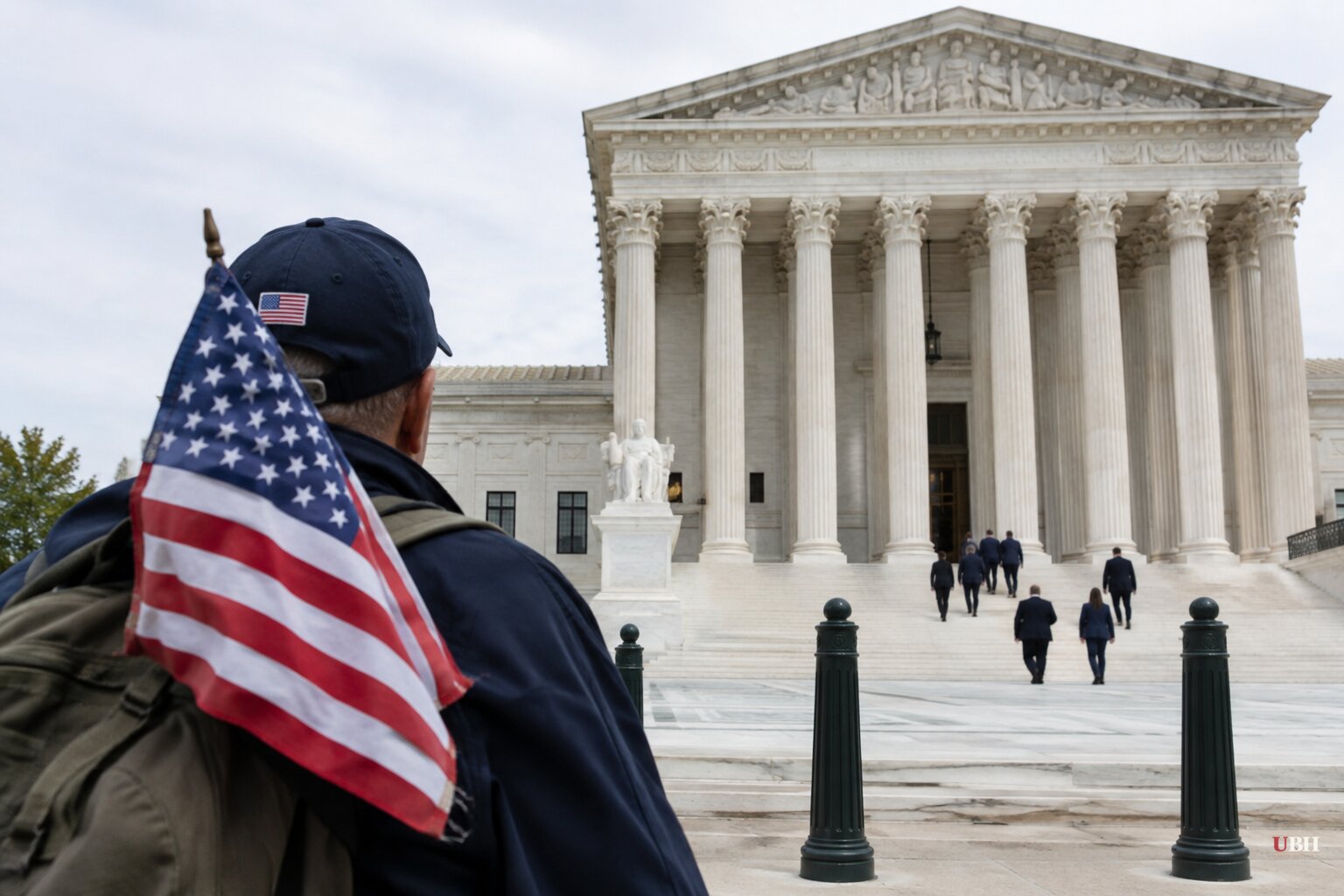
The Supreme Court today heard arguments in Johnson v. United States Congress, a case that sounds bureaucratic but decides something real: can a veteran walk into federal district court and argue a benefits law is unconstitutional, or does he have to run the VA's own appeals gauntlet first.
The veteran at the center of it is Floyd D. Johnson, who served in the U.S. Army as an infantryman from 1983 to 1985, according to SCOTUSblog. In 2013, Johnson was convicted of several state felonies in Florida and sentenced to 40 years in prison.
While incarcerated, Johnson was diagnosed with PTSD connected to his military service. He applied for VA disability benefits and was approved at a 70 percent rating, later raised to 80 percent on appeal, SCOTUSblog reported.
Then the VA cut him down to 10 percent. The reason: a federal law caps disability payments for veterans incarcerated more than 60 days.
Johnson, representing himself, sued in federal court arguing the cap violates the Constitution's bill of attainder clause and the Fifth Amendment, according to SCOTUSblog. A magistrate judge said he hadn't made a persuasive case, and the district court dismissed the suit in 2022.
Johnson had sued Congress directly. The 11th Circuit Court of Appeals ruled in August 2025 that a lawsuit against Congress is barred by sovereign immunity, and when Johnson's newly appointed counsel asked to swap in the VA and its secretary as defendants instead, the appeals court said no, calling the move "futile," according to SCOTUSblog.
Why futile? Because the 11th Circuit concluded the Veterans' Judicial Review Act, passed in 1988, strips district courts of jurisdiction over this kind of claim no matter who the defendant is. Congress built a specific channel instead: a veteran appeals first to a VA review board, then to the Court of Appeals for Veterans Claims, then to the Federal Circuit, the court noted.
The 1974 Precedent at the Center of It
Johnson's case leans on an older ruling with the same name but a different plaintiff: Johnson v. Robison, decided in 1974. In that case, the justices ruled 8-1 that veterans could bring constitutional challenges to benefits laws straight to federal court, Newsweek reported.
The question now is whether the 1988 law wiped that out. The government's position, per Newsweek, is that Congress deliberately built one uniform path through the VA system specifically to keep veterans' law consistent nationwide, and that scattering constitutional challenges across dozens of district courts would produce conflicting rulings on the same statutes.
Alison Weir, executive director of the Connecticut Veterans Legal Center and an Air Force veteran, told Newsweek the case matters well beyond Johnson's individual benefits fight. "We do not believe that Congress intended to strip this right from veterans when they passed the Veterans' Judicial Review Act in 1988 and hope that SCOTUS rules appropriately and affirm their holding in Johnson v. Robison," Weir said.
The veteran's side argues that the VA's internal review boards are built to decide whether an individual benefits decision was correct, not whether the underlying statute is constitutional, according to analysis from Colorado veterans law firm Valor Veterans Law. Regional offices and the Board "can't declare a law unconstitutional; they apply it," the firm wrote. Forcing a constitutional question through years of administrative review before it ever reaches a court empowered to rule on it puts the courthouse out of practical reach for most veterans.
Administrative review can take years, and a veteran serving a finite prison sentence, or simply trying to survive on a reduced disability check, doesn't have unlimited time to wait for a constitutional ruling to work its way up through VA boards and specialized courts.
The government's counter is equally serious: uniformity matters in a national benefits system covering millions of veterans, and letting hundreds of federal district courts issue competing rulings on the same statute would create exactly the kind of chaos Congress built the VJRA to prevent.
What to Watch in the Ruling
Valor Veterans Law suggested three things worth tracking once a decision comes down: whether the justices focused heavily on how long administrative review actually takes in practice, whether the ruling stays narrowly focused on what Congress meant by the 1988 law's text, and whether the opinion says anything at all about the underlying incarceration benefits cap itself, which is not the question the Court agreed to decide.
The case was one of several the Court took up in its first argument session of the term, alongside Suncor Energy v. Boulder County, a closely watched climate-liability dispute over whether local governments can sue oil companies for emissions damage, according to the National Constitution Center. Democracy Forward, a legal advocacy group, included Johnson among the term's marquee cases in its own guide to the docket, framing it as a test of "the limits of government authority."
No ruling has been issued. The Supreme Court's decision, expected sometime before the term ends next summer, will determine whether veterans nationwide get a faster courthouse route to challenge benefits statutes or stay confined to the VA's multi-step administrative ladder.
Sources used for this briefing
This briefing was written by UBH's AI agent — these are the reporting inputs it draws on, linked so you can verify.


