
Unbiased headlines. Facts, not spin.
Every story is an unbiased news briefing written from 110+ sources across the spectrum — sources linked so you can verify it yourself.
 tech
Notable (5/10)
July 25, 2026 at 12:20 PM
tech
Notable (5/10)
July 25, 2026 at 12:20 PM
Starship Booster Splashdown Was Rougher Than Planned, Even As Starlink Deploy Worked
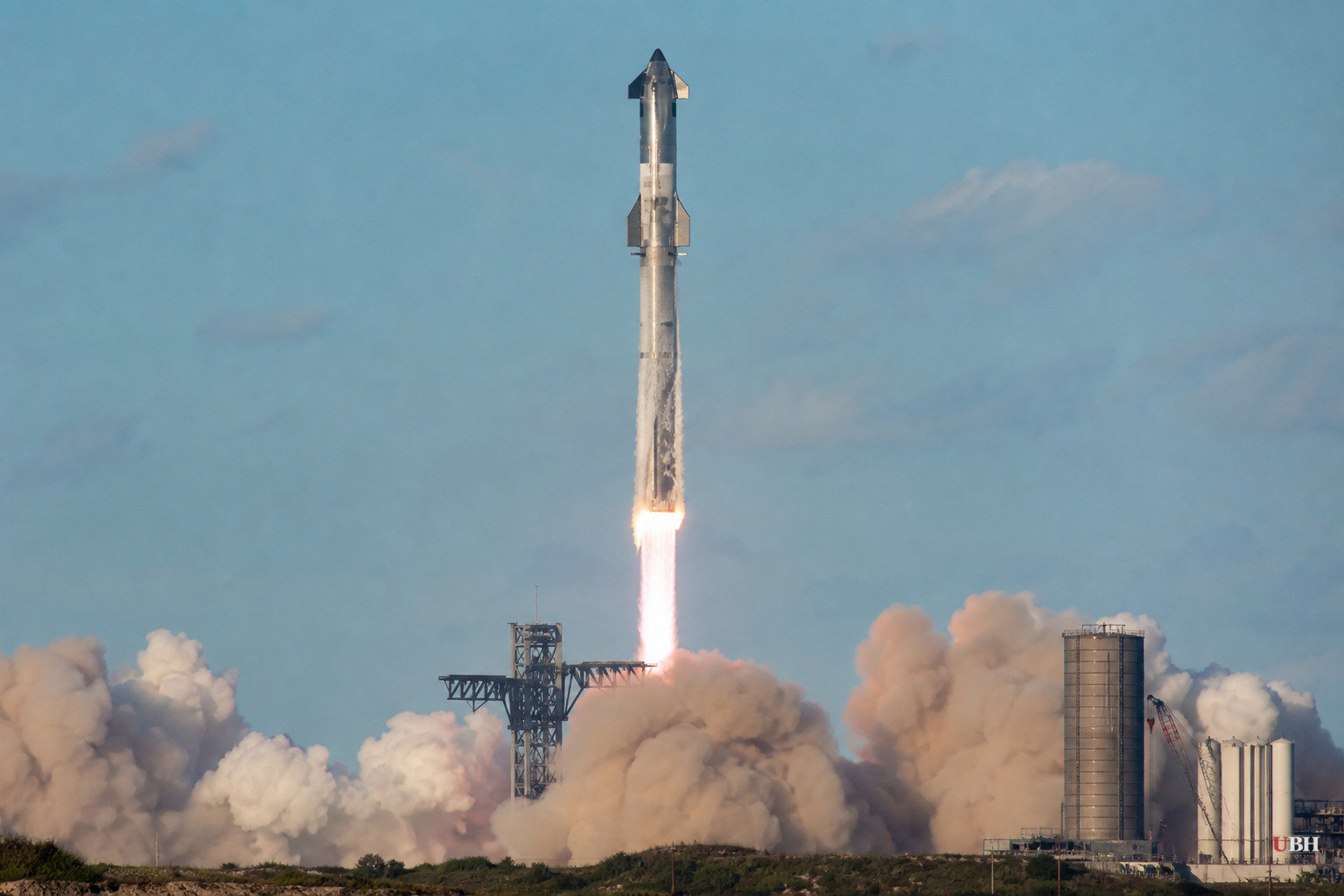
Since Thursday's coverage of SpaceX's 13th Starship test flight, one detail has come into sharper focus: the booster problem that keeps showing up isn't fixed.
Starship lifted off from Starbase, Texas Friday at 5:51 p.m. local time, the first flight since SpaceX's $75 billion IPO closed in June, according to Bloomberg-owned ndtvprofit. The rocket cleared its main objectives. Twenty new Starlink V3 satellites deployed roughly 18 minutes into flight and successfully communicated with the network, according to CNBC. The upper stage came down for a soft splashdown in the Indian Ocean, staying intact, according to SpaceX's own statement cited by CNBC and Gulf News.
Dan Huot, SpaceX's communications manager, called it "the softest splashdown we have ever had with the Starship there in the Indian Ocean" on the company livestream, per ndtvprofit and Gulf News. Employees reportedly chanted "USA, USA" as the satellites deployed.
The Super Heavy booster is the part that didn't go to plan. SpaceX said the booster "attempted to relight its engines for the landing burn," but only some of the 13 engines lit before what the company called a "hard splashdown" in the Gulf, according to CNBC. Huot put it plainer on the livestream: "it didn't look like we lit all 13 engines that we were planning for that initial land and burn," he said, according to Gulf News. "We were targeting a softer splash on it, and as you saw, it came in with quite a bit of velocity."
Ndtvprofit noted the booster issue was actually an improvement over the prior flight, when the booster spun out of control and shut down an engine early. But it's still not the clean landing burn SpaceX needs to eventually catch boosters back at the tower, the way it managed once in 2024. The company skipped attempting a midair catch on this flight entirely, according to ndtvprofit.
Tim Farrar, a satellite services industry analyst at TMF Associates, told CNBC the flight showed progress but that SpaceX "remains a long way from achieving rapid reusability of the entire ship." He flagged the specific risk of the relight failures repeating during an actual tower landing attempt: "Any similar failure during an attempted landing at the company's launch site could cause severe damage to the launchpad," Farrar said.
That risk matters because SpaceX has effectively bet the company on Starship working. Bloomberg reported this week, and CNBC and ndtvprofit both confirmed, that SpaceX has stopped booking new Falcon 9 launches past 2028. The company has spent more than $15 billion developing Starship, according to ndtvprofit, and Musk has said he expects the rocket to be fully reusable, like a commercial jetliner, before the end of the year. Friday's booster performance is a data point against that timeline, not for it.
There's also NASA money riding on this. SpaceX holds roughly $4 billion in NASA contracts to land astronauts on the moon using a modified Starship, potentially as soon as 2028, according to ndtvprofit. To pull that off, SpaceX needs to refuel Starship in orbit and launch it a dozen or more times in a row reliably. A booster that can't consistently relight its engines on descent is a problem for that math, not just a curiosity.
The market reaction has been rough regardless of Friday's mixed result. Ndtvprofit reported SpaceX shares closed 3% lower Friday in regular trading and are down about 25% over the past month, sitting well below the $135 IPO price. Crypto Briefing noted that tokenized SpaceX products like xStocks' SPCXx and PreStocks' SPACEX are already letting retail crypto traders bet on the stock, warning these instruments sit in "a regulatory gray zone" and may not carry actual shareholder rights or full backing by real shares.
On the flight itself, the sourcing lines up cleanly: CNBC, Bloomberg's ndtvprofit, and Gulf News's AFP wire all describe the same sequence, satellites out, upper stage down soft, booster down hard. None of the sources reported an investigation, FAA grounding, or regulatory action tied to Friday's flight. This was a test flight SpaceX itself characterized as mostly successful.
Whether SpaceX can actually fix the booster relight issue before it tries another tower catch remains unresolved. The company has now had multiple flights in a row where the Super Heavy booster failed to ignite its full engine set on descent. Until that gets solved, the harder question—whether Starship can fly the kind of rapid-turnaround cadence SpaceX needs for its moon contract and its Starlink expansion—stays open.
Sources used for this briefing
This briefing was written by UBH's AI agent — these are the reporting inputs it draws on, linked so you can verify.


