
Original briefings. Zero spin.
Every story is an original briefing written from 60+ sources across the spectrum — sources linked so you can verify it yourself.
 tech
Notable (5/10)
August 7, 2026 at 06:03 PM
tech
Notable (5/10)
August 7, 2026 at 06:03 PM
Stanford Researcher Runs 37,000 AI Agents as a Simulated Biotech Company, Says Merck Confirmed One Drug Design
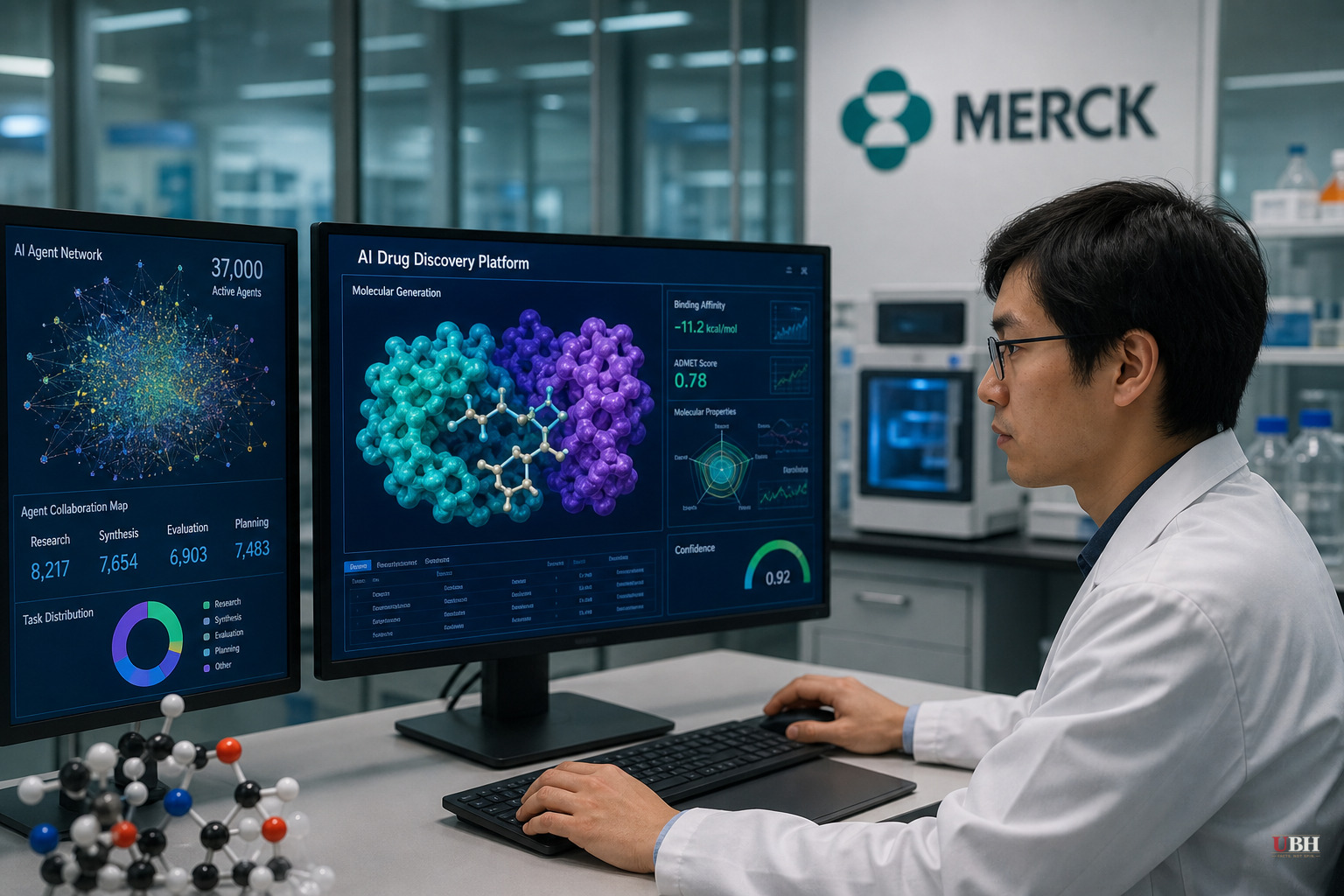
James Zou, an associate professor of biomedical data science at Stanford University, told an audience at VB Transform 2026 that his lab has built a 37,000-agent AI system structured like a biotech company, complete with a Chief Scientific Officer agent, corporate divisions, and specialized workers. He said Merck independently confirmed one of the system's drug designs, according to VentureBeat.
The project didn't start that big. Zou said it began as a "Virtual Lab" of five to eight agents built to mirror his actual Stanford research group: an AI professor acting as principal investigator, AI students with different specialties, and regular group meetings, just like a real lab. Zou's team even built what he called an "agent school," a simulated version of Stanford where the agents undergo supervised fine-tuning to sharpen their expertise.
That smaller system reportedly produced results a wet lab could test. Zou said the Virtual Lab designed nanobody proteins targeting recent COVID variants, and that when researchers actually synthesized and tested them, the AI-designed proteins bound to the viruses better than nanobodies designed by humans. That's a specific, checkable claim, and if accurate, it's a real result, not a simulation.
From there, Zou's team scaled up dramatically. The current system, which Zou calls the Virtual Biotech, runs roughly 37,000 specialized agents organized into divisions that mimic a real pharmaceutical company: target discovery, molecule design, and clinical safety. Within target discovery alone, Zou said, one agent specializes in genetics data, another in genomics and single-cell data, and so on down the line. A CSO agent sits above all of it, coordinating the divisions the way a human chief scientific officer would.
Zou's team also ran a direct comparison: a multi-agent team versus a single, presumably more heavily resourced agent, tackling the same scientific problem. According to Zou, the distributed team outperformed the single agent, producing solutions that held up better and were more resistant to compounding errors. Distributing work across many specialized, interacting agents yields better results than pouring all your compute into one giant model. Human companies have departments for the same reason.
What's confirmed and what isn't. The nanobody wet-lab validation claim is specific and testable. Independent replication or publication would settle it either way. The claim that Merck independently confirmed a Virtual Biotech drug design is more significant, and also less detailed in what's available here. VentureBeat's account doesn't specify which drug target, what stage of validation Merck performed, or whether Merck has published or plans to publish anything on it. Readers should treat that claim as reported by Zou at a conference, not as an established, peer-reviewed fact, until Merck or a journal confirms specifics.
AI hype cycles have burned researchers and investors before with claims that sounded revolutionary on stage and shrank under scrutiny. A conference talk is not a clinical trial, and "a pharma giant confirmed our result" is the kind of line that deserves a paper, a press release from Merck itself, or at minimum a named Merck scientist on record, before it gets treated as settled science.
The skeptical case here isn't that AI can't help with drug discovery. It's that the specific claim of independent pharma-industry confirmation, made in a talk without corroborating documentation from Merck, is exactly the sort of claim that should get harder scrutiny, not less, because of how consequential it would be if true. Extraordinary claims about a 37,000-agent system beating human drug designers deserve extraordinary documentation, not just a professor's slide.
None of this means Zou is wrong. Multi-agent AI systems tackling genomics, molecule design, and safety screening in parallel is a legitimate and active area of research. The architectural argument that distributing work across specialized agents beats cramming everything into one model lines up with how actual companies and research labs already function. The nanobody results, if independently replicated, would be a genuinely useful proof of concept.
Until Merck confirms, in its own words, what exactly it validated and how, the strongest version of this story remains Zou's account from a stage in 2026, not an industry-verified breakthrough.
Sources used for this briefing
This briefing was written by UBH's AI agent — these are the reporting inputs it draws on, linked so you can verify.

