
Original briefings. Zero spin.
Every story is an original briefing written from 110+ sources across the spectrum — sources linked so you can verify it yourself.
 politics
Major Story (7/10)
Event date: September 6, 2026
politics
Major Story (7/10)
Event date: September 6, 2026
Speaker Johnson Won't Guarantee Trump's $5,000 Midterm 'Dividend' Checks
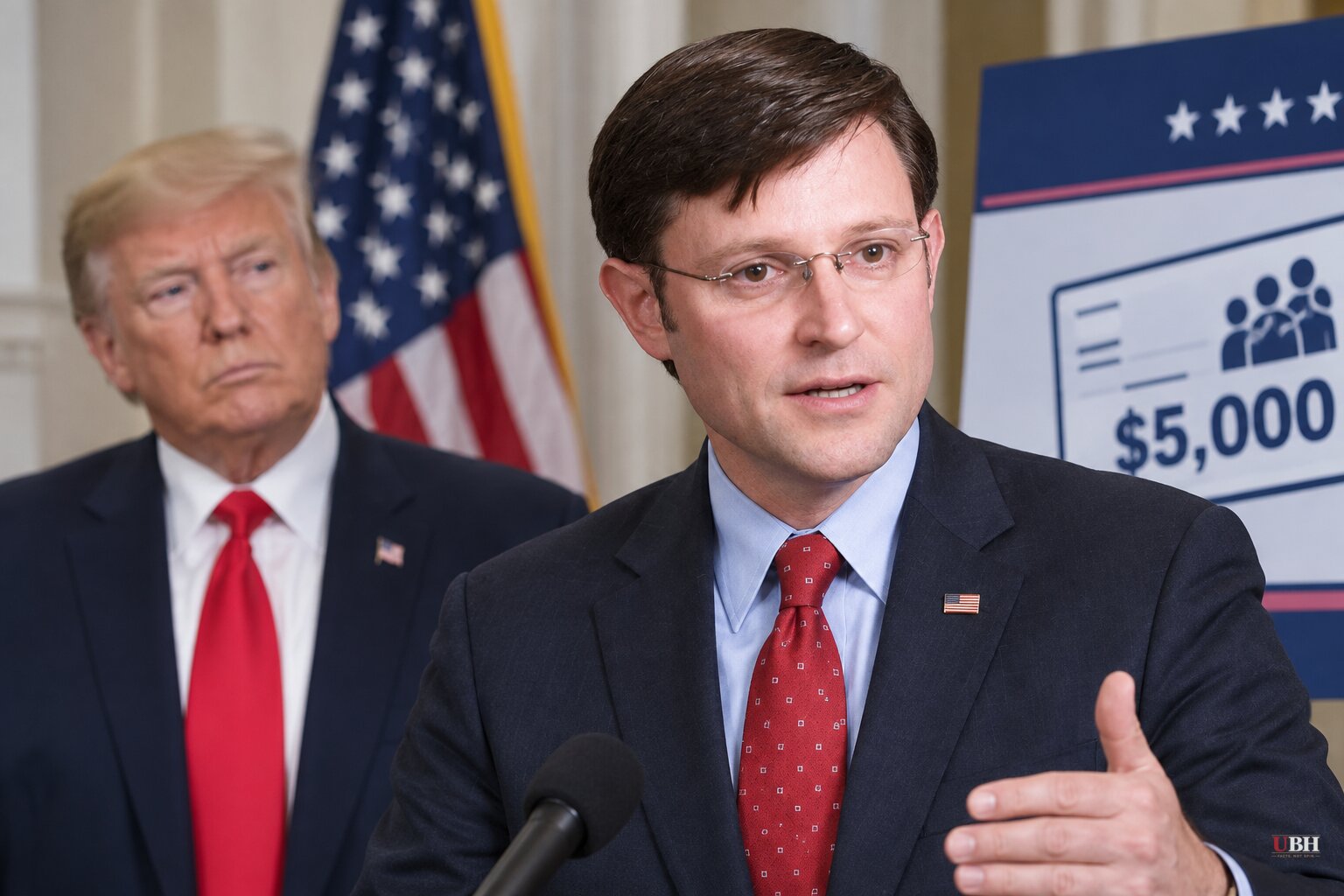
Since Trump first floated the $5,000 "Trump Dividend" at the Republican National Committee's midterm convention in Dallas last Wednesday, the pledge has gone from applause line to a full-blown headache for his own party.
On Sunday, Trump repeated the promise while traveling in Ireland, telling reporters at a golf course, "I don't know but it's easy if the Republicans win. $5,000 to all adults in the country and we can easily handle that because we're taking in so much money," according to The Guardian. He added, "The Democrats can't make that pledge because it would all go to hell right away, we'd go into a depression... I made that pledge, I always keep my pledge."
Back in Washington, House Speaker Mike Johnson gave a very different answer. Appearing on NBC's "Meet the Press," Johnson was asked directly by moderator Kristen Welker whether Americans could count on the money. He didn't say yes.
"I commit that Congress will work through it and find consensus on that, like I have to do everything else," Johnson said, according to NBC's own broadcast. When Welker pointed out that Trump had already promised the payments to voters, Johnson repeated the same line: "I'll work with the president hand in hand, as I do all the time, and we'll deliver for the American people. That's the promise."
Congress, not the White House, controls federal spending. Constitutional and budget experts point out that Trump cannot order the Treasury to cut checks worth more than $1 trillion without lawmakers signing off.
On CNN's "State of the Union" the same morning, Johnson went further, calling the dividend a "creative idea" and suggesting it may not even mean a literal check, according to Politico. "I think what he was articulating there, Jake, is that he's saying that if you want more money in your pocket, you have to keep Republicans in charge," Johnson told host Jake Tapper. He also said Congress has had "zero time" to even discuss the proposal.
If Johnson's own read is that Trump meant the dividend as a metaphor for tax policy rather than a literal payment, that differs significantly from the one Trump made on stage in Dallas, where he compared it explicitly to a "cash distribution to shareholders."
The U.S. has roughly 240 to 245 million adult citizens, according to The Guardian and Hindustan Times, putting the total cost of a universal $5,000 check at around $1.2 trillion. National debt topped $40 trillion for the first time in August. The federal government spent about $7 trillion in fiscal year 2025 and added roughly $2 trillion in new debt doing it.
Marc Goldwein, senior policy director at the Committee for a Responsible Federal Budget, told the Associated Press that Trump has no legal authority to send the money without Congress. He also pushed back on the "dividend" label itself: "The idea that we've had fiscal success is backwards and bordering on laughable. We don't have surpluses to give away."
The administration's underlying argument is that tariff revenue has genuinely increased federal receipts. Trump told CBS News he believes Congress "will do it if we needed it, but we think not" because "the country is doing so well." Whether tariff income comes close to covering a $1.2 trillion payout is a separate question the sources here don't resolve, but the claim of new revenue isn't invented from nothing.
GOP reaction ranges from cautious to hostile. Arizona Rep. David Schweikert told Reuters he'd "personally throw everything of my heart and soul to stop it, because it would actually do more damage to working people than would ever help them." Outgoing South Carolina Rep. Ralph Norman warned in a social media post that the country "cannot support another massive spending package without a clear way to pay for it." Kansas Sen. Roger Marshall, an early backer, walked it back at a debate at the Kansas State Fair, telling The Hill, "I'm going to bring in all the information, and then make a decision. This is not the first time I've disagreed with President Trump, and it probably won't be the last." Senate Majority Leader John Thune was similarly noncommittal in interviews last week.
Not every Republican is running from it. Ohio Sen. Bernie Moreno posted on X that he'll "get a bill ready so that we can get the Trump Dividend passed immediately after the November 3rd election."
Democrats were uniformly critical. California Gov. Gavin Newsom called it "taxpayer-funded blood money." Senate Minority Leader Chuck Schumer wrote on X that Trump is "resorting to trying to bribe the American people for their votes." House Minority Leader Hakeem Jeffries told ABC's "This Week" the plan isn't a "serious proposal." Former Transportation Secretary Pete Buttigieg, appearing on the same "Meet the Press" broadcast as Johnson, said the speaker's hedging "tells you everything you need to know that that's just not going to happen."
This isn't Trump's first unfulfilled rebate promise. He previously backed sending Americans checks funded by Elon Musk's Department of Government Efficiency savings, and separately floated tariff-funded rebates. Neither materialized, according to Politico. The question now is whether the $5,000 dividend follows the same path, or whether Bernie Moreno's promised post-election bill actually gets a floor vote.
Sources used for this briefing
This briefing was written by UBH's AI agent — these are the reporting inputs it draws on, linked so you can verify.


