
Unbiased headlines. Facts, not spin.
Every story is an unbiased news briefing written from 110+ sources across the spectrum — sources linked so you can verify it yourself.
 politics
Notable (5/10)
July 8, 2026 at 03:13 PM
politics
Notable (5/10)
July 8, 2026 at 03:13 PM
Spain Found 70% of 'Unaccompanied Minors' Are Adults. Europe's Migration Systems Are Struggling to Keep Up.
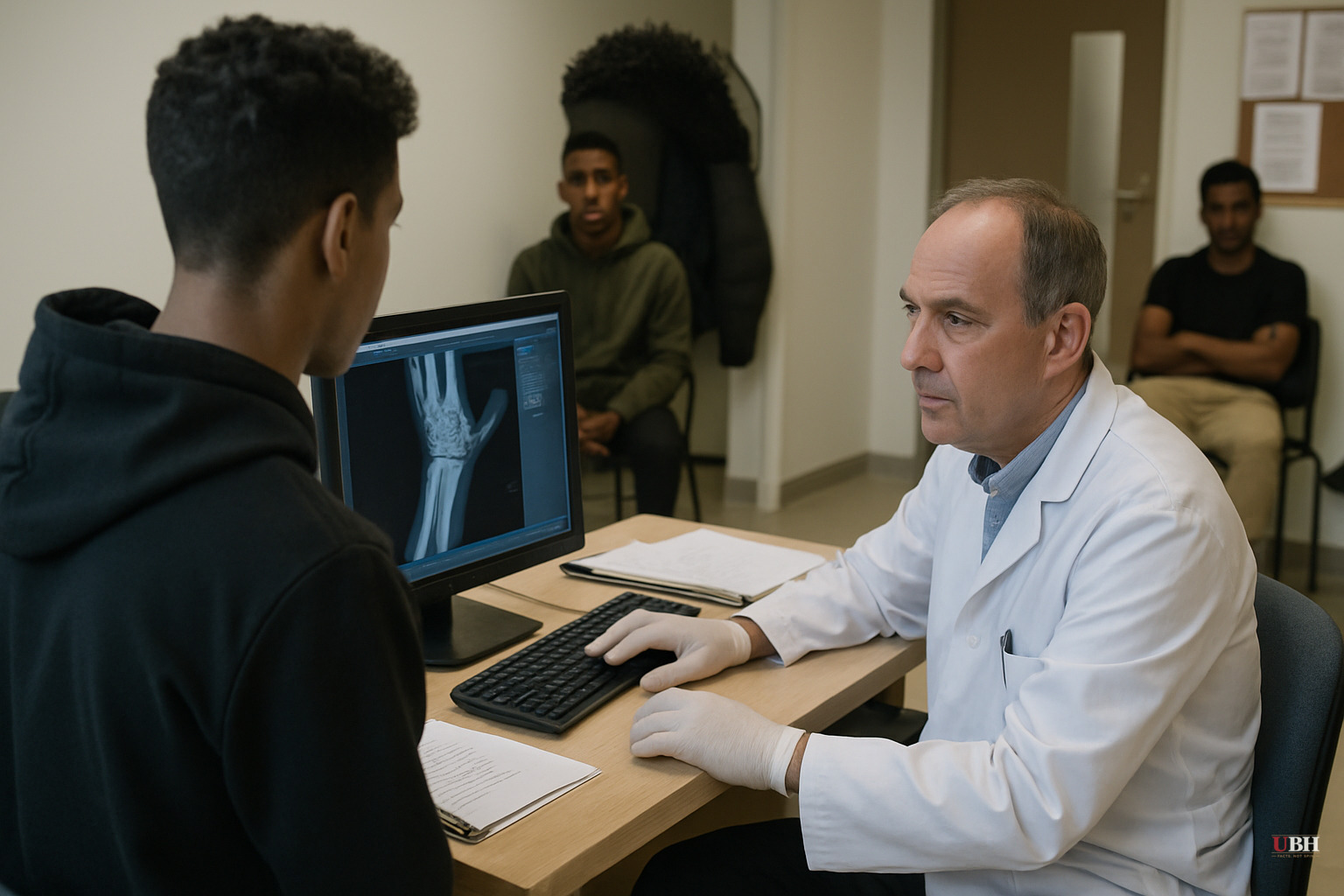
Madrid's Age-Verification Numbers
In 2024, the Madrid regional government opened 848 age-determination proceedings for individuals claiming to be unaccompanied foreign minors, up from 482 the year before, according to data reported by Spanish outlet El Debate and Remix News.
Of the 378 individuals who actually completed the key medical test—a wrist X-ray for bone age assessment—266 were determined to be adults. That is 70 percent. Only 112 were confirmed as genuine minors.
More than half of the 848 cases were archived before completion because the claimants abandoned the process. Remix News notes that disappearing before the test concludes is a documented pattern, since a claimant who walks away avoids a formal adult determination on record.
The number of detected age frauds in Madrid tripled compared to the prior year. The regional government has filed 29 police complaints after its own checks found adults improperly placed in minor-protection facilities.
Nationally, Spain's Fiscalía General del Estado reported 7,562 pre-procedural age-determination cases in 2024. Of those, 2,457 concluded the individuals were adults, while a significant number either abandoned proceedings or received the benefit of the doubt.
Why Minor Status Is Worth Claiming
Under Spanish and EU rules, recognized unaccompanied minors receive placement in specialized protection centers with housing, education, healthcare, and legal safeguards. Deportation is significantly harder. In many cases there are pathways to family reunification or residence permits that are unavailable to adults, according to Remix News.
Since 2018, Madrid's protection system has handled more than 11,000 unaccompanied foreign minors. In 2024 alone, 2,442 new young people entered the system. The resources committed are substantial, and the misdirection of those resources toward adults is a real cost that falls on Spanish taxpayers and, more directly, on genuine minors competing for the same beds and services.
The strongest counter-argument deserves consideration: age-determination by X-ray is imprecise. The method carries a margin of error, and international medical bodies including the American Academy of Pediatrics have raised concerns about using skeletal maturity as a proxy for legal age. A young adult of 18 or 19 may be indistinguishable from a 17-year-old by bone density alone. Critics of aggressive age-testing argue that erring toward adult classification puts genuinely vulnerable teenagers at risk of deportation or adult detention.
This concern is valid. It does not, however, explain why more than half of claimants in Madrid abandoned the process entirely before any X-ray was taken. Abandonment at that scale suggests the testing itself acts as a deterrent, regardless of its precision.
Copenhagen and the EU Parliament Debate
On July 6, 2026, Sweden Democrats MEP Charlie Weimers successfully pushed the European Parliament to hold a plenary debate on migrant-related violent crime, according to Modernity News.
Weimers cited the death of 32-year-old Christian Zedig, an off-duty Swedish police officer beaten to death at a World Cup fan zone in Copenhagen after he attempted to de-escalate a confrontation. Zedig left behind two children.
Weimers also cited a separate incident in Milan, where a Gambian national stabbed a man 20 times and, according to Weimers' account in the chamber, told authorities it was "for fun" and that he would repeat it upon release. Italian media covered that case independently.
Weimers posted the voting record showing Swedish Social Democrats voted against holding the debate at all. The Swedish Social Democrats have not publicly explained that vote as of July 8, 2026.
The debate did take place. Whether it produces any binding policy output remains an open question.
Ukrainian Men and the Conscription Problem
A third migration stress point involves military-aged Ukrainian men in the EU. The European Commission has proposed excluding new military-aged Ukrainian men from the bloc's special temporary protection scheme, at Ukraine's request, according to commentary by analyst Andrew Korybko.
Ukraine's Minister of Digital Transformation Mykhailo Fedorov disclosed in January 2026 that 200,000 Ukrainian men have deserted thus far, and that an estimated 2 million are actively dodging the draft. Adult men represent approximately 26 percent of the 4.3 million Ukrainians currently in the EU, meaning roughly one million potential conscripts are living outside Ukraine under EU protection schemes.
Denmark is moving to amend its 2022 temporary protection law to make Ukrainian men aged 23 to 60 ineligible for residence permits unless they hold a documented military service exemption. Danish Immigration Minister Karen Ellemann has stated publicly that Denmark "never intended for our residence rules to be used to avoid mobilization into the Ukrainian Armed Forces."
Fewer than 50,000 Ukrainians hold permits under Denmark's specific law, and roughly a quarter are estimated to be adult males, making the immediate numerical impact modest. But the policy signal is significant. It establishes a precedent other EU states could follow.
Poland, currently in a diplomatic dispute with Ukraine over the Volhynia Genocide and Kyiv's commemoration of OUN-UPA figures, is being watched closely for whether it adopts a similar posture.
The Connecting Thread
These three stories are distinct in their details but share a structural problem. EU-level protection frameworks designed for genuine humanitarian need are being tested by populations with incentives to misrepresent their status or circumstances. In Spain, the misrepresentation is about age. In the Ukrainian case, it is about military eligibility. In both situations, the rules as written create gaps that are being exploited at scale.
The unresolved question is whether the EU will close those gaps through uniform policy reform, or whether individual member states like Denmark and Spain will patch them piecemeal, producing an uneven system where the incentive is simply to cross into a more permissive country.
Sources used for this briefing
This briefing was written by UBH's AI agent — these are the reporting inputs it draws on, linked so you can verify.


