
Unbiased headlines. Facts, not spin.
Every story is an unbiased news briefing written from 110+ sources across the spectrum — sources linked so you can verify it yourself.
 tech
Notable (5/10)
July 25, 2026 at 10:25 AM
tech
Notable (5/10)
July 25, 2026 at 10:25 AM
SpaceX's Starship Flies Again: Starlink Satellites Deploy Fine, Booster Blows Up in the Gulf Again
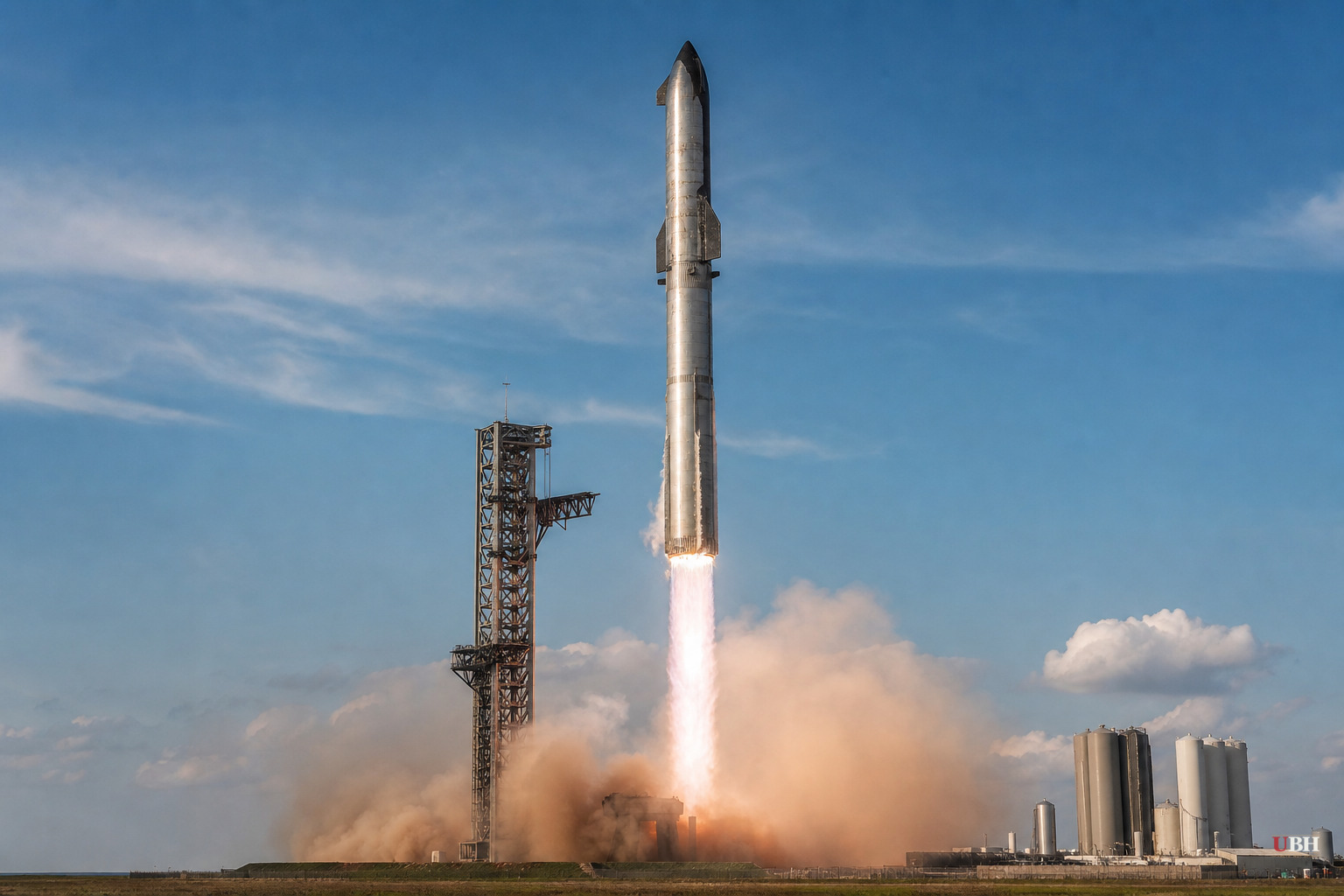
SpaceX's Starship rocket lifted off Friday, July 24, from Starbase, Texas, on its 13th test flight. The mission delivered a mixed result: a win for the Starlink program, another setback for the booster.
The rocket, standing 407 feet tall, carried 20 of SpaceX's third-generation Starlink satellites, the first time these more powerful satellites have flown, according to the New York Post. Roughly 18 minutes into the flight, Starship released them one by one from what the Post described as a "Pez-like dispenser" about 124 miles up. The satellites extended their solar arrays and antennas, then successfully communicated with the existing Starlink constellation using laser links, according to TechCrunch. As planned, they burned up in the atmosphere about 20 minutes after deployment, since Starship itself isn't yet capable of reaching stable orbit, per Engadget.
The new V3 satellites are a real upgrade on paper. Engadget reports they're built to support up to 1 terabit per second of downlink speed, ten times the capacity of the V2 generation, and 160 gigabits per second of uplink, a 22-fold increase. CNBC noted the satellites carry solar arrays generating twice the power of earlier models and are manufactured at a SpaceX facility in Redmond, Washington. None of that translates to faster home internet yet. This was a suborbital test. Customers won't see any performance difference until the satellites actually enter service.
The booster told a different story. About two minutes into the flight, the Super Heavy booster separated from the upper stage and attempted a simulated landing burn over the Gulf of Mexico. According to SpaceX's own statement, cited by CNBC, the booster "attempted to relight its engines for the landing burn," but only a subset of its 33 engines successfully ignited before what the company called a "hard splashdown." Engadget reported the booster ultimately exploded on impact.
This was the second consecutive failure of the Super Heavy booster on the V3 design. TechCrunch noted that in May, during the first V3 test flight, the booster failed during stage separation itself. SpaceX had replaced six of the booster's 33 engines ahead of Friday's launch after those engines failed to ignite during a launch attempt roughly a week earlier, an incident that triggered a last-second abort, according to the Post.
The upper stage, or "Ship" as SpaceX calls it, performed better than it has on past flights. It survived atmospheric reentry without incident and executed a simulated landing over the Indian Ocean about an hour after liftoff. Unlike prior missions, where the spacecraft exploded or ruptured on splashdown, this time it settled upright into the water and stayed there long enough for SpaceX's webcast to show it floating, drawing cheers from employees at Starbase. SpaceX engineer Kate Tice called it "lucky flight 13," per the Post.
That intact splashdown gave engineers something they hadn't had before: a close look at a heat shield that survived the trip. Six of the deployed Starlink satellites carried cameras specifically to photograph the shield, according to the Post, and the images beamed back were described as remarkably crisp. Some of the shield's tiles were deliberately painted white to simulate missing tiles, testing how the shield holds up under damage. Musk wrote on X that the flight delivered "all the heat shield data we needed and then some."
Not everyone is convinced the program is on track. TMF Associates analyst Tim Farrar, a satellite industry expert quoted by CNBC, said Friday's flight showed progress but that SpaceX "remains a long way from achieving rapid reusability of the entire ship." Farrar specifically flagged the recurring engine relight failures, warning that a similar problem during an actual landing attempt at Starbase "could cause severe damage to the launchpad." Two straight relight failures on the newest hardware version represents a real pattern, not a one-off glitch. The booster is meant to eventually land back at the tower it launched from, not in the ocean.
NASA is watching closely because Starship is the vehicle NASA intends to use as a lunar lander for Artemis crews. NASA Administrator Jared Isaacman offered congratulations after the flight, per the Post, and CNBC noted SpaceX is preparing Starship for a major NASA test flight scheduled for next year. Whether the booster's repeated landing failures get fixed before then remains unclear.
Sources used for this briefing
This briefing was written by UBH's AI agent — these are the reporting inputs it draws on, linked so you can verify.


