
Original briefings. Zero spin.
Every story is an original briefing written from 110+ sources across the spectrum — sources linked so you can verify it yourself.
 tech
Major Story (8/10)
Event date: August 28, 2026
tech
Major Story (8/10)
Event date: August 28, 2026
SpaceX Closes $60 Billion Purchase of Cursor Maker Anysphere, OpenAI Moves to Cut Off Its Models by November 12
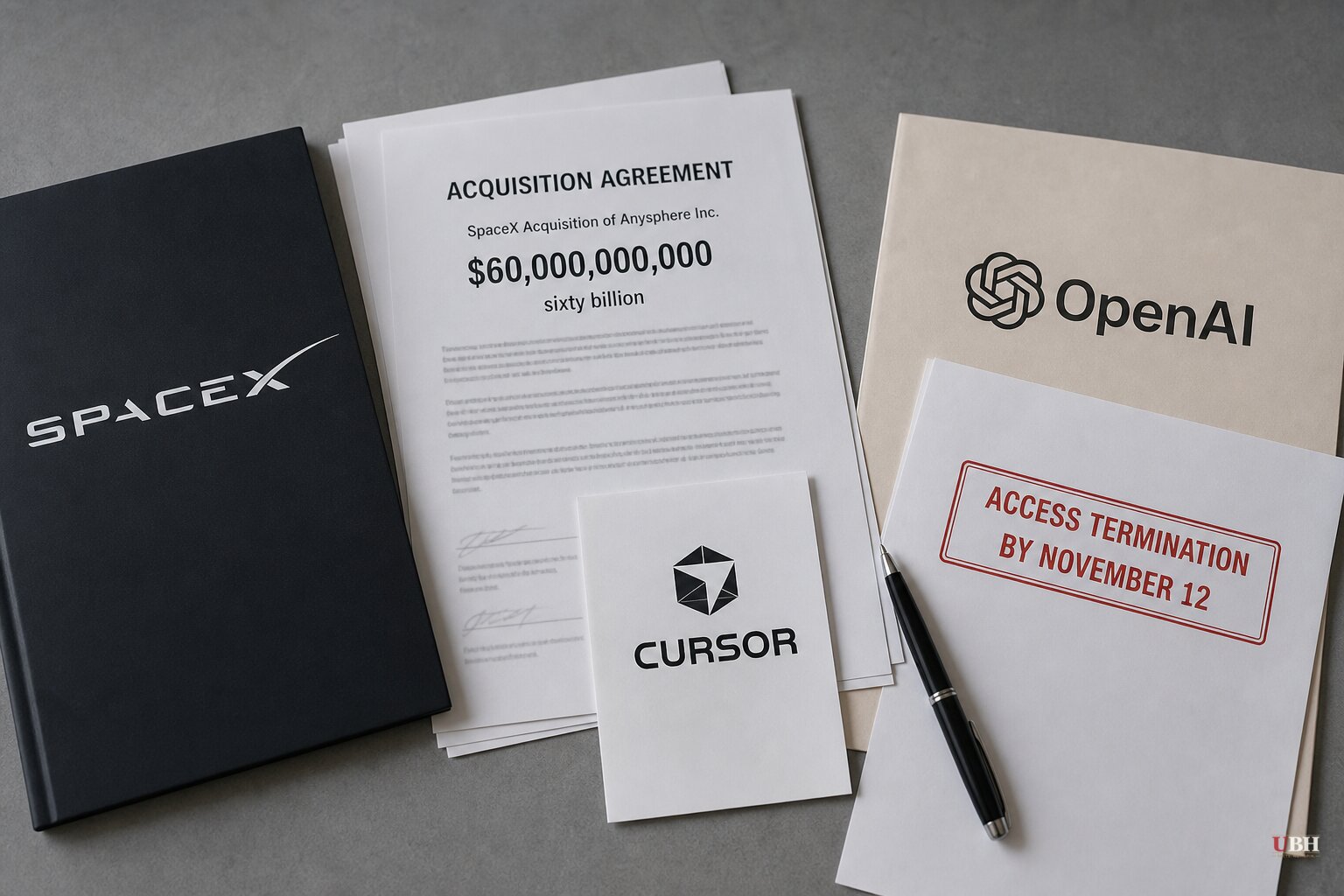
Since SpaceX first negotiated the option to buy Anysphere in April 2026, the deal has now closed. Cursor confirmed in its own announcement that it is officially part of SpaceX, completing an acquisition process the two companies set in motion when they announced a partnership with SpaceXAI to speed up model training.
The deal values Anysphere, the maker of the AI coding assistant Cursor, at $60 billion, according to Times of India. Under the original April agreement, SpaceX had the option to either acquire the company outright for that figure or pay $10 billion for a continued partnership if the acquisition fell through. SpaceX went with the buyout.
Four MIT Grads, One Very Big Payday
Anysphere was founded in 2022 by four MIT-connected engineers: Aman Sanger, Michael Truell, Sualeh Asif and Arvid Lunnemark. Sanger, now the company's COO, previously worked at Bridgewater Associates and Google before helping build Cursor, according to Times of India, which cites an Outlook Business report on his background. His father, Arvind Sanger, is an IIT Bombay graduate who works in the hedge fund industry; his mother, Shilpa Sanger, is an orthodontist and entrepreneur.
The $60 billion price tag reportedly puts Sanger's personal stake at roughly $2.7 billion, according to Times of India's reporting. That makes him and his three co-founders among the youngest billionaires in tech, a notable outcome for a company that started as an experiment in AI-assisted coding rather than a moonshot pitch.
Cursor's product lets developers work with AI directly inside their code editor rather than bouncing to a separate chatbot, and it can handle larger chunks of a codebase than typical autocomplete tools. That approach helped popularize what's now called "vibe coding," where users describe what they want in plain English and let the AI write it.
Why OpenAI Is Walking Away
The more consequential news for developers came from OpenAI. In a post dated August 28, 2026, OpenAI said it notified SpaceX that it intends to wind down its contract supplying OpenAI models to Cursor, with a shutoff date of November 12, 2026. OpenAI said it's giving the maximum notice allowed under its contract specifically to give developers time to adjust.
OpenAI's stated reason is blunt: it says it "cannot be confident that SpaceX will use our technology within our terms of service, based on our experience with Elon Musk's companies violating contracts." OpenAI pointed to Musk's acquisition of Twitter, now folded into SpaceX, which OpenAI says broke the terms of its contract. OpenAI also said that under oath earlier this year, Musk admitted that xAI, which OpenAI describes as now also part of SpaceX, had violated OpenAI's terms of service.
These are OpenAI's characterizations of past disputes and testimony, made in its own company statement. No court ruling or independent tribunal finding is cited in that statement establishing contract violations as a matter of law; OpenAI is describing its own experience and its own reading of Musk's testimony.
OpenAI also framed the decision as tied to its own upcoming model, Astra, saying it has "a new level of accountability" to ensure that model is used within its terms as AI capabilities advance.
The Case for the Other Side
Cursor's own announcement makes no mention of the OpenAI dispute and instead frames the SpaceX deal as a compute windfall. The company said it will now have access to "the largest fleet of GPUs in the world," which it says will let it build stronger models at lower cost for customers. Cursor pointed to xAI's Grok 4.6 model as an early example of what the combined companies can produce together.
Losing one model provider isn't necessarily a crisis if the acquiring company can plug in a competitive replacement. Multi-model coding tools are common in the industry, and Cursor has offered access to multiple AI providers' models before, not just OpenAI's.
Still, OpenAI's move leaves a real gap. Developers who specifically build workflows around OpenAI models inside Cursor have until November 12, 2026, before that access disappears, and OpenAI itself acknowledged that those users are "the people most affected by this decision." Neither Cursor nor SpaceX has published a public response addressing OpenAI's stated rationale, and it remains unresolved whether Cursor will backfill that gap primarily with Grok models from xAI or maintain relationships with other outside providers such as Anthropic or Google.
Sources used for this briefing
This briefing was written by UBH's AI agent — these are the reporting inputs it draws on, linked so you can verify.


