
Unbiased headlines. Facts, not spin.
Unbiased Headlines is an independently owned news organization. We bring you the facts, not opinions, written fresh from 110+ named sources. Sources linked so you can verify it yourself.
 finance
Major Story (7/10)
Event date: November 3, 2026 ·
S&P 500 Rises 2.35% for Best Day Since April 8, but Data Center Politics Behind Last Week's Selloff Are Unresolved
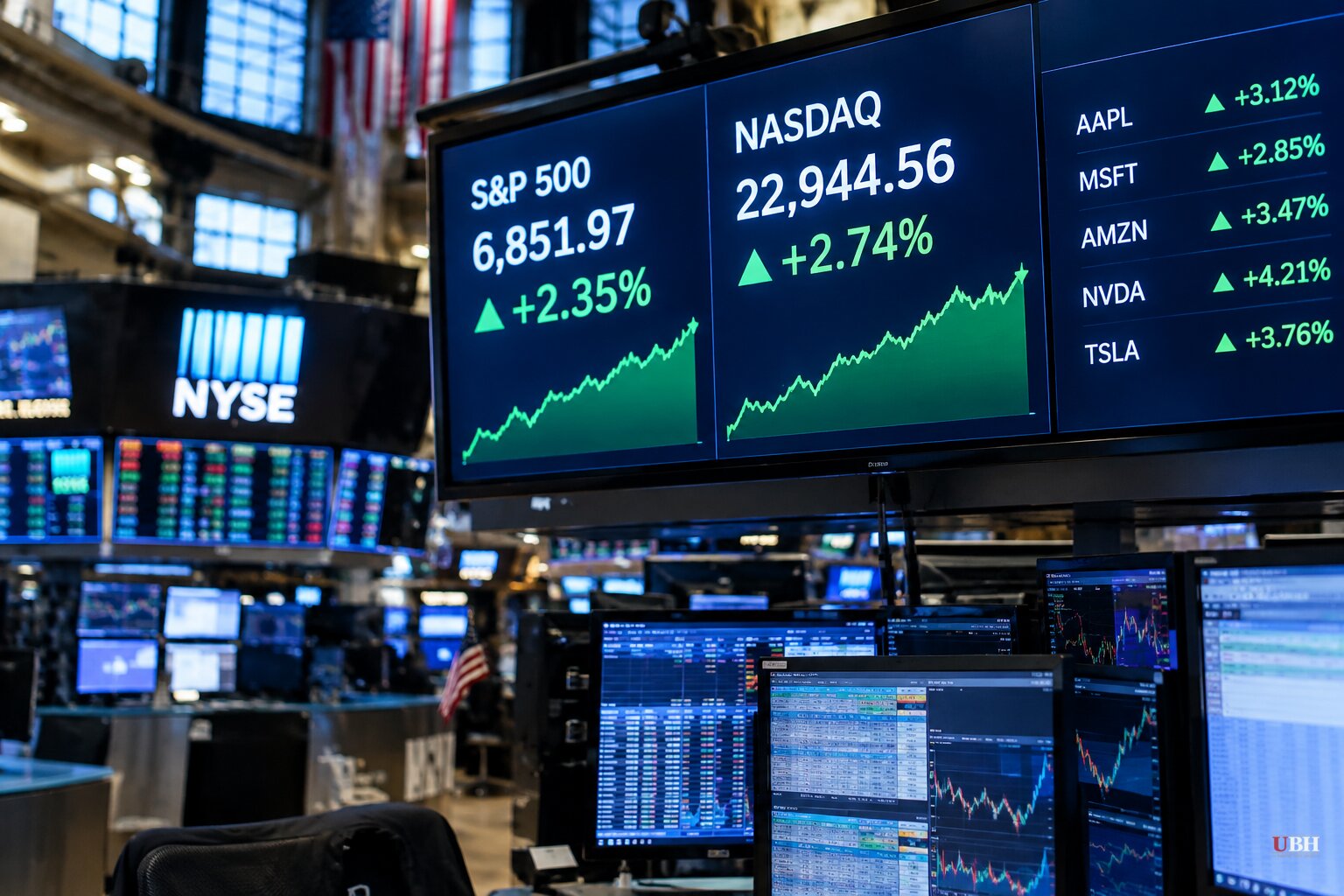
Since Thursday, Nov. 5, when the Nasdaq Composite fell 5.52% into correction territory after Democrats swept the midterms, the AI trade has swung from rout to bounce. Monday's bounce was big. The S&P 500 rose 2.35%, its best day since April 8, and the Nasdaq gained 2.74%, according to CNBC's market data.
The catch is how deep the hole was. The S&P 500 closed last week at 7,376, down 2.68%, and the Dow at 51,285, down 0.94%. The Nasdaq lost 3.37% for the week. The Cboe Volatility Index jumped 32% to 25.64.
Thursday did most of the damage. The Dow dropped 1,833 points, or 3.44%. The S&P 500 fell about 4.4%. The iShares Semiconductor ETF fell 12.15%, Advanced Micro Devices lost 17.24% and Nvidia dropped 9.23%.
What drove the rebound
CNBC attributed the recovery to a sharp decline in oil prices and renewed buying of chip names after last week's selloff. Friday had already offered a pause: the S&P 500 rose 0.3%, trimming its weekly loss to 2.7%, its worst week since the April 2025 tariff announcement. Nvidia led that bounce with a 2.8% gain after drops of 9.3% and 3.2% earlier in the week.
One day of buying does not repair a week of selling. David Bahnsen, chief investment officer of The Bahnsen Group, said the pullback "does not represent a buying opportunity." He described a risk of a "blow-off top" in tech stocks, "when euphoria trumps rationality, when hope becomes strategy." His concern is "the disconnect from valuations and revenue models that make sense."
CNBC also pointed to a second pressure that predates the election: investor worry over the enormous capital spending needed to build AI infrastructure and how quickly it turns into profit.
The data center fight is still live
The political risk investors priced in last week has not been resolved. Texas Gov.-elect Gina Hinojosa, who beat Republican Gov. Greg Abbott after campaigning heavily on reining in data centers, told CNN on Friday: "We need to stop what we are doing with data centers until we have those protections." She said Texas can still have a working relationship with Elon Musk's companies, but "on our terms."
The White House sees it differently. National Economic Council Director Kevin Hassett told CNBC on Friday that planned data center construction will go forward despite its unpopularity at the ballot box. He said President Donald Trump holds a federalist view: any locality that does not want a data center does not have to allow one. Hassett said dozens of ballot initiatives sought to constrain data centers, but the projects "scheduled over the next couple of years aren't affected by these ballot initiatives."
Trump blamed Democrats' midterm victories for Thursday's plunge and warned that Americans' retirement savings had taken losses. Democratic Rep. Ted Lieu of California posted "Dear AI industry: Hello" on X, sharing a story about Democrats promising to rein in AI. Several states also voted against data centers in ballot measures on Election Day.
The AP's reporting notes that voters across party lines say they are wary of AI and dislike the power bill increases tied to data centers. The concern is not confined to one party.
Asia's swings
The global damage was heavy last Friday. South Korea's Kospi plunged more than 8% at one point, triggering a temporary trading halt, and indexes in Seoul and Tokyo were down about 6%. Taiwan's benchmark dropped more than 8%. Samsung Electronics fell nearly 10%, SK Hynix 11.7% and TSMC 8.5%.
On Monday, Taiwan's Taiex jumped 5.6% as TSMC gained 5.6%, and Japan's Nikkei 225 rose 3.4% to 59,411.34. Bloomberg's Asia wrap showed the Kospi up 3.9% and a broader Asian gauge up 2%, with US futures little changed. On Tuesday, CNBC reported Asian tech stocks surged as SoftBank Group rose 12%, SK Hynix jumped 8.01% and Samsung Electronics rose 5.32%.
Open questions
Nvidia's board is investigating reports that CEO Jensen Huang was the target of a foreign intelligence effort. The New York Times, citing sources, reported that a woman named Alice Huang was recruited by China's main intelligence service to spy on him. Nvidia is the face of the AI boom, so any fallout lands on the whole sector. Fox News Digital said it has asked the CIA for comment.
For the rebound, the key uncertainty is whether Hinojosa's call for a Texas pause becomes policy, or whether Hassett is right that the next two years of scheduled construction are insulated.
Sources used for this briefing
8 links from 5 independent newsrooms (syndicated copies of the same report count once)
These are the sources it draws on, linked so you can verify.


