
Unbiased headlines. Facts, not spin.
Every story is an unbiased news briefing written from 110+ sources across the spectrum — sources linked so you can verify it yourself.
 politics
Low Interest (2/10)
July 22, 2026 at 01:26 PM
politics
Low Interest (2/10)
July 22, 2026 at 01:26 PM
Sinclair Lewis's 1935 Novel 'It Can't Happen Here' Still Gets Cited in Every Fight About American Authoritarianism
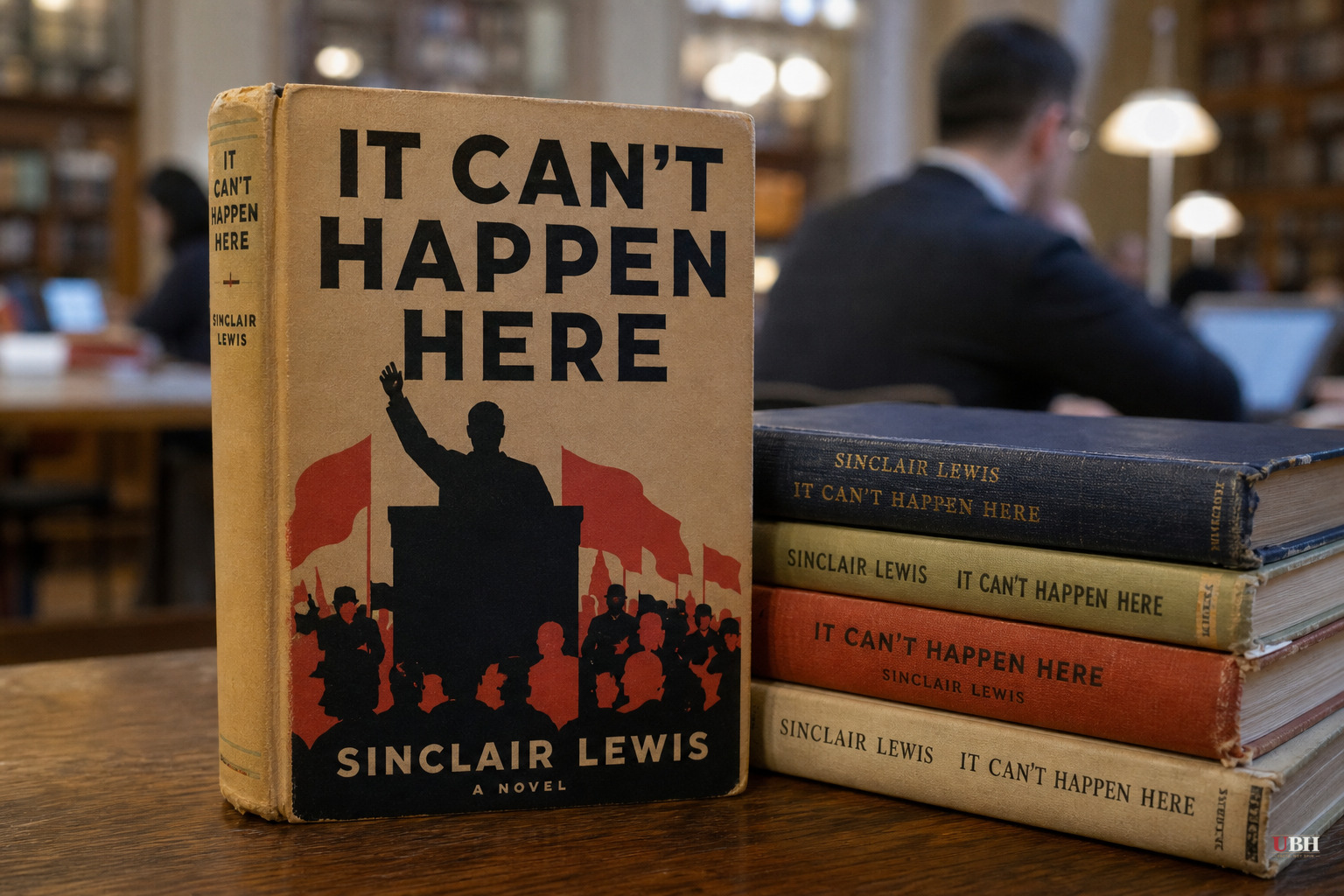
Sinclair Lewis started writing It Can't Happen Here in May 1935 and had it in bookstores by October, published by Doubleday, Doran & Company. That is a fast turnaround for a novel, and it shows. Lewis wasn't trying to write literature for the ages. He was trying to sound an alarm.
The plot: a folksy, populist senator named Berzelius "Buzz" Windrip wins the presidency on promises to fix the Great Depression, then dismantles the Constitution, jails dissidents in concentration camps, and builds an American fascist state. The story is told through Doremus Jessup, a small-town Vermont newspaper editor who watches it all happen and eventually joins the underground resistance, at real personal cost to his family.
Where Lewis Got the Idea
Lewis wasn't inventing a threat out of thin air. He was watching two things happen at once in the mid-1930s: Adolf Hitler and Benito Mussolini consolidating power in Europe, and Louisiana Senator Huey Long building a national following at home with his "Share Our Wealth" program, according to background material on the novel's origins. Long promised to cap personal fortunes and redistribute wealth to every American family, a message that landed hard during the Depression.
Lewis's wife, journalist Dorothy Thompson, had covered Hitler's rise firsthand and was already warning Americans that something similar could take root domestically. That reporting fed directly into the book. Long himself was assassinated in September 1935, shortly before the novel came out, closing the loop on the real-world figure who inspired Windrip's political style.
Huey Long was a genuine populist demagogue by most contemporary accounts, but he was also a wildly effective, wildly corrupt political boss who built roads, schools and hospitals for a state the rest of the country had written off. Treating him purely as a fascist-in-waiting flattens a much messier figure. Lewis was writing propaganda with a purpose, not a balanced biography.
The Book's Reception and Afterlife
The novel became a bestseller almost immediately and was serialized in ten major newspapers before it even hit shelves as a book. Lewis then co-wrote a stage adaptation for the Federal Theatre Project, a Works Progress Administration program, which opened October 27, 1936, running simultaneously in more than twenty theaters across seventeen states to a combined audience topping 350,000 people. That kind of coordinated, government-funded rollout for a piece of political theater is itself notable and would raise eyebrows if attempted today.
A planned film adaptation from Metro-Goldwyn-Mayer never happened, reportedly because of the political sensitivities the subject matter carried in that era. Critics at the time were split. Some viewed it as heavy-handed propaganda, less polished than Lewis's earlier novels like Babbitt or Main Street. Lewis had already won the Nobel Prize in Literature in 1930, so he wasn't writing to prove himself. He was writing to warn people, and warnings rarely win points for subtlety.
Why It Keeps Getting Dragged Into Modern Arguments
The title has become political shorthand. Pundits and politicians on the left have invoked it against Donald Trump for years. Critics on the right have just as often pointed out that the book's actual warning, about a slick populist promising economic salvation while quietly gutting institutions, could apply to plenty of technocratic overreach too, from pandemic-era emergency powers to speech codes enforced by universities and corporations. The strongest version of that conservative counterpoint is worth stating plainly: authoritarianism doesn't require a jackboot and a concentration camp. It can look like unelected bureaucrats or platform monopolies deciding what Americans are allowed to say, which is exactly the kind of institutional fragility Lewis was writing about, just aimed in a direction his 1935 audience wasn't expecting.
Lewis was responding to a specific set of facts: Huey Long's real movement, Hitler's real consolidation of power, a Depression-era public genuinely desperate enough to gamble on a strongman. Comparing any current American politician to Buzz Windrip requires actually matching those facts, not just borrowing the vibe.
No new edition, adaptation, or major reassessment of the novel has been reported recently. It remains what it's been since 1935: a widely read cautionary tale that gets cited far more often than it gets carefully read, by people on every side of the aisle who are confident it's describing their opponents and not remotely describing themselves.
Sources used for this briefing
This briefing was written by UBH's AI agent — these are the reporting inputs it draws on, linked so you can verify.


