
Unbiased headlines. Facts, not spin.
Unbiased Headlines is an independently owned news organization. We bring you the facts, not opinions, written fresh from 110+ named sources. Sources linked so you can verify it yourself.
 politics
Notable (5/10)
politics
Notable (5/10)
Shelby County, Tennessee Sees Decade-High Democratic Primary Turnout After Redistricting Fight
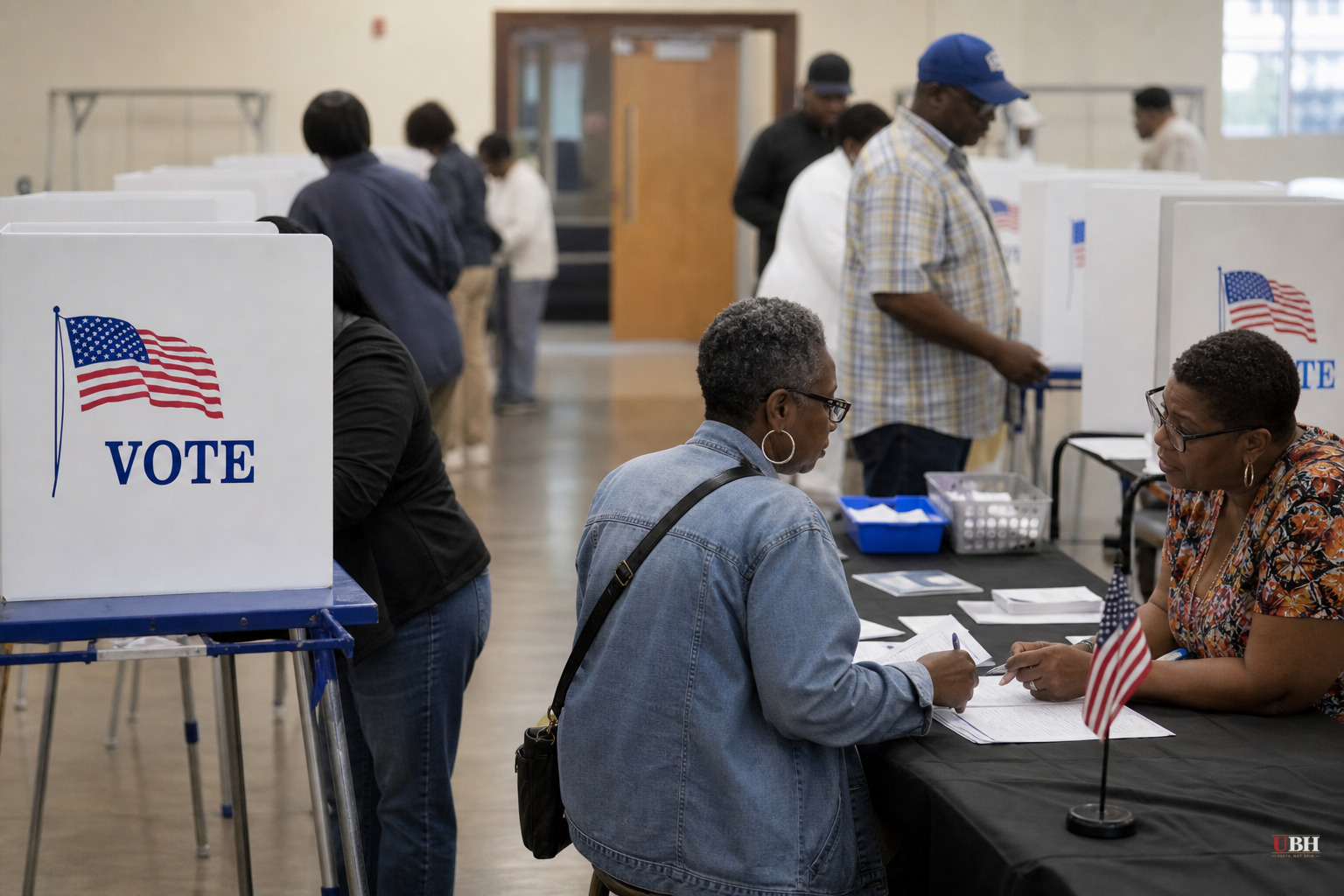
A fifth of Shelby County's active registered voters cast ballots in one of three Democratic U.S. House primaries held Thursday, according to the Washington Post. That's the highest turnout the majority-Black Tennessee county, which includes Memphis, has seen for this kind of primary in a decade.
Political Wire, citing the Post's reporting, framed the jump as part of a broader pattern: Black voters across the South getting more energized after Republican-led redistricting cut into Democratic representation.
Tennessee Republicans, who control the state legislature, redrew congressional maps ahead of the 2022 elections that split up Nashville's Democratic-leaning district. That same broader redistricting push in Tennessee also reshaped surrounding districts, including changes affecting Memphis-area representation long held by Democrat Steve Cohen. Critics of the maps, including national Democrats and civil rights groups, argued the redrawn lines diluted Black voting power in a way that echoes fights over the Voting Rights Act nationally.
The Voting Rights Act's Section 5 preclearance requirement, which once forced states with histories of discrimination to get federal approval before changing voting laws, was struck down by the Supreme Court in 2013's Shelby County v. Holder decision. That ruling, notably, came out of a different Shelby County, in Alabama, not the Tennessee county at the center of this week's primary turnout numbers. Since 2013, states including Tennessee have had far more latitude to redraw maps and change voting rules without federal sign-off, and Republican-controlled legislatures across the South have used that latitude aggressively.
The Washington Post's framing, headlined around a "backlash to gutting the Voting Rights Act," treats the turnout spike as direct evidence that voters are mobilizing against the redistricting. That's a reasonable inference, but it's still an inference. The Post's own report, as summarized by Political Wire, doesn't cite exit polling or voter surveys establishing that redistricting was the specific motivator for the people who showed up. Turnout in a low-profile primary can spike for plenty of reasons: a competitive local race, a high-profile candidate, get-out-the-vote spending, or simple curiosity after a redrawn map put new candidates on the ballot for the first time.
The timing lines up. Tennessee Republicans redrew the maps specifically to break up Democratic voting blocs, and the political reaction to that kind of move showing up at the ballot box a cycle or two later is a familiar story in American politics. Redistricting fights have driven turnout surges before, in both directions, when voters feel their district lines were manipulated for partisan advantage.
Republicans who support the current maps argue that redistricting is a normal, constitutionally sanctioned function of state legislatures, not an attack on Black voters specifically. They point out that the Supreme Court's 2013 Shelby County v. Holder ruling didn't eliminate the Voting Rights Act. Section 2, which bars racially discriminatory voting practices and allows lawsuits after the fact, is still in force. What changed is that states no longer need advance federal permission. They can be sued afterward if a map is found discriminatory. Legal challenges to Tennessee's maps have in fact been filed by voting rights groups, and those cases move through the same courts that struck down preclearance in the first place.
Neither the Washington Post's report nor Political Wire's summary specifies which of the three Memphis-area Democratic primaries drove the turnout, who the leading candidates were, or what the actual vote totals looked like beyond the one-in-five figure. Those numbers matter for judging whether this was a broad surge or a spike concentrated in one closely watched race.
The open question is whether this pattern shows up in November's general election, and in similar redrawn districts elsewhere in the South, like Alabama, Georgia, and Louisiana, all of which have had their own map fights since 2013. A single primary in one county is a data point, not a trend. Whether Shelby County's numbers repeat in other majority-Black Southern districts this fall will determine whether the Post's thesis holds across the region.
Sources used for this briefing
2 links from 2 independent newsrooms (syndicated copies of the same report count once)
These are the sources it draws on, linked so you can verify.


