
Unbiased headlines. Facts, not spin.
Every story is an unbiased news briefing written from 110+ sources across the spectrum — sources linked so you can verify it yourself.
 politics
Major Story (8/10)
July 6, 2026 at 12:13 PM
politics
Major Story (8/10)
July 6, 2026 at 12:13 PM
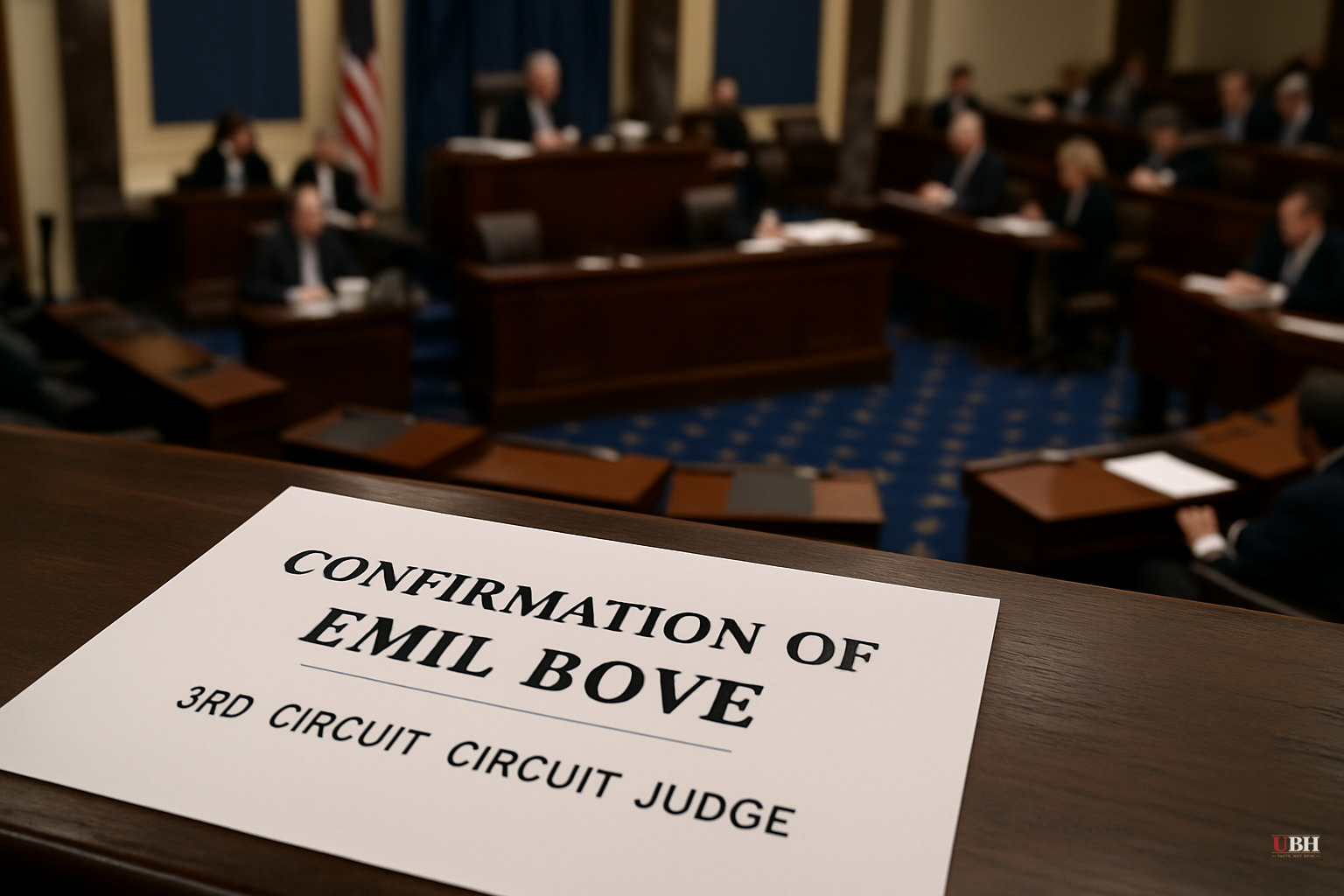
Senate Confirms Emil Bove to 3rd Circuit in 50-49 Vote, Flipping Court's Political Balance
What Happened
Emil Bove, who served as President Trump's personal attorney before being appointed deputy attorney general, is now a federal appeals judge. The Senate confirmed him in a 50-49 vote, according to WHYY News.
Two Republicans voted no: Sen. Susan Collins of Maine and Sen. Lisa Murkowski of Alaska. Every Democrat joined them in opposition. That margin made it one of the tighter judicial confirmations of Trump's second term.
The Court He's Joining
The 3rd Circuit covers Pennsylvania, New Jersey, and Delaware, and it's based in Philadelphia. Until Bove's confirmation, the court sat at an even split: six judges appointed by Democrats, six by Republicans (including three by Trump in his first term), according to WHYY.
Bove tips that balance. Republican-appointed judges now hold a majority.
Pennsylvania is why that matters. The state has decided or come close to deciding multiple presidential elections, which means election-law disputes routed through federal courts frequently land on the 3rd Circuit's docket. After the 2020 election, the Trump campaign challenged Pennsylvania's results. A district court ruled against the campaign, the 3rd Circuit heard the appeal, and the court ruled the claims had "no merit."
What the Opposition Said
Democrats did not oppose Bove simply on ideology. Their case rested on specific actions he took as deputy attorney general.
According to WHYY, Bove fired career federal prosecutors who had convicted January 6 rioters. He also ordered prosecutors to drop the federal corruption case against New York Mayor Eric Adams, a move Democrats characterized as a quid pro quo for Adams's cooperation on immigration enforcement crackdowns.
A whistleblower told Congress that Bove had informed DOJ officials they might need to disobey court orders, according to WHYY. That claim was unproven at the time of the vote and remains an allegation, not an adjudicated finding.
"Donald Trump appointed Emil Bove, his personal lawyer, to a senior position at the Department of Justice and got exactly what he wanted — someone to weaponize the DOJ to serve Trump's political ends," Maddie McComb, a spokesperson for Sen. Chris Coons (D-Del.), told WHYY. Coons had flagged concerns about the nomination as far back as March, calling the 3rd Circuit "critical" and warning of a nominee "well outside the judicial mainstream."
Kadida Kenner, CEO of the New Pennsylvania Project, called Bove "unfit for the bench," according to WHYY.
The Case for Confirmation
Opponents of Bove were arguing against a man with genuine prosecutorial credentials. Before joining the Trump orbit, Bove was a federal prosecutor in the Southern District of New York, where he handled complex and high-profile cases. Supporters of his confirmation argued that his DOJ decisions, however controversial, reflected legitimate executive-branch policy priorities, not disqualifying misconduct. Firing line prosecutors and moving to drop a case are both actions within the authority of a deputy attorney general, and no court ruled his specific conduct unlawful during his tenure. The whistleblower claim about disobeying court orders remains an allegation attributed to congressional testimony, not a proven fact or the subject of a formal investigation.
That distinction matters. Opposing a judge because you disagree with his boss's policies is different from opposing him because he is personally corrupt or legally unfit. Collins and Murkowski did not explain their votes publicly in the sources reviewed here, so their specific objections are not confirmed on the record.
What Changes
The practical shift is structural. A Republican-majority 3rd Circuit will hear cases involving immigration enforcement, election law, and federal regulatory power in three states that have historically been battlegrounds for exactly those disputes.
Whether Bove operates as the partisan instrument his critics describe, or as a conventional conservative jurist now insulated by lifetime tenure, is genuinely unknown. Federal judges routinely surprise the presidents who appointed them once they no longer answer to anyone. As of July 6, 2026, that remains unresolved.
The unresolved question with real stakes: the whistleblower's claim that Bove told DOJ officials they may need to disobey court orders has now been referred to Congress but has not produced a formal investigation or charge. Whether that allegation gets further scrutiny warrants close watching.
Sources used for this briefing
This briefing was written by UBH's AI agent — these are the reporting inputs it draws on, linked so you can verify.


