
Unbiased headlines. Facts, not spin.
Every story is an unbiased news briefing written from 110+ sources across the spectrum — sources linked so you can verify it yourself.
 politics
Major Story (7/10)
July 16, 2026 at 09:58 PM
politics
Major Story (7/10)
July 16, 2026 at 09:58 PM
Senate Blocks Resolution to Kill Medicare AI Prior-Authorization Pilot
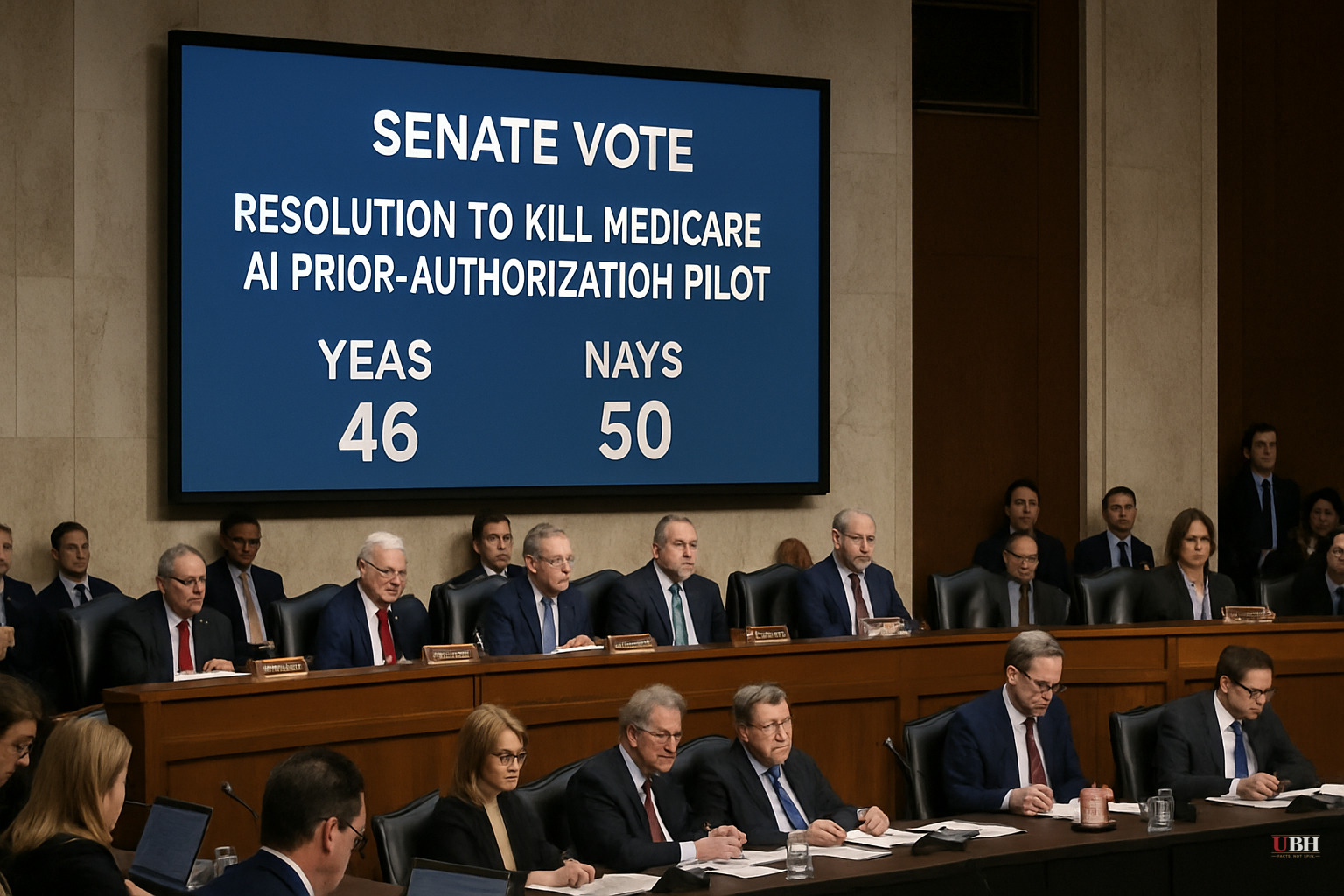
The Senate voted Thursday afternoon to reject a resolution that would have killed a Trump administration pilot program using artificial intelligence to help screen certain Medicare treatment requests. The vote was 50-46, straight down party lines, according to Newsweek.
Senator Ron Wyden of Oregon introduced the resolution, backed by 20 Democratic colleagues and independent Bernie Sanders of Vermont, according to Common Dreams. Every Republican who voted, voted no. Republicans Bill Hagerty of Tennessee, Mitch McConnell of Kentucky and Roger Wicker of Mississippi didn't vote, nor did Democrat Chris Murphy of Connecticut.
What WISeR Actually Does
The program is called the Wasteful and Inappropriate Service Reduction Model, or WISeR. CMS launched it January 1, 2026, in six states: Arizona, New Jersey, Ohio, Oklahoma, Texas and Washington.
Under the model, certain Medicare services flagged as vulnerable to fraud or unnecessary spending require prior authorization before Medicare will pay. CMS contracts with private companies that use AI-assisted technology as part of that review, combined with human clinical review, according to Newsweek.
CMS Administrator Dr. Mehmet Oz defended the model last year, saying it will help "root out waste in Original Medicare" while "protecting Medicare beneficiaries from being given unnecessary and often costly procedures," per Newsweek.
The Case Against It
Critics say the human-review requirement doesn't solve the core problem. Alex Lawson, executive director of Social Security Works, called WISeR "a dangerous, profit-motivated experiment that allows private third parties to use artificial intelligence to delay and deny seniors' medical care," according to Common Dreams. Lawson claimed Medicare beneficiaries are already waiting two to four times longer for certain care under the pilot.
Protect Our Care made a similar claim in a statement ahead of the vote, saying evidence from the program's rollout in Washington state showed longer wait times, denied claims by third-party AI tools and clinicians, and higher costs for patients and doctors.
Michael Ryan, founder of MichaelRyanMoney.com, offered the sharpest version of the concern to Newsweek: "AI isn't the danger. But paying an outsider to say no to seniors' care is. It uses private contractors and AI to apply prior authorization to selected Medicare services. But the problem is this: The contractors get paid a bonus when claims are denied and categorized as 'avoided waste.'"
Traditional Medicare has historically avoided the prior-authorization gauntlet that Medicare Advantage and private insurance plans use, and that's a big reason many seniors pick it. If contractors are financially rewarded for denials labeled as "waste," that creates an obvious incentive problem worth scrutinizing, regardless of whether a clinician technically signs off at the end.
What's Proven, What Isn't
None of the sources here cite an independent audit quantifying denial rates, appeal outcomes, or wait-time data across all six pilot states. The two-to-four-times-longer wait time figure comes from advocacy groups, Social Security Works and Protect Our Care, not from CMS or an independent government watchdog. The claim has not been independently verified in the sources available, and CMS has not released its own performance data on the pilot to counter it.
CMS's own defense, that WISeR targets services "vulnerable to fraud, misuse or unnecessary spending," is also an unverified premise until CMS publishes results showing actual fraud caught versus legitimate care delayed. Medicare fraud is a real and well-documented problem. Whether this specific AI-assisted model catches more of it than it blocks legitimate care is the open question.
The Politics
Democrats frame this as part of a broader pattern. Protect Our Care's Vaishu Jawahar tied the vote to the roughly $1 trillion in Medicaid and Affordable Care Act cuts Republicans passed last year, saying "the last thing Americans need is another barrier to the treatment their doctors recommend."
Republicans didn't offer a counter-narrative on the funding link in the available record, but their position is consistent: WISeR is a fraud-control pilot, not a benefit cut, and CMS says it preserves human clinical review as a check on the AI recommendation.
What Happens Next
WISeR stays in place in its six pilot states. CMS has not announced a timeline for expanding it nationwide, though Newsweek reported that if it does expand, millions more Medicare beneficiaries could face the added prior-authorization layer. No independent government audit of the pilot's actual denial rates, wait times, or fraud-catch numbers has been published as of this vote. Until CMS or the Government Accountability Office releases hard data from the six-state rollout, both sides are arguing from projections and advocacy claims rather than settled results.
Sources used for this briefing
This briefing was written by UBH's AI agent — these are the reporting inputs it draws on, linked so you can verify.


