
Unbiased headlines. Facts, not spin.
Every story is an unbiased news briefing written from 110+ sources across the spectrum — sources linked so you can verify it yourself.
 tech
Notable (6/10)
August 9, 2026 at 01:07 PM
tech
Notable (6/10)
August 9, 2026 at 01:07 PM
Schools Are Punishing Students Based on AI Detectors That Don't Actually Work
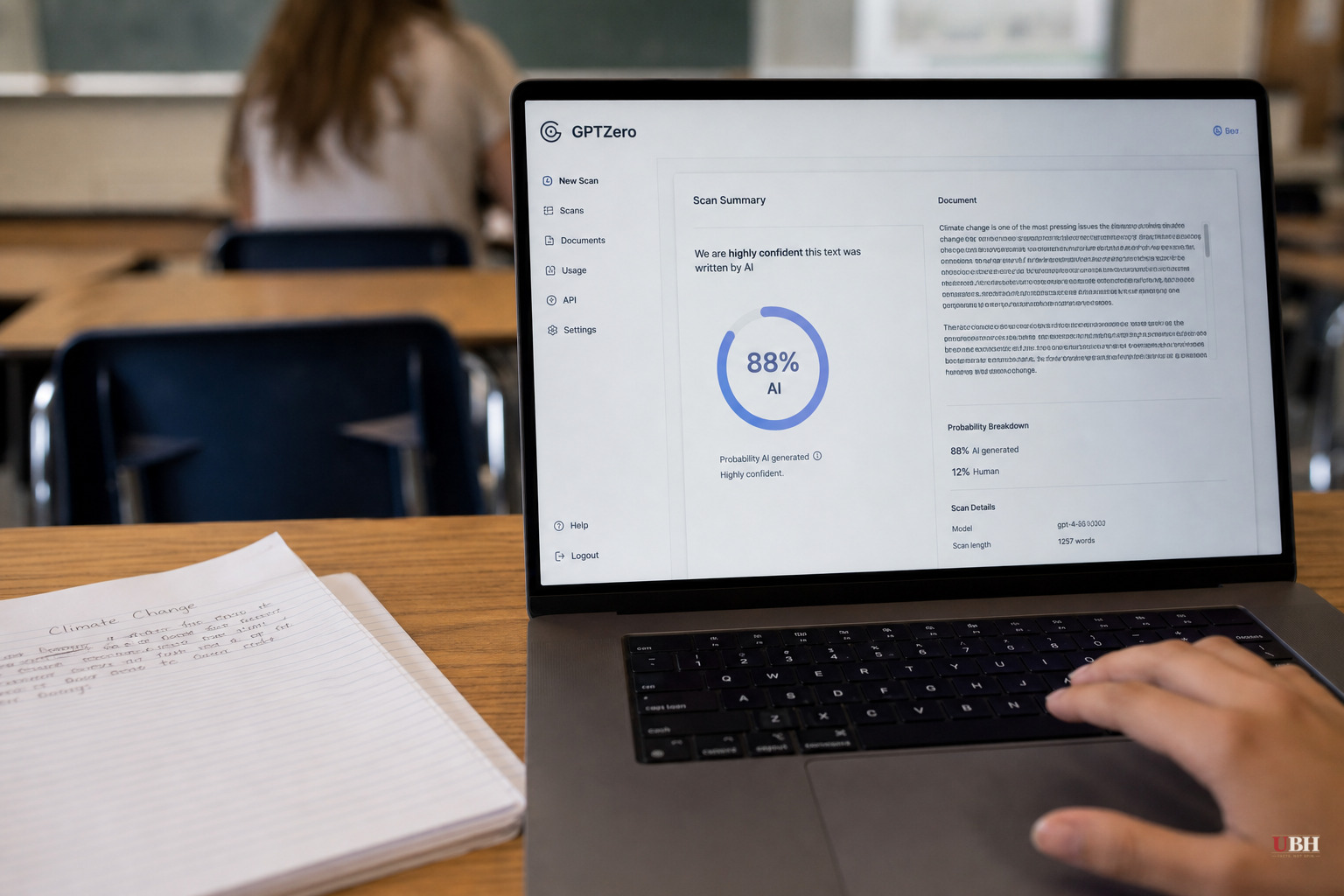
Teachers across the country are running student essays through AI detectors and treating the results as evidence, even though the companies making these tools admit they're often wrong.
According to The Verge, a survey from the Center for Democracy and Technology found that 43 percent of sixth-through-12th-grade teachers in the U.S. regularly used AI detectors between 2024 and 2025. That's a massive, fast adoption curve for a technology nobody has proven works reliably.
Here's the problem. Old-school plagiarism checkers like Turnitin compared a paper against a database of real text, scholarly articles, and web pages to find matching sentences. That's a testable, falsifiable method. You either copied the sentence or you didn't.
AI detectors don't do that. Tools like GPTZero, Pangram, and Turnitin's newer AI-detection feature use their own AI models to guess whether a piece of writing sounds machine-generated. GPTZero says it analyzes wording, rhythm, sentence structure, and tone patterns that supposedly show up more often in AI writing, according to The Verge's reporting on the company's own description of its process.
The tools rely on probability judgments rather than fact-checks. And this has been getting people in trouble for years now. Students who write clean, structured prose, or who speak English as a second language and lean on formal phrasing, get flagged more often because their natural style resembles what these models associate with AI output.
Turnitin has said publicly that its AI detector falsely flags human writing as AI-generated in less than 1 percent of cases, per The Verge. That sounds reassuring until you consider the scale. If a school district runs tens of thousands of essays through the tool every semester, even a fraction of a percent in false positives means real students facing real academic consequences for work they wrote themselves.
And there's a deeper structural issue nobody in this fight fully controls: unlike plagiarism, which leaves a matching paper trail, AI-generated text often leaves no verifiable fingerprint at all. A student accused of plagiarism can point to the fact that no identical source exists. A student accused of using AI has almost nothing to point to except their own word. That's an inherently harder allegation to disprove, and it's worth being honest about that asymmetry rather than pretending detection scores settle the question.
Some universities didn't even choose this fight deliberately. When Turnitin rolled out its AI detection feature in 2023, schools that already used Turnitin for plagiarism checks found the AI tool had been automatically switched on inside their learning management systems, according to The Verge. Faculty were suddenly making accusations off a feature they didn't ask for and, in many cases, didn't fully understand.
Tool-makers are responding to a real and fast-moving problem. ChatGPT, Google Gemini, and Microsoft Copilot have made it trivially easy for a student to generate a passable essay in seconds, and teachers who've spent decades grading student writing know instinctively when something reads off. Some of them are turning to detectors not out of blind faith in the technology but because they have no other tool at all, and doing nothing isn't a real option when cheating is genuinely happening.
But convenience doesn't equal accuracy. Some educators, per The Verge, have already backed away from relying on Turnitin's plagiarism percentages because of false positives and ambiguity over whether overlap was intentional. That same skepticism hasn't caught up with AI detection, even though the underlying uncertainty is arguably worse, because at least a plagiarism match is a verifiable data point. An AI-detection score is a statistical hunch dressed up as a verdict.
None of the major AI detection companies have published independent, peer-reviewed accuracy data that would settle how often these tools get it wrong across different student populations, writing styles, or languages. Turnitin's own 1-percent-false-positive claim is a company-reported figure, not an outside audit. Schools adopting these tools at scale are, in effect, running an unverified experiment on their own students' academic records.
The unresolved question is what happens to a student's transcript, scholarship eligibility, or disciplinary record when they're accused based on a tool nobody, including its maker, will guarantee is accurate. No state has passed legislation requiring due-process standards specific to AI-detection accusations. Until that changes, or until an independent party audits these tools the way accuracy claims deserve, students are stuck contesting a black box with their academic future on the line.
Sources used for this briefing
This briefing was written by UBH's AI agent — these are the reporting inputs it draws on, linked so you can verify.


