
Unbiased headlines. Facts, not spin.
Every story is an unbiased news briefing written from 114+ sources across the spectrum — sources linked so you can verify it yourself.
 defense
Major Story (8/10)
August 7, 2026 at 01:04 PM
defense
Major Story (8/10)
August 7, 2026 at 01:04 PM
Saudi Arabia, Turkey and Pakistan Sign NATO-Style Defense Pact in Mecca
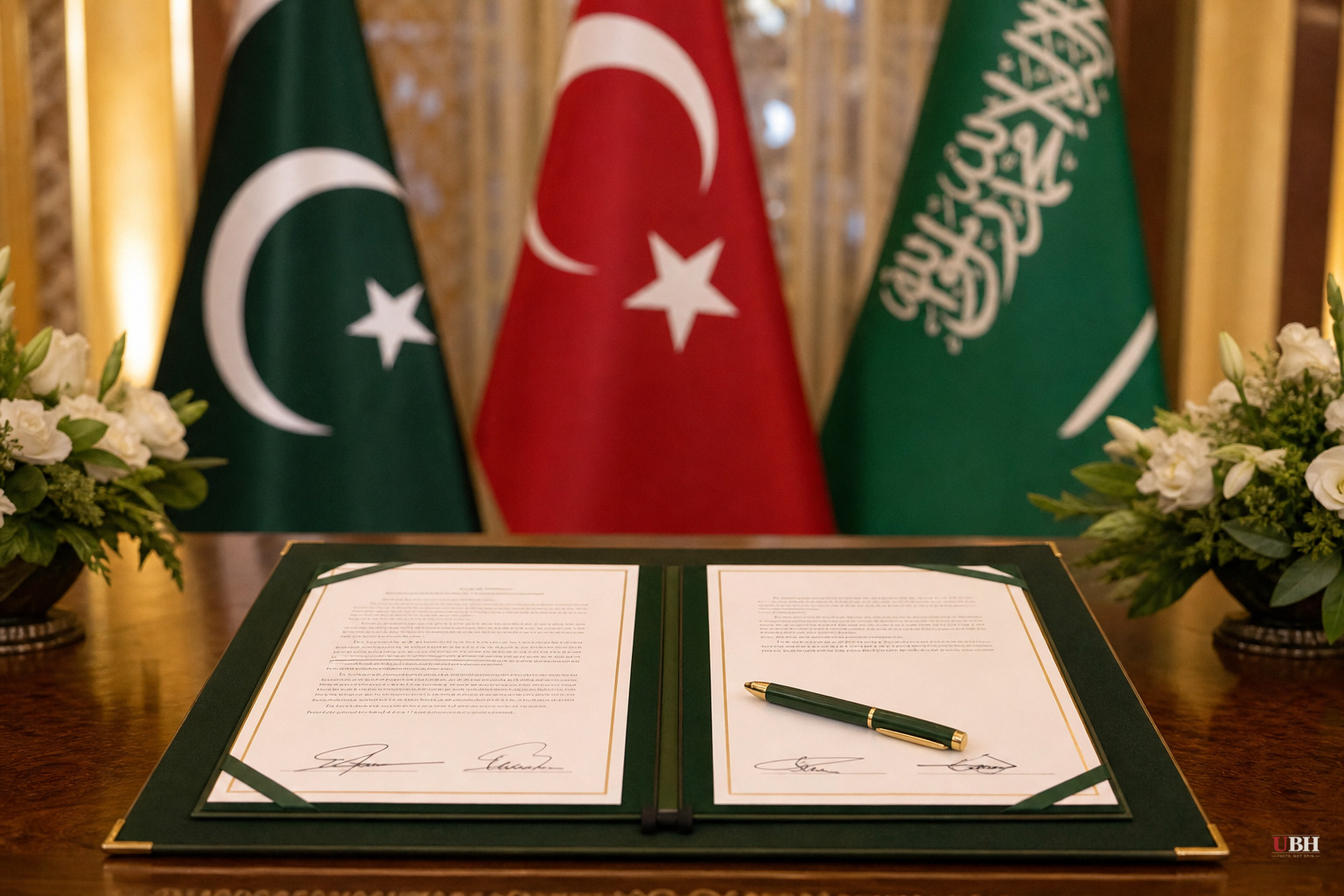
Saudi Arabia, Turkey and Pakistan signed a trilateral defense pact in Mecca on Friday, August 7, binding the three countries to a mutual-defense clause modeled on NATO's Article 5.
Saudi Crown Prince Mohammed bin Salman, Turkish President Recep Tayyip Erdogan and Pakistani Prime Minister Shehbaz Sharif signed what's being called the Mecca Joint Defence Agreement, according to a joint statement carried by Saudi state media and Pakistan's Foreign Ministry. The text says an armed attack against any one of the three states will be treated as an attack against all of them.
A senior Saudi official told Reuters just hours before the signing that the kingdom was bracing for attacks from Iran's proxies in Yemen and Iraq, based on intelligence gathered domestically and shared by regional allies and the US, according to Breaking Defense. Saudi Arabia has been hit repeatedly since the US and Israel struck Iran, according to Al Jazeera, which dates the conflict to February 28.
This isn't a deal built from scratch. Saudi Arabia and Pakistan signed their own bilateral defense accord last September, effectively putting the kingdom under Pakistan's nuclear umbrella, according to Breaking Defense. Pakistan is the only nuclear-armed state in the Muslim world, according to Middle East Eye. Turkey brings NATO's second-largest army to the table. Saudi Arabia brings oil wealth, custodianship of Mecca and Medina, and the only Arab G20 seat.
Pakistani Prime Minister Sharif and army chief Asim Munir arrived in Saudi Arabia a day before the signing and performed Umrah in Mecca, according to Al Jazeera. Erdogan traveled separately to meet bin Salman on Friday.
A Turkish official told Reuters the agreement is purely defensive, isn't aimed at any specific country, and doesn't replace any existing bilateral commitments the three states hold elsewhere—including, presumably, Turkey's NATO membership. An Ankara-based source told Middle East Eye the pact "will not alter or undermine any other alliance commitments the three countries may have."
Why now, and why it matters strategically
Umar Karim, a Saudi foreign policy expert at the University of Birmingham, called the alignment "a highly significant development" oriented against Iran's push for regional dominance, according to Al-Monitor. He noted that Turkey and Pakistan both border Iran, giving the bloc leverage Saudi Arabia doesn't have on its own.
Andreas Krieg of King's College London framed it as hedging rather than replacement. "Saudi Arabia, Turkey and Pakistan are not trying to replace the United States," Krieg told Al-Monitor. "They are building the capacity to protect their interests when Washington cannot or will not do so." He said Riyadh "wants several layers of security rather than one American umbrella" after the shock of the Iran war.
The US has been Saudi Arabia's security guarantor for decades. If Riyadh feels it needs a backup plan involving Pakistani nukes and Turkish drones, that's a data point on how much Gulf allies currently trust Washington's commitment, not just Iranian aggression.
The regional friction nobody's papering over
This alliance isn't a natural fit. Turkey and Saudi Arabia have clashed for over a decade. Erdogan backed Arab Spring protest movements that Riyadh viewed as a direct threat to monarchical rule, according to Middle East Eye. A decade ago, Saudi Arabia and the UAE backed opposing sides against Turkey in Libya's civil war. Riyadh also backed Egyptian President Abdel Fattah el-Sisi, a general Erdogan once denounced publicly.
Those wounds have healed enough for business. Saudi Arabia and Turkey began repairing ties around 2021, and in 2023 Riyadh signed what Ankara called its largest-ever defense export contract for Turkish drones, according to Middle East Eye. Erdogan and Sisi have also drawn closer, driven by shared alarm over Israel's war in Gaza—which Middle East Eye's report notes has been characterized by the United Nations as genocide, a characterization Israel disputes.
Al Jazeera's Doha-based correspondent Osama Bin Javaid described the pact as putting "three of the largest Muslim populations together," calling it the start of a broader shift in regional alignment.
Whether this alliance gets tested soon remains unresolved. Iran-backed Houthi forces in Yemen and Shia militias in Iraq have already struck Saudi targets, and Riyadh's own intelligence points to more attacks coming. If Saudi Arabia invokes the mutual-defense clause, the world finds out fast whether Pakistan and Turkey are prepared to back words with troops, aircraft, or nuclear deterrence against Iran-linked forces. Nobody signed up for that test lightly, and nobody knows yet how it plays out.
Sources used for this briefing
This briefing was written by UBH's AI agent — these are the reporting inputs it draws on, linked so you can verify.


