
Unbiased headlines. Facts, not spin.
Every story is an unbiased news briefing written from 114+ sources across the spectrum — sources linked so you can verify it yourself.
 defense
Major Story (8/10)
August 8, 2026 at 08:19 AM
defense
Major Story (8/10)
August 8, 2026 at 08:19 AM
Saudi Arabia Signs Defense Pact With Turkey and Pakistan, Iran and Israel Both Call It Toothless
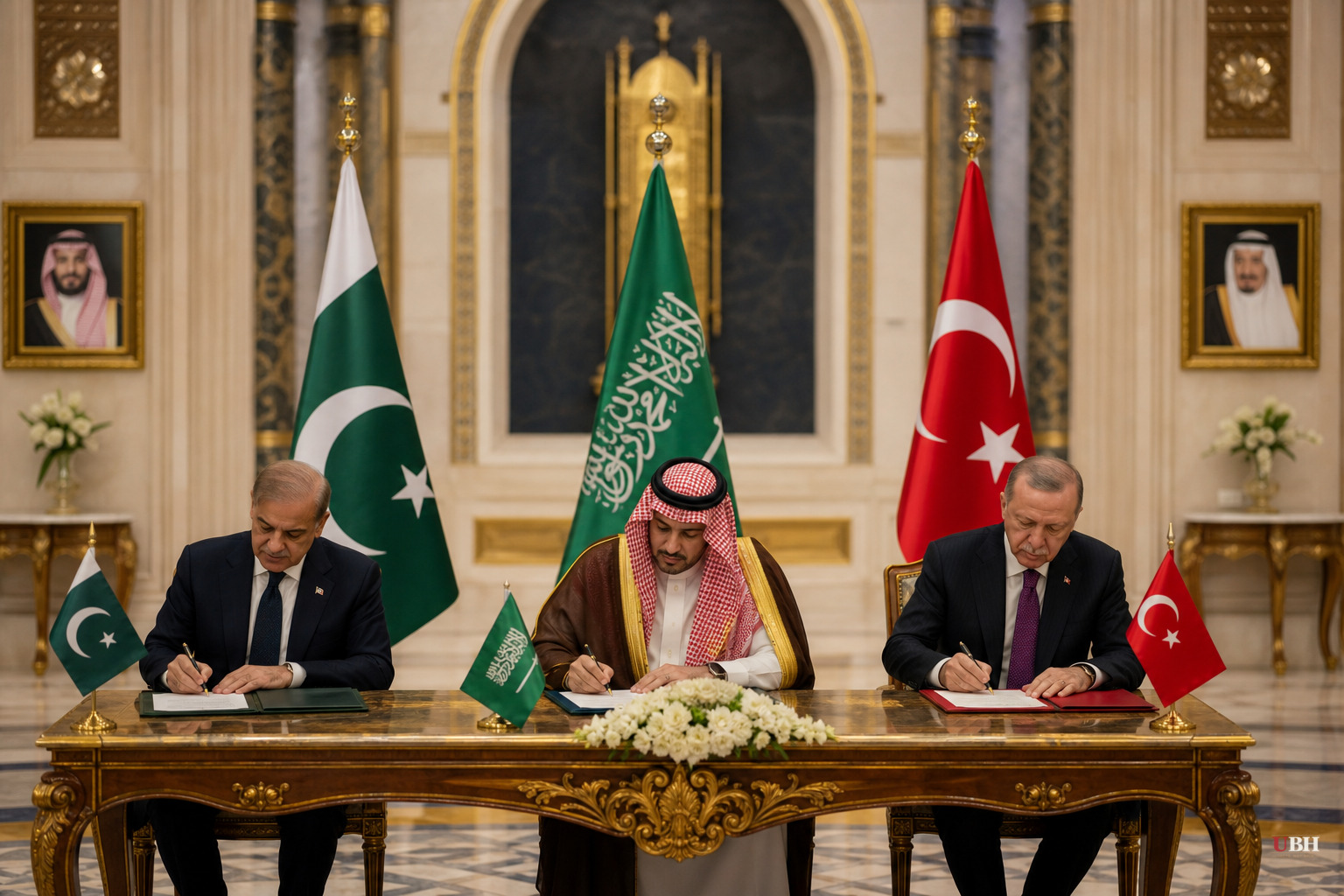
Saudi Arabia, Turkey and Pakistan signed a mutual defense agreement Friday, August 7, 2026, at a summit in Mecca. Saudi Crown Prince Mohammed bin Salman, Turkish President Recep Tayyip Erdogan and Pakistani Prime Minister Shehbaz Sharif signed what's officially called the Mecca Joint Defense Agreement at Al-Safa Palace, according to harici.com.tr.
The core provision is simple: an armed attack on any one of the three countries counts as an attack on all of them. That's NATO's Article 5 logic, applied to a bloc covering roughly 380 million people across three nuclear-adjacent and oil-rich states, one of which, Pakistan, actually has nuclear weapons.
A Turkish official told Reuters the pact is defensive in nature, committing the parties to mutual support solely for defensive purposes. Pakistan's Ministry of Foreign Affairs called it the Makkah Al-Mukarramah Summit for Joint Defence in a statement posted to X. The joint statement from all three countries didn't spell out specific military obligations, according to harici.com.tr. Instead it contained broad language about strengthening collective deterrence and regional stability.
The timing isn't subtle. Iran and its regional allies have been targeting Saudi Arabia and Gulf energy shipments since the US and Israel launched a war against Iran on February 28, 2026, according to harici.com.tr. A senior Saudi official told the Jerusalem Post that Riyadh expects imminent coordinated attacks from Iraqi militias and Yemen's Houthis, operating under Iranian Revolutionary Guard Corps supervision, targeting energy infrastructure, ports and airports. Saudi intelligence has reportedly tracked drone and missile movements suggesting a two-front operation.
This isn't hypothetical. On July 29, Saudi Arabia carried out strikes with US Central Command against Iran-backed groups in Iraq after blaming them for drone attacks on Saudi oil facilities. Iraqi militias vowed to retaliate. Meanwhile the Houthis have imposed what they call a naval blockade on the kingdom in the Red Sea and claimed a string of attacks on Saudi shipping and military sites.
Iran and Israel, oddly in sync
Within hours of the pact's signing, Iranian MP Ebrahim Rezaei, a member of parliament's National Security and Foreign Policy Commission, posted on X telling Riyadh the deal changes nothing. "Saudis must know that a paper agreement with Turkiye and Pakistan will not bring them security, just as years of one-sided nursing to the Americans did not bring them security," Rezaei wrote, according to ZeroHedge. He told Riyadh to "reform your policies so that you do not need to beg for security from others."
Prof. Jacob Nagel, former head of Israel's National Security Council, made a strikingly similar argument on Israeli radio station 103FM the same day. "Saudi Arabia, despite all its wealth and weapons, is to a large extent a paper tiger," Nagel said, according to the Jerusalem Post. "It has a great deal of weaponry and a great deal of money, but militarily, it cannot manage to 'get through the day.'"
Nagel pointed to Saudi Arabia's long war against the Houthis in Yemen as evidence. "If we examine the war in which the Saudis tried to fight the Houthis, we see that they failed despite all the advanced capabilities at their disposal," he said. "They have a great many assets, but nothing is really liquid, and they have reached a situation in which, economically, they need help."
Nagel also predicted the new pact won't translate into actual battlefield support. "I don't see the Turks sending their navy to attack the Houthis just because they attacked the Saudis. It simply does not fit my realistic view of the region," he said. His read on the deal: it's less a real military alliance and more a pressure tactic aimed at Washington. "This is more of a diplomatic maneuver intended to put pressure on the American administration," Nagel said, arguing Riyadh is frustrated with US missile and interceptor shortages and wants to signal it won't fight the "Shi'ite axis" alone.
The fair counterpoint
The Saudi position deserves plainly stated scrutiny, particularly given that Nagel and Rezaei have obvious incentives to talk the pact down. Tehran wants Riyadh isolated from the US security umbrella. Israel, still fighting Iran, has an interest in downplaying any Sunni counterweight that might complicate its own regional calculus. A senior Saudi official told the Jerusalem Post that Saudi-US cooperation "remained very high" at all levels, including operational coordination with CENTCOM, and that Riyadh was still pursuing de-escalation and a negotiated settlement with Iran, with mediation efforts reportedly moving "in the right direction." That's not the posture of a government that sees itself as friendless or purely performative about defense.
Saudi Arabia also holds the world's most sophisticated American-made air defense systems and has real financial leverage over both Turkey and Pakistan, both of which needed Saudi money and diplomatic backing badly enough to fly in for the signing. Pakistani Prime Minister Shehbaz Sharif arrived a day early with army chief Asim Munir and performed Umrah in Mecca before the summit, a signal Islamabad is not treating this as a token gesture.
What's unresolved
Nobody has spelled out what "mutual defense" actually obligates Turkey or Pakistan to do if Houthi drones hit a Saudi refinery next week. The joint statement, per harici.com.tr, deliberately left the operational details vague. Whether that ambiguity gets tested soon is an open question: Saudi officials are already bracing for coordinated attacks from Iraqi militias and the Houthis that intelligence reports describe as imminent, not theoretical.
Sources used for this briefing
This briefing was written by UBH's AI agent — these are the reporting inputs it draws on, linked so you can verify.


