
Unbiased headlines. Facts, not spin.
Unbiased Headlines is an independently owned news organization. We bring you the facts, not opinions, written fresh from 110+ named sources. Sources linked so you can verify it yourself.
 finance
Major Story (8/10)
Samsung Posts 107.4 Trillion Won Quarterly Profit and a 30 Trillion Won Dividend. Shares Fall More Than 5% in Seoul
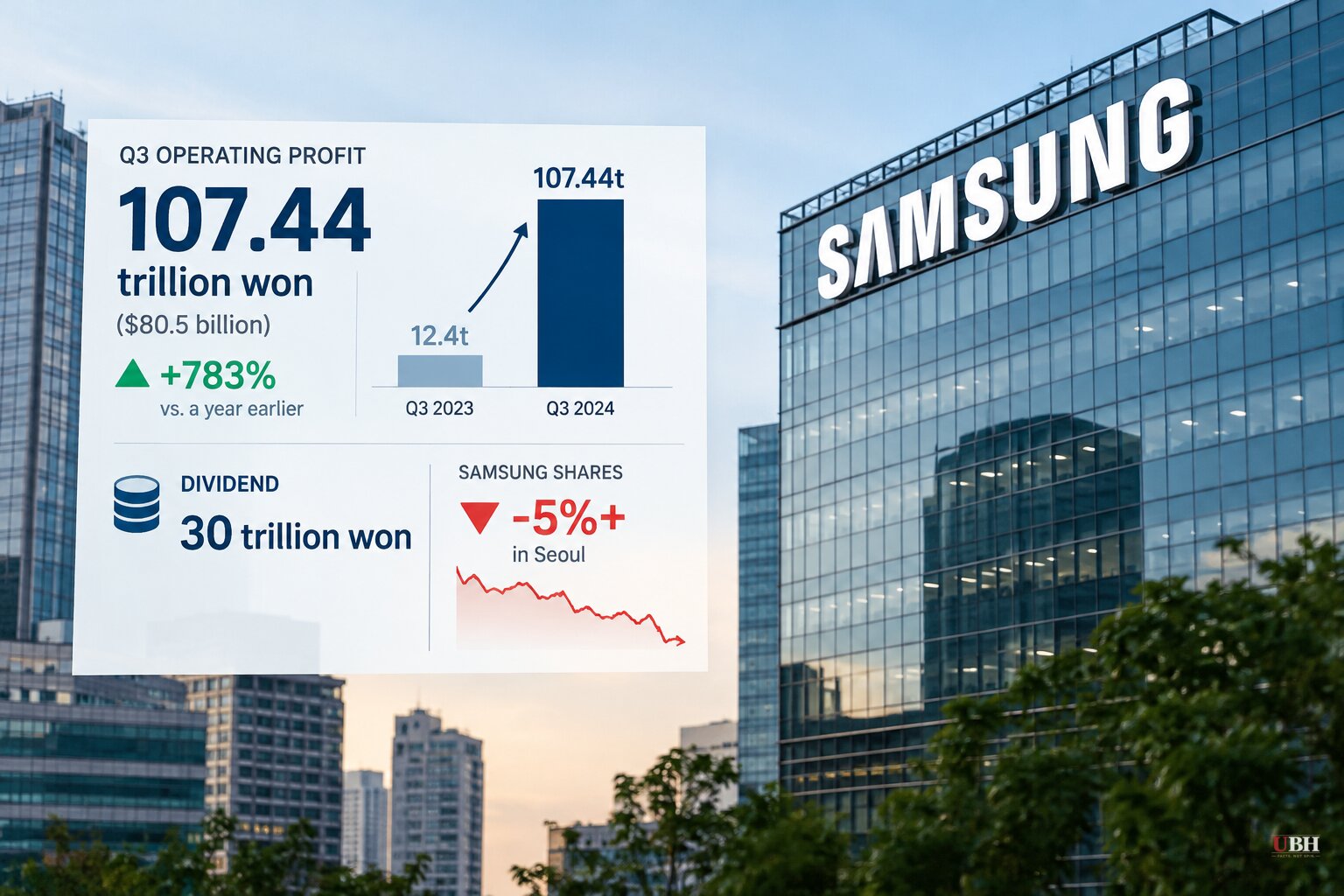
Samsung Electronics has now posted four straight quarters of record revenue and profit, and its full third-quarter report on Thursday, Oct. 29 pushed the numbers into territory no tech company has reached before.
Revenue for July through September came in at 195.25 trillion won. Operating profit was 107.44 trillion won, a 55% margin. Net profit was 75.1 trillion won. Samsung said it is the first technology company anywhere to book more than 100 trillion won in operating profit in a single quarter.
The stock did not cooperate. Samsung shares fell more than 5% in Seoul trading Thursday morning.
A razor-thin miss
Against LSEG SmartEstimates, revenue of 195.25 trillion won landed just under the 195.79 trillion won forecast. Operating profit of 107.44 trillion won was just under the 107.66 trillion won estimate. Both gaps are tiny.
Bloomberg News reported that the semiconductor division fell short of market expectations for operating profit and that capital spending rose. Those were cited as reasons for investor disappointment.
Year over year, revenue rose 126.88% and operating profit rose 783.11%. Quarter over quarter, revenue was up 13.85%.
Memory is the whole story
The Device Solutions division, which includes chips, earned 106.5 trillion won of the company's 107.4 trillion won operating profit on 147.1 trillion won in sales. The consumer side, Device eXperience, which covers phones, TVs and appliances, lost 0.8 trillion won.
Samsung said its memory business set quarterly records for revenue and operating profit. It credited a focus on AI products, higher market prices across applications, a big ramp in HBM4 sales and rising demand for server SSDs.
On the earnings call, management said DRAM average selling prices rose about 20% from the prior quarter and NAND prices rose in the high teens. Shipments grew only low-to-mid single digits for DRAM and mid single digits for NAND. Most of the profit jump was price, not volume.
HBM4 sales more than tripled from the previous quarter and now make up roughly 60% of Samsung's HBM sales. Management said 2027 HBM supply is already sold out at an agreed target price. It also said it has signed multiyear supply contracts with 10 major customers and is negotiating with 10 others, with several near final stages.
For the fourth quarter, Samsung guided DRAM bit growth in the mid-to-high teens percent and NAND in the mid-teens. It expects AI infrastructure spending in 2027 to reach a historic level and AI-driven demand to far exceed industry supply.
The dividend and the open question
The board approved a third-quarter dividend of 30 trillion won ($22.5 billion), or 4,601 won per common and preferred share, payable Nov. 27. That is more than 12 times the roughly 370 won per share paid in each of the first two quarters.
Samsung's 2026 shareholder-return target is 90 trillion to 110 trillion won. Between 55 trillion and 75 trillion won of that has not yet been distributed or committed. The company said it will pay it out through dividends and substantial buybacks and cancellations. The board is scheduled to finalize the total and the execution plan in late January 2027.
Samsung also acknowledged the gap between its common and preferred share prices. "We are aware of market interest in the price gap between its common and preferred shares, and will actively consider adjusting the proportion of preferred shares in its buyback and cancellation programs based on market conditions," the company said.
Analyst and company views
Josh Gilbert, APAC lead analyst at eToro, said the reaction reflects how high expectations have climbed. "Investors have been so spoilt by the AI trade that a record result is now treated as the bare minimum rather than a reason to celebrate," he said.
Gilbert also pointed to concentration risk. "For all the talk of Samsung being a diversified giant, anyone holding the stock today is really holding a memory maker with a phone business attached," he said. He added that the company's fortunes now depend heavily on memory prices.
Samsung's own framing is the opposite. It says demand will stay robust and supply tight, and CFO Sooncheol Park told analysts the results show "the strength of our technologies and our ability to sustain growth."
Shares in Samsung and other tech giants have also fallen from their June record highs amid concerns over U.S. tech firms' AI spending, according to AFP.
The first concrete step on the payout comes Nov. 27, when the 30 trillion won dividend is paid. The larger unknown is how much of the remaining 55 trillion to 75 trillion won goes to buybacks, and how many of those buybacks target preferred shares. That decision is not due until the board meets in late January 2027.
Sources used for this briefing
8 links from 7 independent newsrooms (syndicated copies of the same report count once)
These are the sources it draws on, linked so you can verify.


