
Unbiased headlines. Facts, not spin.
Unbiased Headlines is an independently owned news organization. We bring you the facts, not opinions, written fresh from 110+ named sources. Sources linked so you can verify it yourself.
 defense
Breaking / Critical (9/10)
Russian Delegation Source Says Abu Dhabi Talks Center on European Security as G7 Ministers Demand a Seat
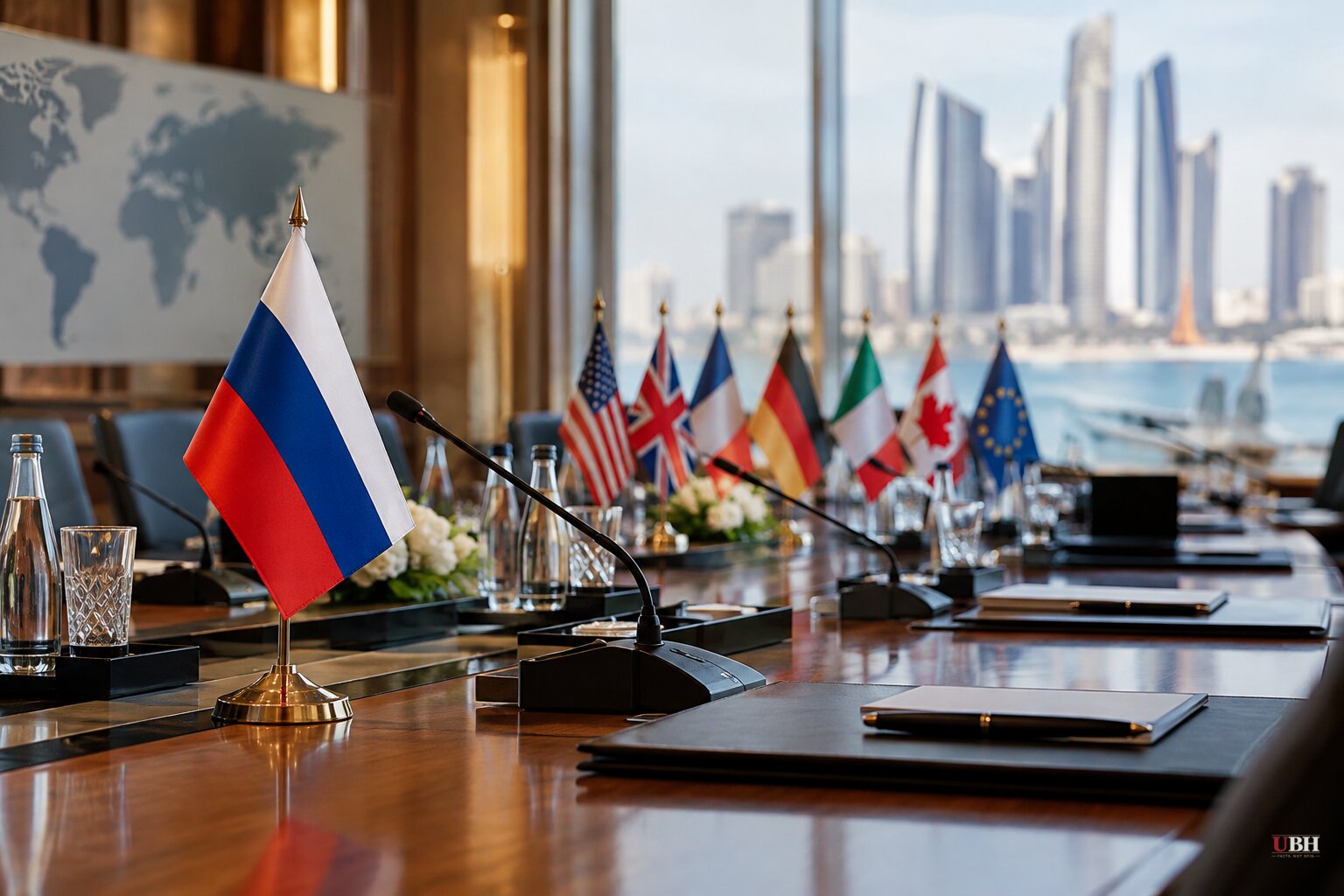
Since the U.S., Russia and Ukraine agreed to sit down in Abu Dhabi, the agenda has grown well beyond Ukraine. Two days of talks are scheduled to open later today, Nov. 10, and run through Wednesday.
A source in Russia's 11-person delegation said Moscow sees the main thrust of the talks as hammering out "key elements" of a new postwar security framework for Europe. "Whilst the Ukrainian settlement, being a matter of critical importance, is just one aspect of this wide-ranging discussion, it is subordinate to the main objective — the creation of a comprehensive and indivisible security architecture for the entire continent," the source said.
The makeup of the delegation fits that description. It is led by Kremlin aide Vladimir Medinsky and includes Deputy Foreign Ministers Sergei Ryabkov and Mikhail Galuzin, military intelligence chief Igor Kostyukov and Yuri Zhigarlovsky of the General Staff. Ryabkov helped draft Russia's sweeping security demands to NATO shortly before the 2022 invasion.
Washington's four priorities
U.S. envoy Jared Kushner laid out the American position in a post on X. He said the administration is working on four things: ending the fighting, credible postwar security guarantees, an economic and prosperity plan for Ukraine, and humanitarian measures including the return of prisoners and civilians.
Kushner also described a European security framework built on "stronger consultation, reliable crisis communications, greater military transparency, and reciprocal measures to reduce escalation risks." He said it would fully respect the sovereignty of every nation. He and Steve Witkoff plan to meet representatives of Ukraine, the EU, NATO, Germany, France, Britain and Italy before the sessions begin.
A U.S. administration official previewing the talks went further. The official said negotiators could revive the NATO-Russia Council, suspended since 2022, and potentially lift sanctions on Russia to reach a deal. The official also said Washington had discussed with Russia security guarantees for Ukraine "effectively very similar to Nato" and called a U.S. guarantee "a really, really big deal" that would be up to Trump and Volodymyr Zelenskyy.
Critics cited by The Guardian note that NATO's Article 5 does not oblige members to defend one another militarily. They also say cyberattacks and hybrid warfare blur what would trigger a response.
Europe wants in
Foreign ministers from the Group of Seven pressed Secretary of State Marco Rubio on the issue Monday in Paris. It was Rubio's first meeting with allies since the midterm elections in which Republicans took heavy losses.
German Foreign Minister Johann Wadephul said it is "certainly neither necessary, nor right, nor appropriate to make a fundamental change" to Europe's security architecture. "Europe belongs at this table," he said. "There can be no solution without Europe."
Wadephul said Abu Dhabi must show whether Russia is "genuinely prepared to negotiate." He urged Moscow to drop "maximalist demands" and warned against a "negotiation show." With Russian strikes on civilian infrastructure continuing, he said, Germany sees "no substantial contribution whatsoever" from Moscow toward real momentum.
Ukrainian Foreign Minister Andrii Sybiha is due to join a Ukraine session in Paris on Tuesday. "No one has the right to decide our fate behind our backs," he said before leaving for the meeting.
Representatives of France, Britain, Germany, the EU, NATO and Italy are expected in Abu Dhabi and plan to speak with U.S. and Ukrainian officials. Russia has not said it will hold direct talks with the Europeans this week.
Territory and the ground war
President Trump told reporters at the White House on Monday that Washington sees "a very strong inclination to end Russia and Ukraine," adding that the U.S. is involved "because I want to see people stop getting killed."
A U.S. official separately told Reuters that Moscow and Kyiv were privately showing some flexibility on a possible territorial exchange. A senior Ukrainian official rejected that, telling Reuters that any discussion of territory must happen between national leaders and come with appropriate security guarantees.
Russia's public demand has not changed. Putin wants Ukraine to withdraw from Donetsk, Luhansk, Zaporizhzhia and Kherson, the four regions Moscow claimed to annex in 2022 but never fully captured. He also rejects a general halt in fighting.
Zelenskyy said in his Monday night address that recent battlefield gains and Russian losses are "truly strengthening Ukraine's negotiating positions." Kyiv's delegation is led again by Rustem Umerov, head of the Foreign Intelligence Service. It includes Kyrylo Budanov, head of Zelenskyy's office, Davyd Arakhamia and Serhii Kyslytsia. All four took part in earlier rounds.
The talks are also the first since the U.S. joined Israel in strikes on Iran, and Iran is expected to feature in the G7 discussions in Paris on Tuesday. Rubio said Sunday that work on a postwar security framework had advanced but that "nothing's been finalized yet."
Whether Moscow's framing of the talks as a European security negotiation will produce any direct meeting with European officials remains to be seen. So far, Russia has not said it will hold one.
Sources used for this briefing
8 links from 8 independent newsrooms (syndicated copies of the same report count once)
These are the sources it draws on, linked so you can verify.


