
Unbiased headlines. Facts, not spin.
Unbiased Headlines is an independently owned news organization. We bring you the facts, not opinions, written fresh from 110+ named sources. Sources linked so you can verify it yourself.
 defense
Breaking / Critical (9/10)
Event date: November 19, 2026 ·
Russia Fires at Least 110 Missiles at Ukraine Hours After Shenzhen Summit as Trump Rates Meeting '12 Out of 10'
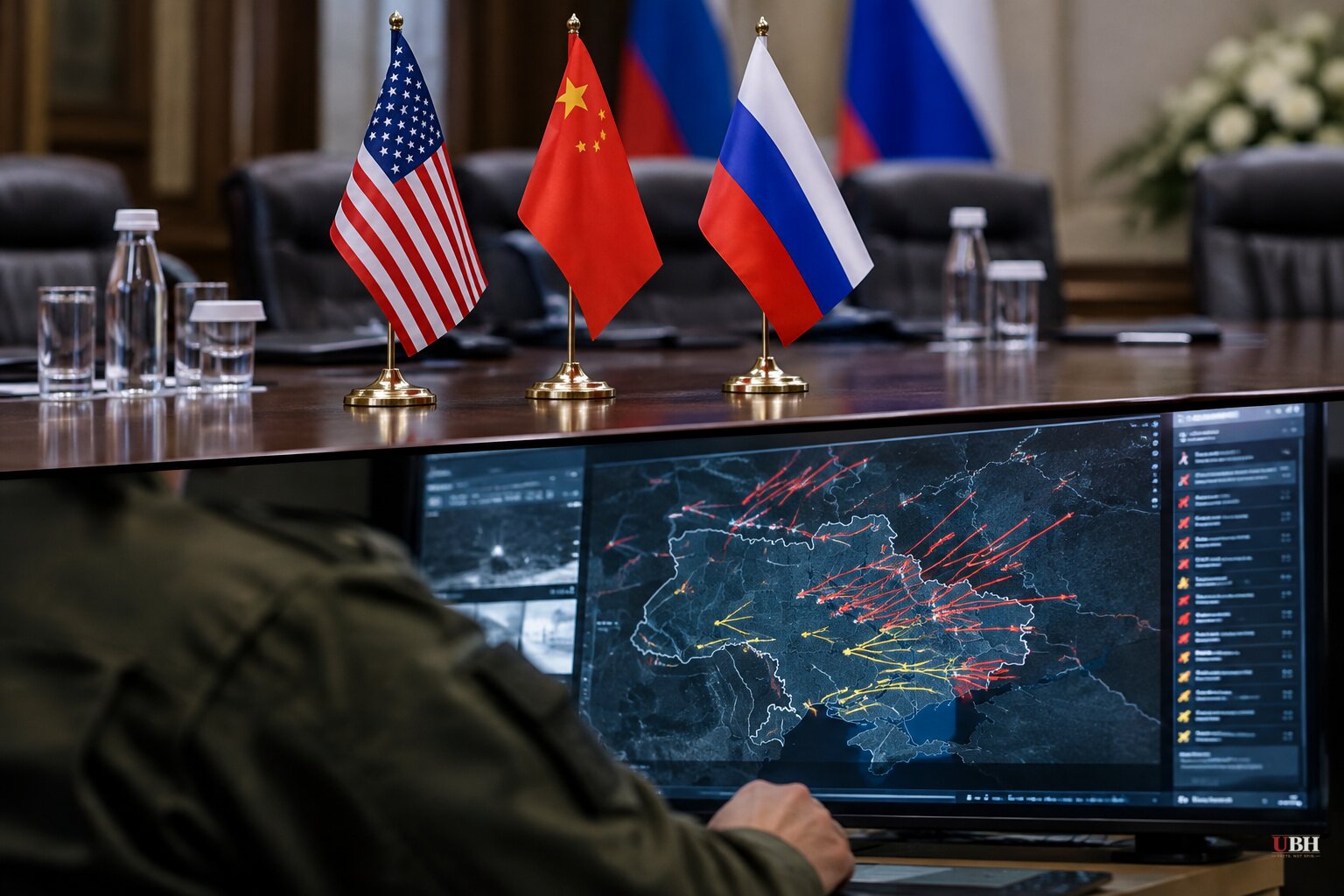
Since Trump, Xi Jinping and Vladimir Putin met in Shenzhen this week, the war has not paused. Overnight into Friday, Nov. 20, Russia hit Ukraine with what President Volodymyr Zelensky called "the biggest [attack] this year."
Kyiv said Russia fired at least 110 missiles. About 400 drones joined them, including 120 jet-powered models that are essentially compact cruise missiles. Ukrainian authorities said the assault lasted more than ten hours, killed nine people and injured at least 28.
"It was very difficult, we had losses, dead civilians, wounded people, absolutely terrible night," Zelensky told CNN.
Poland's airspace violated
The attack spilled into NATO territory. The Polish government said its airspace was violated, with "objects" flying in and falling inside the country. Polish and NATO fighter jets were scrambled and Patriot batteries were activated.
NATO Secretary General Mark Rutte called the incident "clearly dangerous – a consequence of Russia's ongoing war against Ukraine." European Commission President Ursula von der Leyen pledged "full solidarity" with Poland and said the EU would "strengthen our defense readiness."
Poland's Defense Minister Władysław Kosiniak-Kamysz said the timing was "no accident." Poland was holding military exercises, and defense ministers from several European countries were in the country.
Trump: 'tired' Putin wants a deal
Trump gave the summit "12 out of 10," touted talks on artificial intelligence, and said Putin wants a deal on Ukraine. He returned to Joint Base Andrews on Thursday evening and told reporters he would hold a "historic" press conference Friday.
After the summit, Trump spoke with European leaders and Zelensky. Four people familiar with that conversation told The Washington Post that Trump said Putin was eager for peace and urged the Europeans to make a deal with the Kremlin so they could redirect the money they spend on Ukraine. CNN reported Trump described Putin as "tired."
The summit itself produced no breakthrough on Ukraine. Putin used the stage to repeat his maximalist demands and called the atmosphere "relaxed and very intimate." Trump called Putin a "friend" during the meeting, which drew sharp reactions in Europe.
Asked by CNN whether that word gave Putin license to keep attacking, Zelensky said that if the U.S. president talks about Putin "like he is a friend," Putin "doesn't feel that he is a killer, he doesn't feel enough pressure."
The administration's stated position is different. U.S. special envoy Jared Kushner said in early November that Washington is "working intensively with all parties" on practical arrangements, including security guarantees for Ukraine and a broader security architecture for Europe. "President Trump has made achieving peace a priority," he wrote.
A January deadline
The Financial Times, citing four people familiar with the matter, reported that the Trump administration has told European and Ukrainian officials it wants a peace agreement by the beginning of January 2027. Kushner and special envoy Steve Witkoff reportedly pressed that urgency in meetings in Moscow, Dublin and Berlin.
"The Americans are pushing hard and there's some concern that it would need a great deal of Ukrainian concessions to get anywhere near a deal," one European official told the paper. Another said the Americans are in a hurry while Putin is not.
A Ukrainian official told the FT the timeline has raised fears in Kyiv that Zelensky could be pressured into Moscow's terms before Democrats take control of Congress. The same official said speed restrictions on Starshield and delays in interceptor deliveries are "a deliberate choice" by the Trump administration to help Russia win favorable terms. That is one anonymous official's claim. The administration has not been quoted in the report responding to it.
Two people familiar with the Kremlin's position told the FT that Russia wants a planned campaign of airstrikes to raise its leverage. That makes a quick deal unlikely, they said. Friday's barrage fits that description, though no one has tied it publicly to that plan.
Critics inside the conservative camp
The pressure is not only coming from Kyiv and Brussels. Rebeccah Heinrichs, a senior fellow at the Hudson Institute, wrote in National Review that the U.S. approach rests on two Russian narratives: that Moscow's demands are reasonable, and that its victory is a matter of when, not if.
She cited Witkoff calling Putin a "humanitarian," Trump lifting sanctions on Russian diesel, and the waiver of enforcement of much of the Lindsey O. Graham Sanctioning Russia and Iran Act of 2026. She also pointed to Trump's public pressure on Zelensky to take a deal. Heinrichs argues the State Department, not the special envoys, should lead the mediation.
Security at the summit
The White House also took counterintelligence precautions on the trip. Journalists aboard Air Force One were told to seal phones used in China in signal-blocking bags, and an aide collected staffers' burner phones to be discarded or wiped, CBS correspondent Jennifer Jacobs said.
"We want to be careful, and we didn't want to have people have phones when they shouldn't have phones," Trump told NBC's Gabe Gutierrez.
What comes next
Trump is due to host the G20 summit in Miami next month. Two sources told the FT that U.S. officials have floated talks there with European leaders on ending the war. A French official told the paper there will be no such talks at the G20, because Ukraine has not yet been invited.
That leaves a short calendar: a U.S. target of early January, a Kremlin that has ruled out ceasefire talks, and a G20 where the party whose territory is at stake has no invitation. Whether Trump's Friday press conference changes any of that is the next test.
Sources used for this briefing
6 links from 6 independent newsrooms (syndicated copies of the same report count once)
These are the sources it draws on, linked so you can verify.
More coverage: Donald Trump and Ukraine


