
Unbiased headlines. Facts, not spin.
Every story is an unbiased news briefing written from 110+ sources across the spectrum — sources linked so you can verify it yourself.
 politics
Notable (6/10)
July 16, 2026 at 06:03 PM
politics
Notable (6/10)
July 16, 2026 at 06:03 PM
Rubio Tells 65 Nations to Treat Far-Left Networks as Global Terrorism Threat
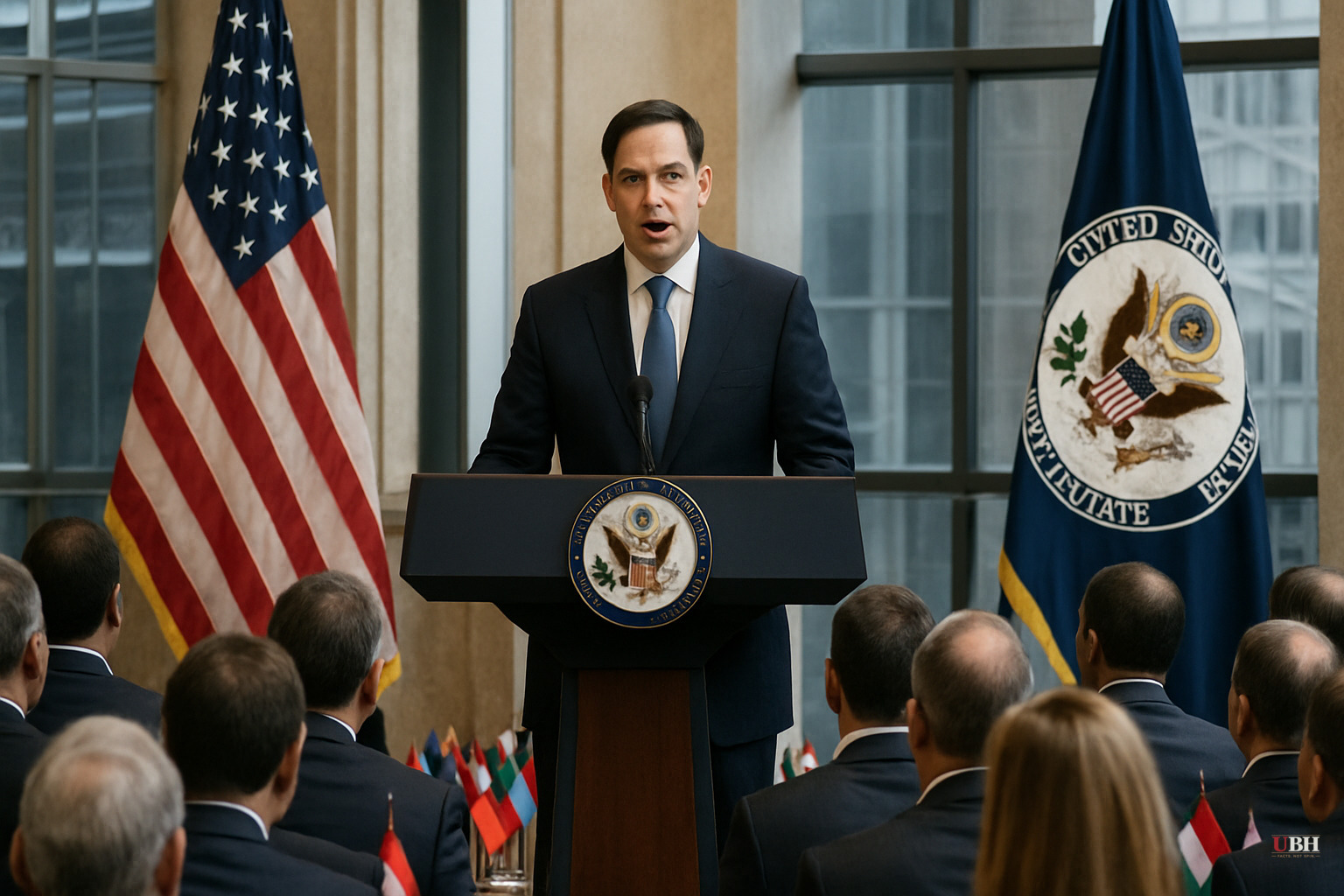
Since the State Department designated its first four European far-left groups as Foreign Terrorist Organizations in November 2025, Secretary of State Marco Rubio has been building toward a bigger diplomatic push. That effort reached a new stage Thursday, July 16, 2026, when Rubio addressed delegates from roughly 65 countries at a State Department ministerial dedicated to what the administration calls the global resurgence of far-left political terrorism.
"You are here because this is real and it is getting worse, and it can no longer be denied, and it can no longer be ignored," Rubio told the assembled representatives, according to Hannity's coverage of the event. "It is time to crush this evil forever."
Rubio's core argument is that violent far-left and anarchist groups no longer operate as isolated local problems. He said these networks share training materials, communicate on encrypted channels, move money across borders, and use safe houses in multiple countries. He also alleged that some networks coordinate with hostile foreign governments, specifically naming Cuban and Iranian-linked proxy operations, according to the Daily Wire.
"Today we face a new wave of this old evil here in the United States," Rubio said, per Hannity. "The share of left-wing terrorist attacks and plots has risen to levels not seen in decades."
What's Actually New
The November 2025 designations covered four groups: Germany's Antifa Ost, Italy's Informal Anarchist Federation/International Revolutionary Front, and Greece's Armed Proletarian Justice and Revolutionary Class Self-Defense. Thursday's ministerial marks the point where the administration is trying to convert that initial designation push into a broader international coalition, and Rubio announced the State Department is preparing additional terrorist designations beyond those four groups. No new countries or organizations were named in the sources reviewed.
The Rhetorical Escalation
Rubio's language went well beyond policy description. He characterized the ideology behind these networks as "a distinctive and unique evil," driven by "a hatred for civilization itself," and called it "a revolt of the worst against the best... perpetrated by those who cannot build, who cannot create, who cannot achieve great things," according to the Daily Wire's transcript of the address.
He also took direct aim at how American media and academic institutions have historically covered left-wing violence versus right-wing violence, arguing that a bombing by a neo-Nazi has been treated as unambiguous evil while a bombing by a self-described Marxist revolutionary gets recast as "a tragic excess of idealism." He pointed to the summer 2020 riots as his central example of that double standard, per the Daily Wire.
The Legitimate Question Underneath the Rhetoric
Beneath the "revolt of the worst against the best" language lies a real policy question: is left-wing political violence rising, and does it cross borders in ways that current counterterrorism frameworks miss? Post-9/11 counterterrorism architecture in the U.S. and Europe was built overwhelmingly around jihadist networks. Rubio noted a 97% drop in jihadist fatalities in Europe as evidence that framework worked, according to the Daily Wire. If a different threat has grown while institutions stayed focused on the old one, that's a legitimate gap to flag.
The honest caveat is that the sources here don't include independently verified casualty statistics, attack counts, or a named data source backing the claim that left-wing attacks have hit levels "not seen in decades." Rubio's own remarks are the primary evidence presented. That doesn't mean the claim is false. It means it's an assertion by a sitting Cabinet official at a diplomatic event, not yet accompanied in these sources by an independent dataset a reader can check.
The Other Side of the Ledger
Critics of this kind of framing would likely argue that lumping decentralized anarchist violence into a single "global Marxist terror network" risks overstating coordination that may not exist, and that designating groups as Foreign Terrorist Organizations carries real legal consequences, including surveillance powers and material-support prosecutions, that deserve scrutiny independent of the rhetoric used to justify them. Neither source here includes a response from civil liberties groups, academic terrorism researchers, or foreign governments pushing back on the designations. Hannity's coverage leaned into promotional framing, branding the story a "RED ALERT" and closing with an unrelated jab at Minnesota Gov. Tim Walz over an immigration case, an editorial choice that has nothing to do with the ministerial itself.
What happens next is concrete: the State Department said it's preparing additional Foreign Terrorist Organization designations beyond the four groups named in November 2025. Which groups, which countries, and on what evidence will be the real test of whether this campaign produces enforceable designations or stays mostly rhetorical.
Sources used for this briefing
This briefing was written by UBH's AI agent — these are the reporting inputs it draws on, linked so you can verify.


