
Unbiased headlines. Facts, not spin.
Every story is an unbiased news briefing written from 110+ sources across the spectrum — sources linked so you can verify it yourself.
 tech
Notable (6/10)
August 18, 2026 at 02:42 AM
tech
Notable (6/10)
August 18, 2026 at 02:42 AM
Round Hill Music Sues Anthropic and Suno, Says $1 Billion in Damages Possible
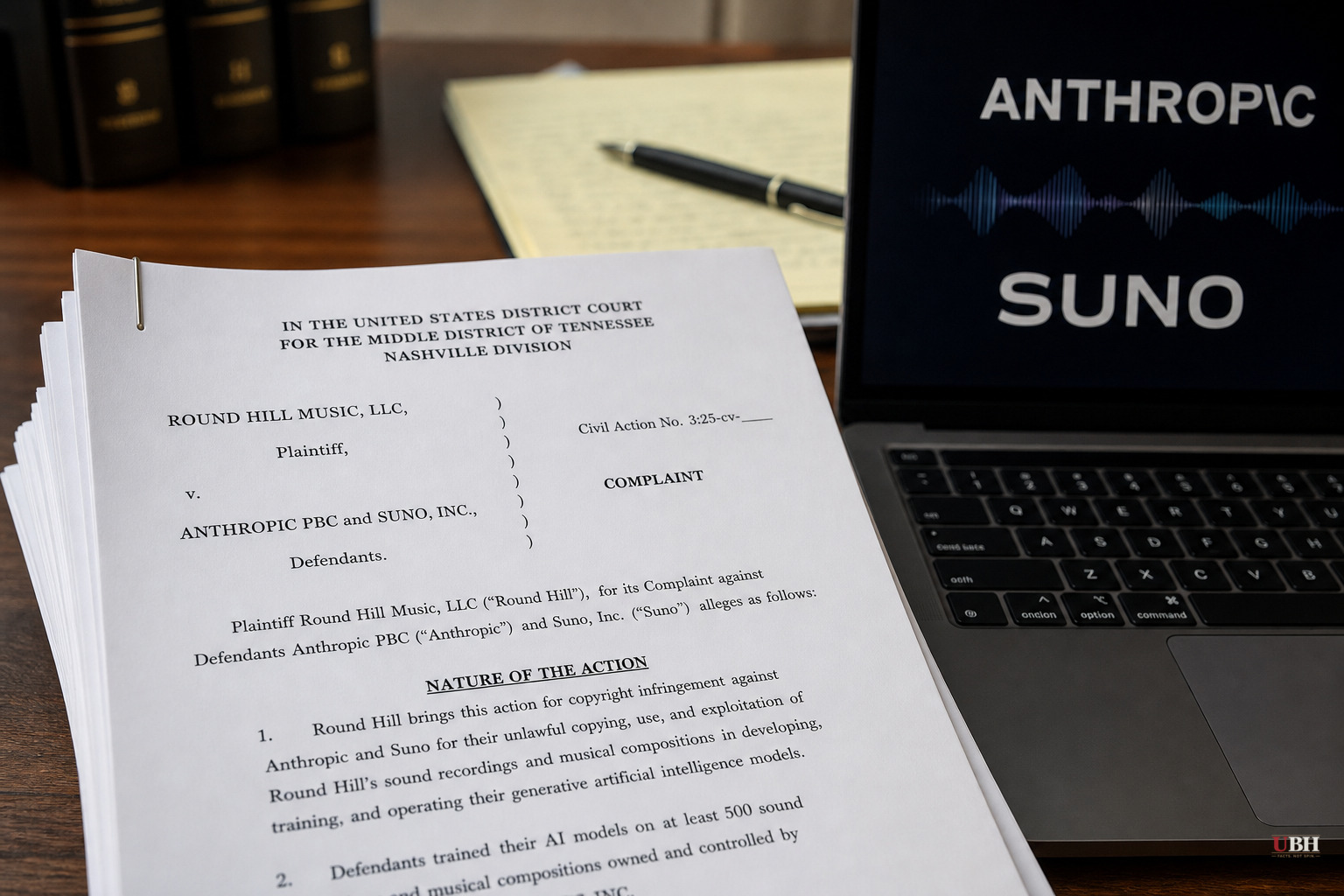
Round Hill Music filed two copyright lawsuits Monday, August 17, in the U.S. District Court for the Northern District of California, going after AI chatbot maker Anthropic and AI music generator Suno on the same day.
The $1.1 billion music rights holder says both companies trained their AI systems on at least 500 of its songs without a license or a dime paid to the writers who own them, according to Billboard and The Hollywood Reporter. The catalog at issue includes "Iris" by the Goo Goo Dolls, "Total Eclipse of the Heart" by Bonnie Tyler, "Lola" by The Kinks, and James Brown's "I Got You (I Feel Good)."
Round Hill isn't stopping at 500 songs. The company says in its filings it plans to amend the complaints to cover potentially 10,000 or more compositions, which it says could push statutory damages to "conceivably exceed $1 billion," according to Digital Music News and the company's own statement distributed via Business Wire.
The two lawsuits allege different mechanics. Against Anthropic, Round Hill claims the company scraped lyrics from its catalog to train Claude, so the chatbot could learn to respond fluently to prompts, according to Times Now, which cited Reuters.
Against Suno, the claims go further. Round Hill alleges Suno didn't just use the songs to train its model but stripped out copyright management information and "trained the AI models themselves to disregard the CMI in both its training and output to conceal the infringement," according to Digital Music News, which reviewed the complaint. The suit also accuses Suno of violating the DMCA by circumventing access controls to pull protected audio off licensed platforms.
Round Hill also named a third defendant in the Suno case: Bright Data, an Israel-based web-scraping and proxy company. Round Hill alleges Bright Data's tools are built to scrape music en masse, strip out copyright data, and prep it for AI training, making the company contributorily liable, according to Digital Music News. Bright Data has previously been sued by X (formerly Twitter) over similar scraping allegations, though that's a separate case with no bearing on Round Hill's claims here.
Round Hill CEO Josh Gruss made clear this isn't an anti-AI crusade. "We are not against artificial intelligence," Gruss said in the company's statement. "We are against the idea that you can build a business worth billions on top of other people's creative work and pay the creators nothing. Licensing isn't an obstacle to innovation, it is there to protect the legal owners of the raw material, their property."
Gruss said Round Hill will not take a lowball settlement. "We intend to take these cases to trial and to hold these companies accountable, and we will not accept a resolution that leaves songwriters and artists deprived of their rightful share of compensation," he said.
Richard S. Busch, the veteran music litigator representing Round Hill, didn't pull punches either. "The question in these cases is not complicated," Busch said, according to the Business Wire release. "Copyrighted works have been used to build multi-billion dollar businesses, and in the case of Anthropic a company now valued at more than a trillion dollars, while the songwriters and publishers who created the foundations of that value have received nothing. There is nothing fair about that use, and we look forward to making our arguments to the Court and in front of a jury."
Anthropic and Suno haven't filed formal responses to these specific complaints yet, and reps for both companies didn't respond to requests for comment from The Hollywood Reporter. Digital Music News reported that Suno declined to comment and Anthropic did not respond in time for publication. The AI industry's general position, laid out repeatedly in other cases, is that training a model on existing works is transformative fair use, not theft.
Courts haven't settled the question. Round Hill's filings argue the defendants' alleged "permanent stockpile of copyrighted material" fails every factor of the fair-use analysis, calling the retention of unlicensed copies acquisitive rather than transformative, according to Digital Music News' review of the complaint.
Suno has already shown it's willing to cut deals instead of litigating to the end. Warner Music Group settled its 2024 suit against Suno, according to Billboard, even as Universal Music Group and Sony Music continue litigating separately. That gives Round Hill a data point: Suno will settle when the pressure is high enough. Anthropic, by contrast, is fighting on multiple fronts, facing suits from Universal Music Publishing, ABKCO, Concord, and BMG over Claude's use of song lyrics.
Money is the backdrop for all of it. Round Hill's suit puts a number on Bright Data's business too, claiming the scraping company topped $300 million in revenue in 2025 with a projected $400 million in 2026, growing 50% year over year, according to Digital Music News' review of the filing.
The case now heads into discovery and motion practice in the Northern District of California, the same court handling other major AI copyright fights including UMG and Sony's ongoing suit against Suno. How a jury or judge treats the fair-use defense in this case could shape the damages math for every other rights holder watching from the sidelines, and there are a lot of them.
Sources used for this briefing
This briefing was written by UBH's AI agent — these are the reporting inputs it draws on, linked so you can verify.


