
Original briefings. Zero spin.
Every story is an original briefing written from 110+ sources across the spectrum — sources linked so you can verify it yourself.
 tech
Major Story (7/10)
Event date: August 25, 2026
tech
Major Story (7/10)
Event date: August 25, 2026
Report Finds Nearly 19,000 Manipulated Antibody Images Across 16 Lab Supply Companies
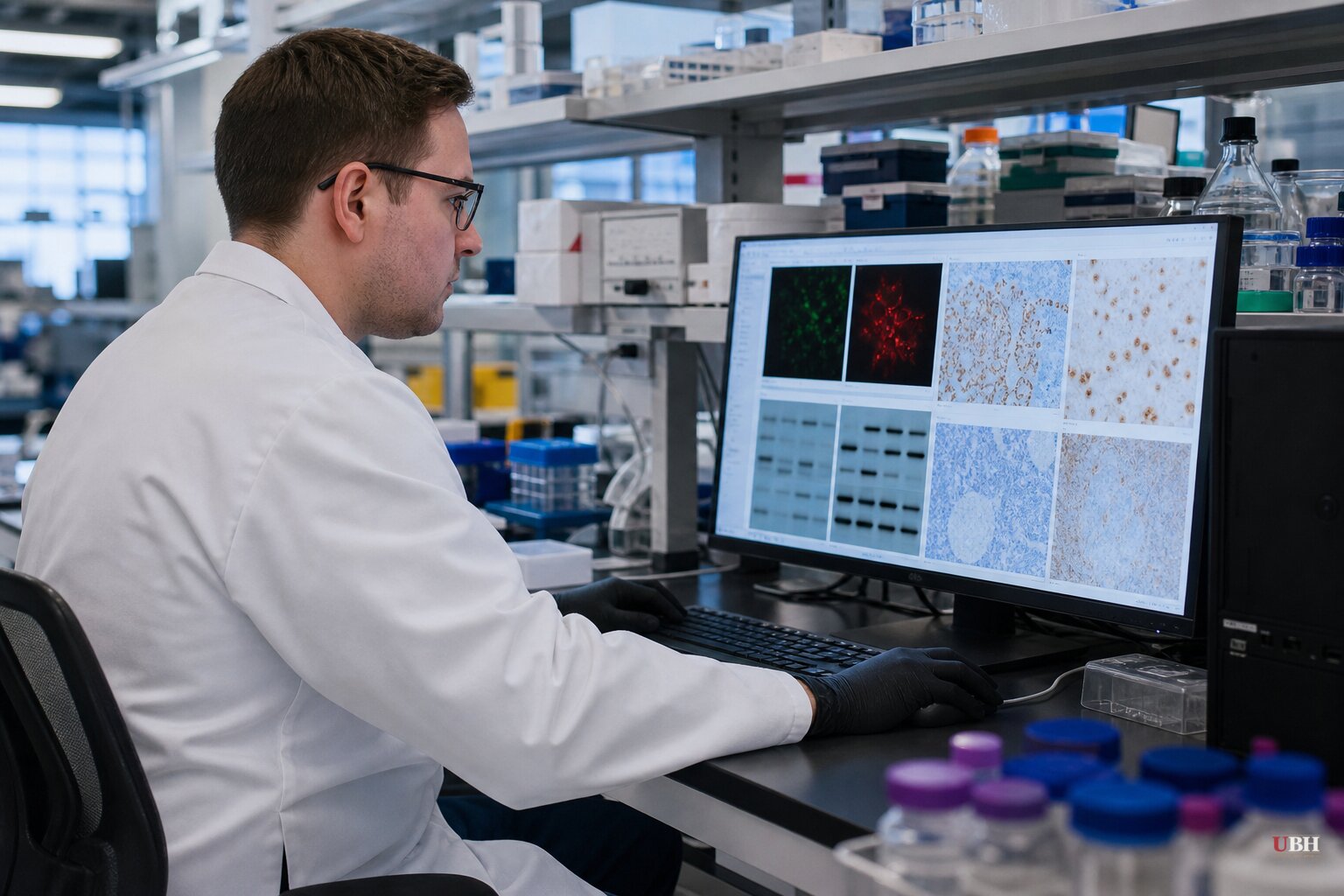
Scientists buy antibodies the way you'd buy a wrench from a hardware store catalog. You trust the picture on the page shows a real product that actually works. According to a report released Tuesday, August 25, by Reese Richardson, a metascientist at Northwestern University, that trust was misplaced on a massive scale.
Richardson's database, hosted on Zenodo, documents 18,943 problematic images spanning 17,495 antibody products sold by 16 companies. Nearly 7 percent of the images he examined showed signs of manipulation.
On May 17, 2026, science sleuth Sholto David flagged a single fabricated image in Thermo Fisher Scientific's antibody catalog, according to Richardson's own blog. Within two weeks that number hit 100. By June 3, it was over 450 images at Thermo Fisher alone, plus one at Abcam.
Richardson kept digging. The new report, published Tuesday and covered by GenomeWeb, Nature, and Chemistry World's C&EN, names companies well beyond Thermo Fisher: Abcam, R&D Systems, ProteoGenix, OriGene, MilliporeSigma, LSBio, Boster Biological Technology, G-Biosciences, GeneTex, Huabio, Antibodies.com, Abnova, Bioss, Novus Biologicals, and Santa Cruz Biotechnology.
How the fakery works
Antibodies work because the immune system generates them to recognize specific proteins. Companies sell antibodies to researchers who need to detect those same proteins in cell cultures, tissue samples, or gels. To prove their antibodies actually work, vendors publish validation images, usually Western blots or fluorescence microscopy shots, in their sales catalogs.
Richardson's method, according to C&EN, involved downloading these images and cranking up the contrast to expose background noise that should be unique to each individual experiment. What he found instead: identical background patterns reused across supposedly different antibodies, protein bands digitally shifted up or down to land closer to the target size, and sections that appeared painted over with photo-editing software.
"The background noise is the exact same, but the band is moving around," Richardson told C&EN.
Four vendors account for the bulk of the flagged images, according to Nature: G-Biosciences with 6,388 images, Thermo Fisher with 5,580, LSBio with 2,695, and OriGene with 2,236.
Not proof the products don't work, but proof nobody was checking
Nature is careful to note that image alteration doesn't automatically mean the underlying antibody is defective. That distinction matters. A company could have a perfectly functional antibody and still have faked or "improved" the marketing image out of laziness or carelessness rather than an attempt to sell a product that doesn't work.
But the scale here undercuts any argument that this is a handful of isolated mistakes. Richardson told GenomeWeb the antibody industry looks like "a Wild West when it comes to claiming which [antibody] works and which does not," and that "every other company is doing the exact same thing as Thermo Fisher."
Elisabeth Bik, an independent research-integrity consultant, put it bluntly to C&EN: "Scientists should be outraged because they've been sold products that are not clearly validated."
This isn't a new problem dressed up as one. Nature cites a 2023 study of 614 commercial antibodies that found more than half didn't work as advertised, with the annual cost of ineffective antibodies estimated at more than $1 billion. Simona Colantonio, director of the Antibody Characterization Laboratory at the Frederick National Laboratory for Cancer Research, told Nature she wasn't shocked: "I've been burned so many times buying commercial antibodies that don't work."
Company responses
Thermo Fisher told Nature its ongoing internal review has found "no evidence of impact to antibody performance or the underlying scientific data" and said the company remains "confident in the quality of the products within our antibody catalog."
LSBio told Nature its flagged entries "amount to less than 0.04% of the total offering on our platform." According to Richardson's count, 0.04% of LSBio's catalog still works out to nearly 2,700 individual images.
Neither company has announced a recall or independent third-party audit. No regulatory body oversees antibody validation claims the way the FDA oversees drug marketing, and Richardson told GenomeWeb he believes "we need regulation of the research antibody industry."
Federal research grants already run through the National Institutes of Health, which requires rigor and reproducibility standards for grant recipients but does not audit vendor marketing images. Whether Congress or the FDA has any appetite to regulate an obscure B2B reagent market is an open question.
What happens next
Richardson has said his database is not a complete audit of any company's catalog, and he's explicit that a vendor with fewer flagged images isn't necessarily cleaner, just less thoroughly searched. The Zenodo repository remains open for outside submissions of suspicious images.
The unresolved question is who pays to fix this. Labs running on federal grant money have spent, by Nature's cited estimate, over a billion dollars a year on antibodies that don't perform as advertised. Whether that money gets clawed back, whether journals start requiring proof of antibody validation independent of vendor claims, and whether any of these 16 companies face consequences beyond a bad news cycle remain unanswered as of this week.
Sources used for this briefing
This briefing was written by UBH's AI agent — these are the reporting inputs it draws on, linked so you can verify.


