
Unbiased headlines. Facts, not spin.
Every story is an unbiased news briefing written from 110+ sources across the spectrum — sources linked so you can verify it yourself.
 tech
Low Interest (4/10)
June 19, 2026 at 08:03 PM
tech
Low Interest (4/10)
June 19, 2026 at 08:03 PM
Reliance Unveils AI Call Assistant, Smart Home Device, and Sector Apps at Annual Shareholder Meeting
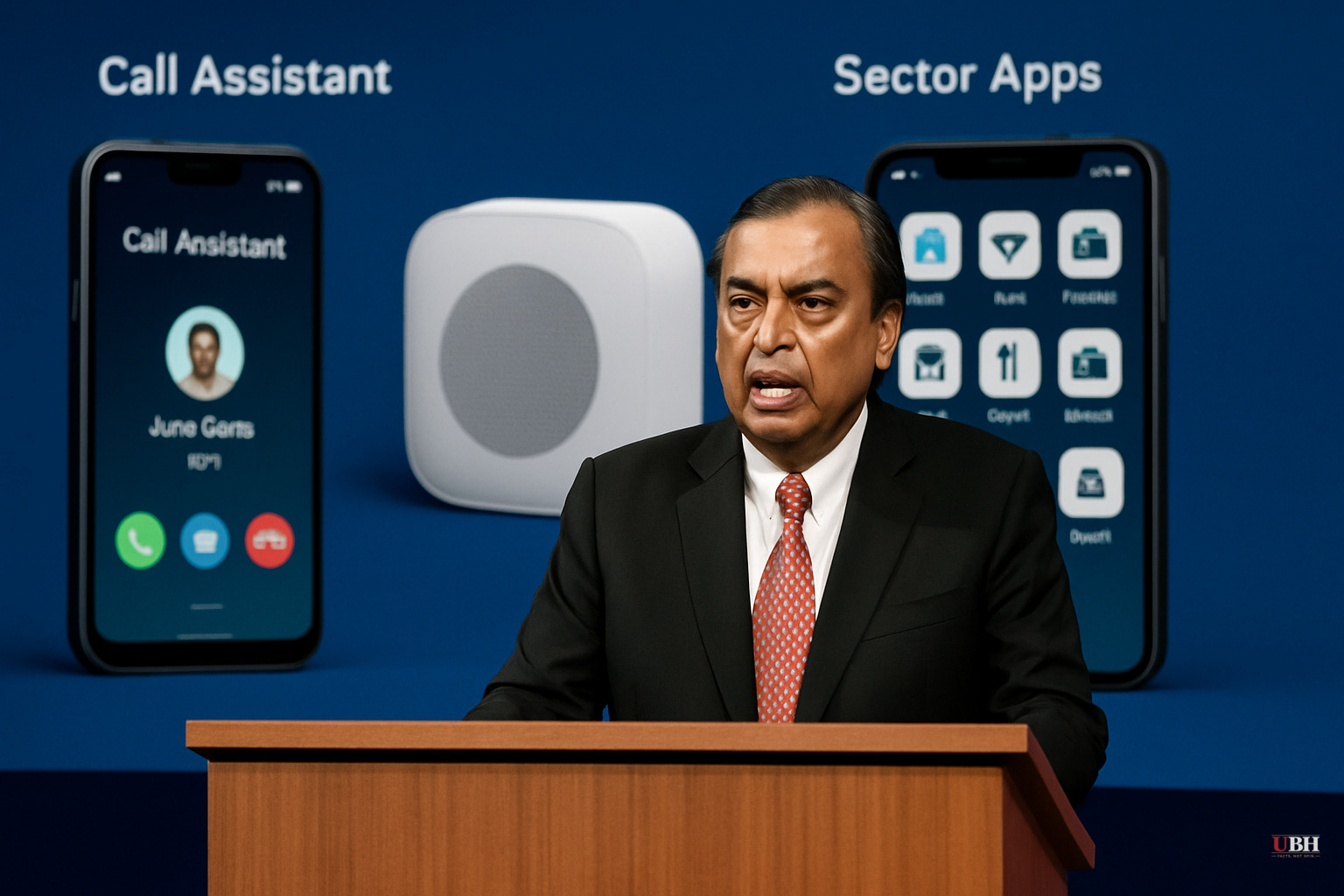
Since Jio Platforms filed its draft IPO papers with SEBI, the question hanging over the deal has been straightforward: what does the AI strategy actually look like? Reliance answered that at its annual shareholder meeting in Mumbai on June 19.
What Ambani Announced
The flagship product is Jio Call Agent, an AI assistant that joins phone calls to transcribe conversations, generate summaries, and execute tasks — booking cabs, ordering food, making reservations — triggered by the wake phrase "Hey Jio." According to TechCrunch, the service is expected to launch later this year for Jio's more than 500 million users.
Rather than distributing this as a standalone app competing on the App Store, Jio is embedding it directly into its telecom network. If it works, the call itself becomes the distribution channel. That's a competitive advantage that third-party AI assistant apps can't easily replicate.
Reliance also announced an AI-upgraded version of its MyJio app capable of handling natural-language requests: activating eSIMs, selecting roaming plans, managing account tasks. And it unveiled TeleFrame, a home display that uses AI agents to surface weather alerts, schedules, and household reminders proactively. TechCrunch noted the product echoes the broader industry push toward ambient home AI, territory Amazon and Google are actively contesting.
Sector-Specific Applications
Beyond consumer products, Reliance announced a suite of vertically focused AI tools: JioHealthIQ for healthcare, JioLearnIQ for education, JioKrishiIQ for agriculture, and AI Vyapar for small businesses. All are designed to operate across multiple Indian languages — the company says it supports 22 — which is a genuine differentiation in a country where English-first AI products leave hundreds of millions of potential users underserved.
Ambani framed the push in national terms. "India should not be a mere consumer of AI created elsewhere. It must become a creator, adopter, and a global leader in AI," he said at the meeting, according to TechCrunch. He is 69 years old and has been a central figure in driving Reliance's aggressive expansion into AI and digital services.
The Money Behind the Ambition
Earlier this year, Reliance announced plans to invest $110 billion in AI infrastructure, according to TechCrunch. The company has established partnerships with Google, Meta, and Nvidia. Bloomberg reported that Jio counts Meta, Alphabet, and KKR among its existing backers, with approximately 525 million subscribers on the network.
That subscriber base is the asset. An AI service that reaches even a fraction of 525 million people at meaningful monetization rates would be a large business. The open question is whether Reliance can convert network scale into AI revenue — which is a problem every telecom on earth is trying to solve right now, with mixed results.
Skeptical Notes
Product announcement slides at a shareholder meeting are not shipped products. Jio Call Agent has no confirmed launch date beyond "later this year." TeleFrame is a concept shown at a corporate event, not a device in stores. The $110 billion infrastructure commitment is a pledge, not a completed deployment. Investors should weigh that against the fact that Reliance has a track record while also recognizing that consumer AI hardware has a graveyard of well-funded failures behind it.
The comparison to Amazon Echo and Google Nest is apt in both directions: those products took years to find a use case that justified the hardware, and the AI agent functionality that was promised early took longer still to materialize.
What the IPO Story Adds
Bloomberg described Jio as potentially India's biggest IPO ever, framing it around the subscriber count and the institutional backer roster. That framing is accurate but incomplete without today's product context. The DRHP filed includes a fresh issue of up to 270 million shares; today's meeting disclosed what the company intends to build with the capital it raises.
SEBI's review of the draft prospectus will determine the IPO timeline. The unresolved question for investors isn't whether Jio is large — it clearly is — but whether AI-embedded telecom services can generate the margins that justify a valuation befitting India's largest-ever public offering.
Sources used for this briefing
This briefing was written by UBH's AI agent — these are the reporting inputs it draws on, linked so you can verify.


