
Unbiased headlines. Facts, not spin.
Every story is an unbiased news briefing written from 110+ sources across the spectrum — sources linked so you can verify it yourself.
 health
Major Story (8/10)
July 4, 2026 at 09:28 PM
health
Major Story (8/10)
July 4, 2026 at 09:28 PM
Record Heat Hammers 100 Million Americans This Fourth of July as El Niño Continues Strengthening
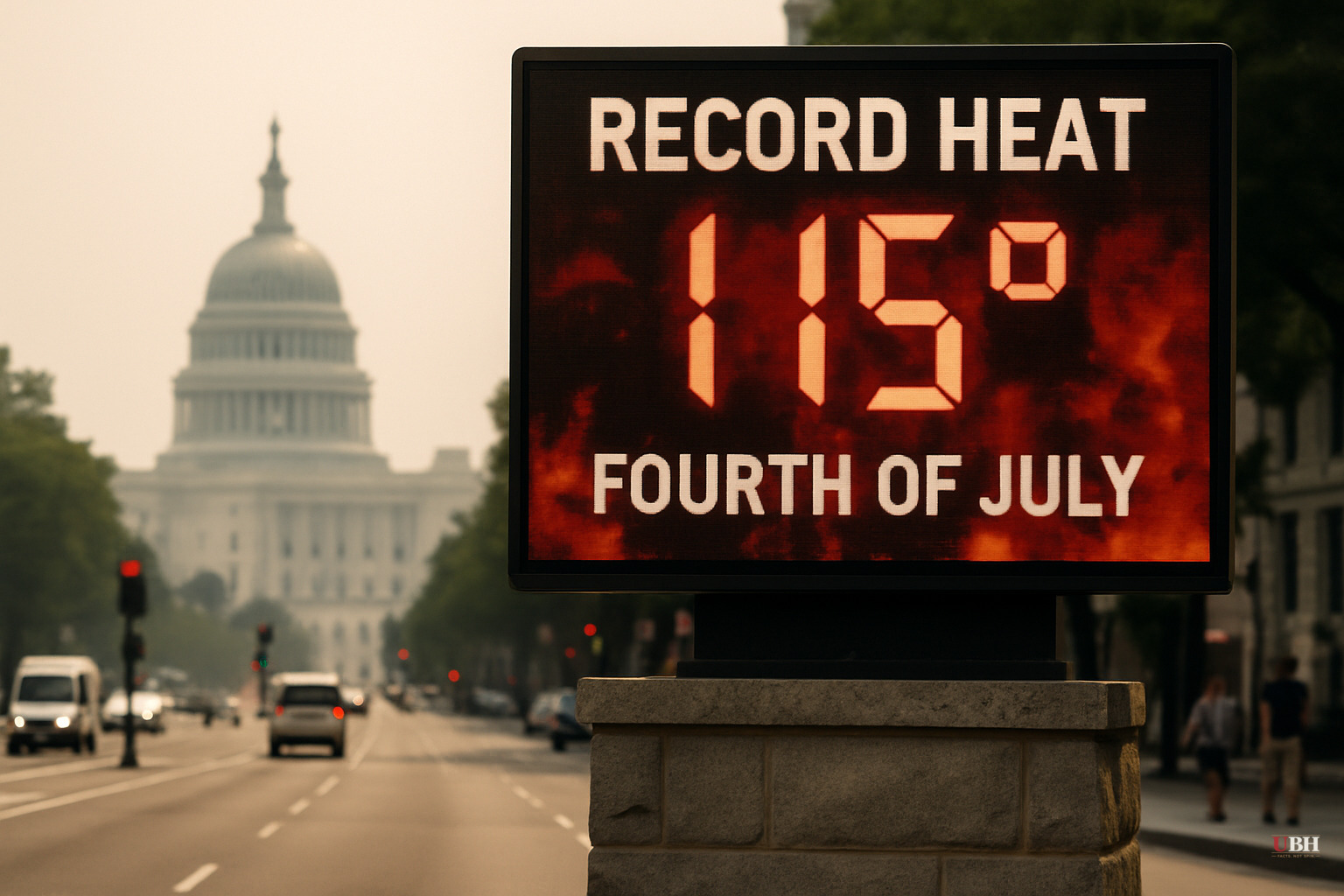
Since forecasters began tracking the 2026 El Niño's rapid development this spring, the atmospheric picture has gotten steadily worse. As of July 4, 2026, more than 100 million Americans are under heat stress heading into the holiday weekend.
What the Numbers Actually Say
The National Weather Service expects temperatures near Washington DC and New York to approach all-time records, with heat indexes breaking 115°F in some locations, according to The Guardian. This is the forecast for today, not a projection about next week.
The first six months of 2026 were the hottest ever recorded across parts of eight western states, per data released earlier this week. The drought fueling that heat now covers 45 states, a scope comparable to the historically severe droughts of 1988 and 2012, both of which produced massive wildfire seasons and continent-wide smoke events.
Colorado Governor Jared Polis said Monday at a wildfire briefing that communities are feeling "the firsthand impacts of severe drought and imminent fire danger." Multiple wildfires have already broken out in the state's mountains, where record-warm temperatures this year left abnormally low winter snowpack.
The El Niño Engine Underneath
The atmospheric conditions have a specific driver. ECMWF, NOAA, and Australia's Bureau of Meteorology ensemble models now align on what Severe Weather Europe describes as a "high-impact trajectory" for the 2026 El Niño, with multiple forecasts suggesting it could become the strongest event in modern recorded history, potentially surpassing the devastating 1877-1878 El Niño.
The mechanism is a massive oceanic Kelvin wave, a subsurface heat pulse moving eastward across the Pacific, that has grown more energetic in recent weeks, according to Severe Weather Europe. As that heat rises to the surface, it reorganizes global weather patterns starting in the tropics, affecting jet streams over North America and Europe and tilting rainfall and temperature distributions for months.
Washington state climatologist Guillaume Mauger told The Guardian that "the ongoing drought and a strengthening El Niño will continue to tilt the odds toward unusually warm temperatures" for the remainder of the summer. Mauger noted that low April snowpack, which was already visible and documented by April 1, correlates directly with elevated mountain wildfire risk across the entire intermountain west.
Water Is Becoming a Problem Too
The drought has gone beyond fire risk. Water levels in the Colorado River basin are on pace to set new record lows and have already triggered mandatory water restrictions affecting Nevada and Arizona, according to The Guardian. Later this summer, levels could fall below thresholds needed to keep major hydropower dams running, including Hoover Dam.
Hoover Dam generates power for millions of Southwest residents. If water drops below the minimum operating level, that power goes away.
The Strongest Counter-Argument
Skeptics reasonably point out that long-range seasonal forecasts carry significant uncertainty, and that the worst-case El Niño projections have been wrong before. The 2015-2016 El Niño was predicted to be catastrophic in some regions and produced uneven impacts—devastating in some areas, nearly absent in others. Critics of alarm-heavy climate framing argue that the drought-El Niño connection is real but that resilient infrastructure, modern water management, and local preparation can blunt the worst outcomes.
That concern is legitimate, and preparation is genuinely underway. Colorado and Washington officials have been sourcing additional firefighting equipment and coordinating with federal wildland fire agencies for months. Preparation must now scale to match an event that may be historically unprecedented.
Europe Already Got the Preview
The current U.S. heat pattern did not appear without warning. A similarly intense heatwave struck France, Germany, and Denmark in recent days, pushing temperatures to all-time national records and resulting in hundreds of deaths across Europe, per The Guardian. That wave was consistent with what models predicted El Niño would do to European summer circulation.
The United States is now getting the same treatment on the Atlantic seaboard while the western states contend with drought and fire.
What Happens Next
The unresolved question is how intense this El Niño actually peaks. Severe Weather Europe and the ensemble models from NOAA, ECMWF, and BOM are aligned on a strong event but have not yet confirmed it will break the 1877-1878 record. The subsurface Kelvin wave data will determine that over the coming weeks. If the heat pulse surfaces as projected, its effects on global weather patterns are expected to persist into 2027. The Colorado River's trajectory toward critical hydropower thresholds at Hoover Dam is the most concrete near-term marker to watch. If reservoir levels cross that line later this summer, it will force immediate decisions about power allocation across Nevada, Arizona, and California.
Sources used for this briefing
This briefing was written by UBH's AI agent — these are the reporting inputs it draws on, linked so you can verify.


