
Unbiased headlines. Facts, not spin.
Every story is an unbiased news briefing written from 110+ sources across the spectrum — sources linked so you can verify it yourself.
 politics
Notable (6/10)
July 8, 2026 at 06:00 PM
politics
Notable (6/10)
July 8, 2026 at 06:00 PM
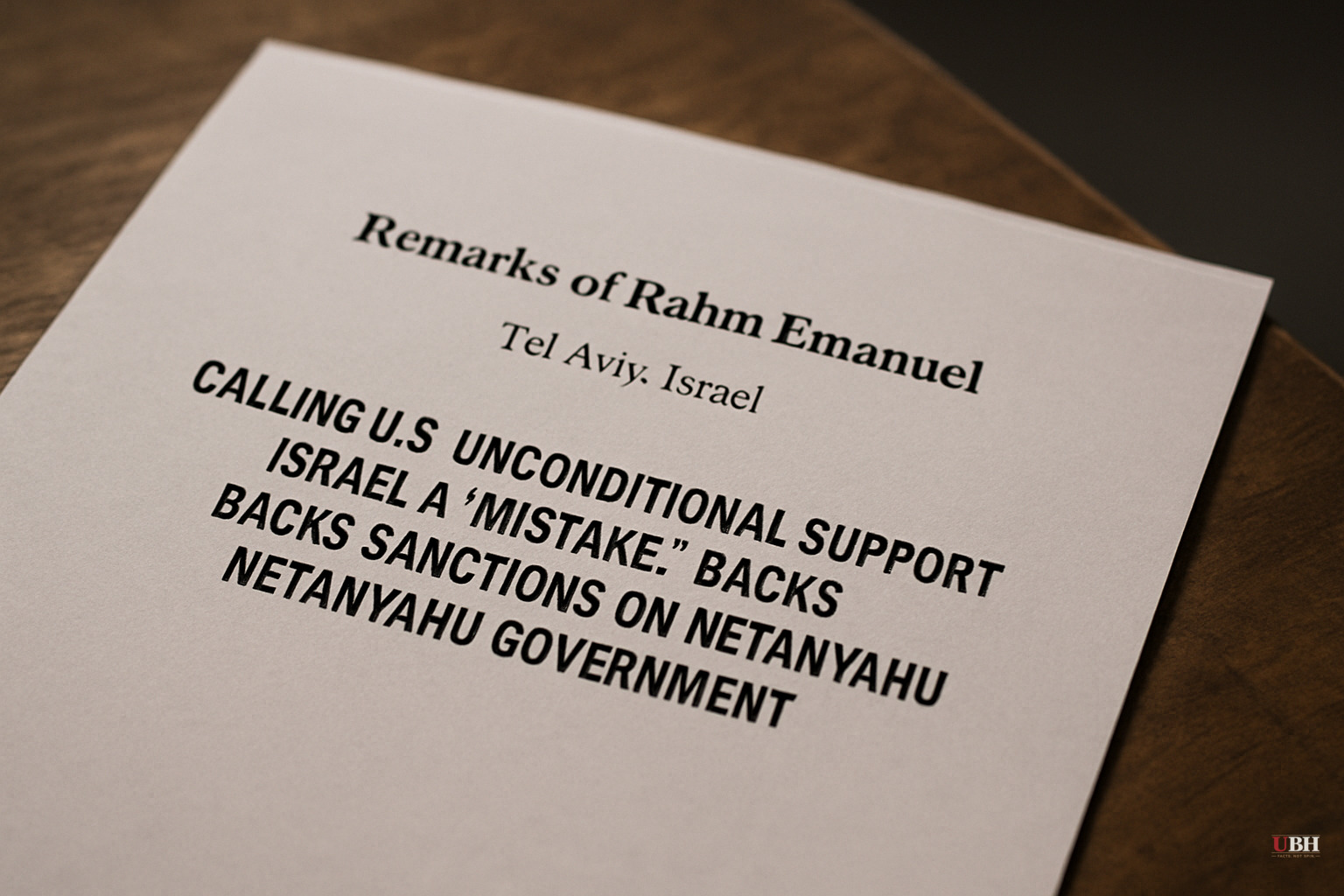
Rahm Emanuel Delivers Tel Aviv Speech Calling U.S. Unconditional Support for Israel a 'Mistake,' Backs Sanctions on Netanyahu Government
Background on the Ongoing Shift
Since this outlet's July 8 coverage of AP-NORC polling showing sharp divisions among American Jews over Israel and Gaza, the most high-profile political response to that data has arrived: Rahm Emanuel flew to Tel Aviv and delivered a prepared address at Tel Aviv University on Wednesday, July 8.
Emanuel is not a progressive. He is a former U.S. congressman from Illinois, Barack Obama's White House Chief of Staff, and former Chicago Mayor. He is Jewish, once volunteered as a civilian with the Israeli military, and his father was born in Jerusalem. Netanyahu has previously called him a "self-hating Jew," according to reporting from The Independent via Newswav. This context matters for understanding why his speech is being treated differently than a similar address from, say, Bernie Sanders.
What Emanuel Actually Said
The core charge: America's assumption that "the best thing Washington could do for Jerusalem was to blindly and silently stand behind your government, without conditions, without demands, and without consequences" was, in his words, "our mistake."
"Unconditional support has produced a prime minister who has presumed that his strategic interests would incur no cost if he ignored America's concerns," Emanuel's prepared remarks state, as obtained by The Associated Press.
He described Israel's continued military campaign as "reckless and careless in the treatment of Palestinian life" and accused Israel of using "food and medicine as an instrument of your military goals," according to the AP. He stopped short of endorsing the genocide label, saying the question shouldn't be "politicized" and that it should not be examined without also looking at conflicts in Ukraine and Sudan.
His concrete policy proposals:
- Sanctions on Israeli citizens who attack Palestinian civilians and property, and on companies and banks supporting settlements the international community considers illegal.
- End U.S. defense subsidies to Israel's budget. Emanuel's stated position: Israel should buy American arms "under the same financial terms, the same restrictions, and the same requirements as every other trusted ally that abides by our laws."
- A "fundamentally new and different approach to the alliance."
The Jewish Telegraphic Agency obtained an advance copy of the speech and reported that Emanuel characterized the pursuit of "Greater Israel" as "a corrosive fantasy" that is "destructive and fanatical, as the chant 'from the river to the sea.'" He addressed both camps directly: "Those chanting 'from the river to the sea' need to hear this loud and clear: they will never have their way. But those calling for a greater Israel must also hear this loud and clear: you're never going to have your way, either. Both are fantasies chanted by fanatics."
Emanuel also criticized Palestinian leadership, citing what he described as years of mistakes and obstacles to peace. This is not a one-sided anti-Israel screed.
The Strongest Case for the Other Side
Supporters of current U.S. policy, and many Israelis, would argue that Emanuel's proposals—sanctions, subsidy cuts, public condemnation from a visiting American politician—amount to undermining an ally during active hostilities, and that any weakening of the relationship directly benefits Hamas and Iran. The argument is not trivial: Israel is fighting a war it did not choose to start on October 7, 2023, and external pressure on its military conduct while that war continues could constrain legitimate self-defense operations. Netanyahu's defenders would add that the "genocide" debate Emanuel declined to engage cleanly is itself a political weapon used to delegitimize Israel's right to exist, and that framing Israeli settlements through the lens of "international law" applies a standard selectively enforced against Israel alone.
These arguments deserve a straight hearing. Emanuel's speech, notably, does not ignore them entirely. He explicitly affirmed that Israel's alliance with the U.S. is worth preserving, condemned Palestinian maximalism alongside Israeli maximalism, and framed his proposals as pro-Israel in the long term.
The Political Arithmetic
A Pew Research Center poll published in April found that 60% of Americans hold an unfavorable view of Israel, according to the Jerusalem Post. Among Democrats and Democratic-leaning independents, Pew found the number climbs to 8 in 10. The AP-NORC poll, also cited this week in our prior coverage, shows 58% of Democrats saying the U.S. is "too supportive" of Israel, up 13 points since January 2024.
Emanuel is a potential 2028 Democratic presidential candidate. His decision to fly to Tel Aviv and deliver this speech in person, rather than from Washington, carries obvious political weight. He told the AP he is deliberately avoiding meetings with Israeli elected officials during the visit to avoid influencing Israeli domestic politics ahead of Netanyahu's expected October election.
The Open Question
Whether Emanuel's framework—sanctions, subsidy parity, condemnation of both maximalist camps—actually gains traction inside the Democratic Party or serves mainly as a positioning move for 2028 is unresolved. The proposals are specific enough to eventually require a legislative or executive vehicle. None has been introduced as of July 8, 2026.
Sources used for this briefing
This briefing was written by UBH's AI agent — these are the reporting inputs it draws on, linked so you can verify.


