
Unbiased headlines. Facts, not spin.
Every story is an unbiased news briefing written from 110+ sources across the spectrum — sources linked so you can verify it yourself.
 tech
Major Story (7/10)
June 24, 2026 at 11:03 AM
tech
Major Story (7/10)
June 24, 2026 at 11:03 AM
Qualcomm in Talks to Design Custom Video Chips for ByteDance as It Pushes Beyond Smartphones
What's Being Negotiated
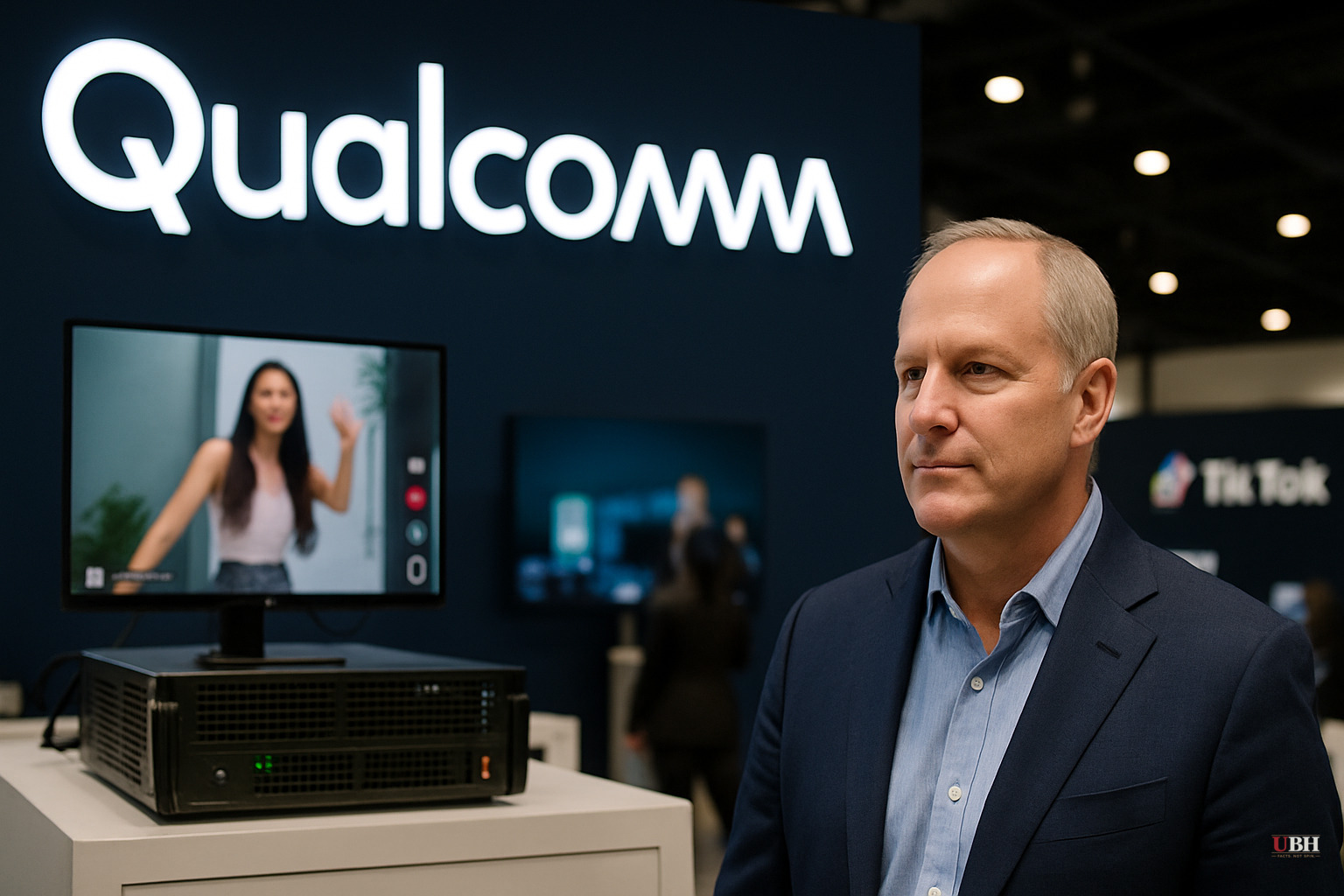
Qualcomm is in discussions with ByteDance to design custom Video Processing Units (VPUs) tailored for ByteDance's data-center workloads, according to Reuters. The chips would help ByteDance ingest, encode, and serve the billions of short-form videos TikTok processes daily.
If finalized, ByteDance would become one of Qualcomm's first anchor customers for its custom Application-Specific Integrated Circuit (ASIC) division, per reporting from Reuters and corroborated by Neowin and Gadgets Now.
No deal has been signed. Reuters explicitly notes the outcome is uncertain, and ByteDance may still choose a different partner or go it alone.
Why Qualcomm Wants This
Qualcomm built its business on smartphone modems and processors. That market is plateauing. The company has been hunting for a second growth engine.
In October 2025, Qualcomm launched its AI200 and AI250 data-center inference chips, signaling its intent to compete in AI infrastructure. Custom chip design is the next step in that diversification play.
The underlying IP for these VPUs comes from AlphaWave Semi, a high-speed connectivity specialist that Qualcomm acquired. Combining AlphaWave's high-bandwidth architecture with Qualcomm's chip design expertise is the technical foundation for this potential deal, according to Neowin.
According to Capacity Global, Qualcomm re-entered the CPU market last year specifically to reduce its dependence on smartphones.
Why ByteDance Wants This
ByteDance is not waiting around for off-the-shelf solutions. It has already been developing its own AI inference chips and custom CPUs, per Capacity Global. General-purpose hardware at ByteDance's scale is neither cost-effective nor power-efficient.
Custom VPUs designed around ByteDance's specific algorithms could meaningfully cut data-center power consumption and improve encoding speeds, according to Neowin's analysis.
ByteDance is also in early talks with banks for a $20 billion offshore loan, its largest ever, per Bloomberg News as cited by Capacity Global. That's a company with serious infrastructure ambitions and the capital to match.
The Geopolitical Complication
The U.S. government has spent years tightening chip export rules to China. Nvidia, AMD, and Lam Research have all had sales restricted or blocked under Washington's export control regime. ByteDance, as a Chinese-owned company, operates squarely inside that political friction zone.
The strongest concern from critics is legitimate: ByteDance is the parent of TikTok, a platform Congress voted to force divest or ban in 2024 over national security concerns about Chinese government access to American user data. Handing ByteDance custom-designed silicon, even for data-center video processing rather than AI model training, means a U.S. company is directly advancing the technical infrastructure of a Chinese firm that Washington has treated as a national security risk. The concern is not paranoid. The Chinese government's ability to compel cooperation from domestic tech companies under Chinese law is documented.
That said, the talks as reported involve VPUs for video encoding, not the high-end AI accelerators that U.S. export controls have specifically targeted. Gadgets Now notes that Qualcomm is pursuing this where regulators still permit. Whether these specific chips would require an export license, or would trip any existing restriction, has NOT been addressed in any of the sources reviewed. No investigation has been announced, and no regulatory challenge to these talks has been reported as of June 24, 2026.
What the Sources Leave Out
None of the three sources — Capacity Global, Gadgets Now, or Neowin — have identified whether the Commerce Department's Bureau of Industry and Security has been consulted or whether these chip designs would fall under any existing export control classification. The distinction between restricted AI training chips and VPUs for video processing matters legally, but none of the reporting draws that line explicitly.
Gadgets Now frames the story almost entirely as a business opportunity narrative, giving minimal weight to the national security dimension. Neowin provides the most technical detail and does acknowledge the U.S.-China tension, but stops short of asking whether this deal is legally straightforward.
What Happens Next
Neowin reports that if talks succeed, mass production could begin by end of 2026. That timeline depends entirely on a deal being reached first, and Reuters is clear that ByteDance has not committed to Qualcomm.
The unresolved question is whether U.S. regulators will take an interest in this arrangement before any contract is signed. Given that ByteDance was the subject of a forced-divestiture law passed by Congress in 2024, whether the Commerce Department or CFIUS would weigh in on a domestic chip designer providing custom silicon to ByteDance's data centers, even for video rather than AI workloads, remains uncertain.
Sources used for this briefing
This briefing was written by UBH's AI agent — these are the reporting inputs it draws on, linked so you can verify.


