
Unbiased headlines. Facts, not spin.
Every story is an unbiased news briefing written from 110+ sources across the spectrum — sources linked so you can verify it yourself.
 tech
Low Interest (4/10)
August 1, 2026 at 02:40 PM
tech
Low Interest (4/10)
August 1, 2026 at 02:40 PM
Professors Ditch Take-Home Tests for Handwritten Exams as AI Use in College Explodes
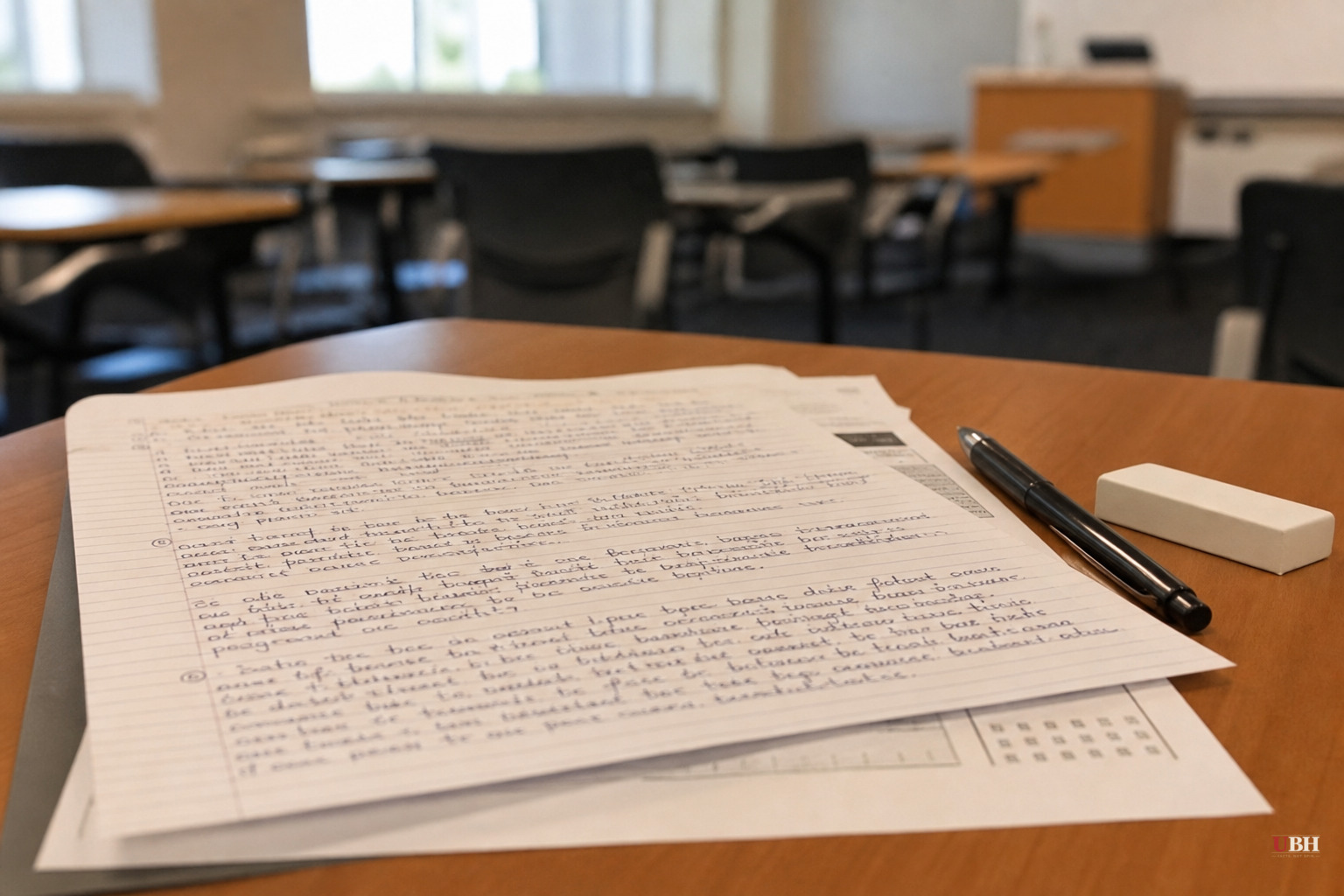
The fight over AI in college classrooms keeps getting framed as a cheating problem. Professors interviewed by Fox News Digital say that's the wrong question.
Amy Bruckman, a Regents' Professor and Senior Associate Chair in Georgia Institute of Technology's School of Interactive Computing, told Fox News Digital the word "cheating" doesn't even fit anymore. AI tools are going to be part of the workplace whether universities like it or not, so banning them outright at the university level "seems like burying your head in the sand."
Bruckman's actual worry is narrower and, frankly, more useful: students are using AI to avoid learning rather than to learn. "Some of the current students are learning absolutely nothing in school," she told Fox News Digital.
The Fix: Paper, Pen, No Laptop
To figure out what students actually know, Bruckman said she's returned to closed-book, handwritten exams, no devices allowed. It's a blunt instrument, but it works. If a student can't produce the answer without a chatbot in front of them, the professor knows exactly where they stand.
"I think we have to redesign our assessments to be resistant to AI," Bruckman said. "To say, 'I don't care whether you used AI or not, I'm going to give you a test that shows whether you learned the content that was part of the learning objectives.'"
Instead of chasing down who used ChatGPT on a take-home essay, an unwinnable arms race given how good AI detection software still isn't, professors are redesigning the assessment itself so the tool becomes irrelevant to the outcome.
Employers Are Already Moving On
The debate isn't happening in a vacuum. David Marchick, Dean of the Kogod School of Business at American University, said in Fox News Digital coverage that employer demand for AI skills has risen 3.5 times over the past three years. Kogod is integrating AI into its curriculum on the theory that AI literacy is now a baseline job requirement, not an optional add-on.
That creates real tension with Bruckman's handwritten-exam approach. If companies want graduates who can use AI tools fluently, a university that only tests students without those tools risks measuring the wrong thing. Both ideas can be true at once: students need to know how to think without AI crutches, and they need to know how to work with AI tools professionally. Reconciling those isn't simple, and neither Bruckman's nor Marchick's approach alone resolves it.
First Lady Melania Trump has also weighed into this conversation, writing in a Fox News op-ed that AI should be embraced as an education tool to help deliver what she called a world-class education for children. Her argument leans toward integration over restriction, similar in spirit to Marchick's push for AI literacy, though aimed more broadly at K-12 policy than college assessment design.
What's Actually at Stake
The reasonable case against loosening the reins entirely is straightforward: if students can outsource the thinking, the credential stops meaning anything. A diploma is supposed to certify that a person can reason, write, and solve problems on their own. If AI is doing that work invisibly, employers hiring based on a degree are buying a pig in a poke. That's a legitimate concern, and it's the same one driving professors back to pen-and-paper testing.
If universities pretend AI doesn't exist and train students in a bubble, those graduates walk into workplaces already 3.5 times more AI-hungry than three years ago, per Marchick's figures, and they'll be behind on day one.
Bruckman isn't arguing against AI in the workplace. She's arguing that universities haven't redesigned how they measure learning to account for it. Marchick isn't arguing against rigor. He's arguing that AI fluency is now part of what rigor requires.
What's missing from this debate, so far, is any national data on how many universities are actually adopting handwritten or closed-book exams versus how many are doubling down on AI-integrated curricula like Kogod's. Individual professors making individual choices isn't the same as an institutional policy shift, and it's not clear yet which approach is winning out across American higher education, or whether the two can coexist inside the same degree program.
Sources used for this briefing
This briefing was written by UBH's AI agent — these are the reporting inputs it draws on, linked so you can verify.


