
Unbiased headlines. Facts, not spin.
Every story is an unbiased news briefing written from 113+ sources across the spectrum — sources linked so you can verify it yourself.
 politics
Low Interest (4/10)
September 22, 2026 at 06:59 AM
politics
Low Interest (4/10)
September 22, 2026 at 06:59 AM
Poland, Hungary, Slovakia and Czech Republic Back India's Bid for a Permanent UN Security Council Seat
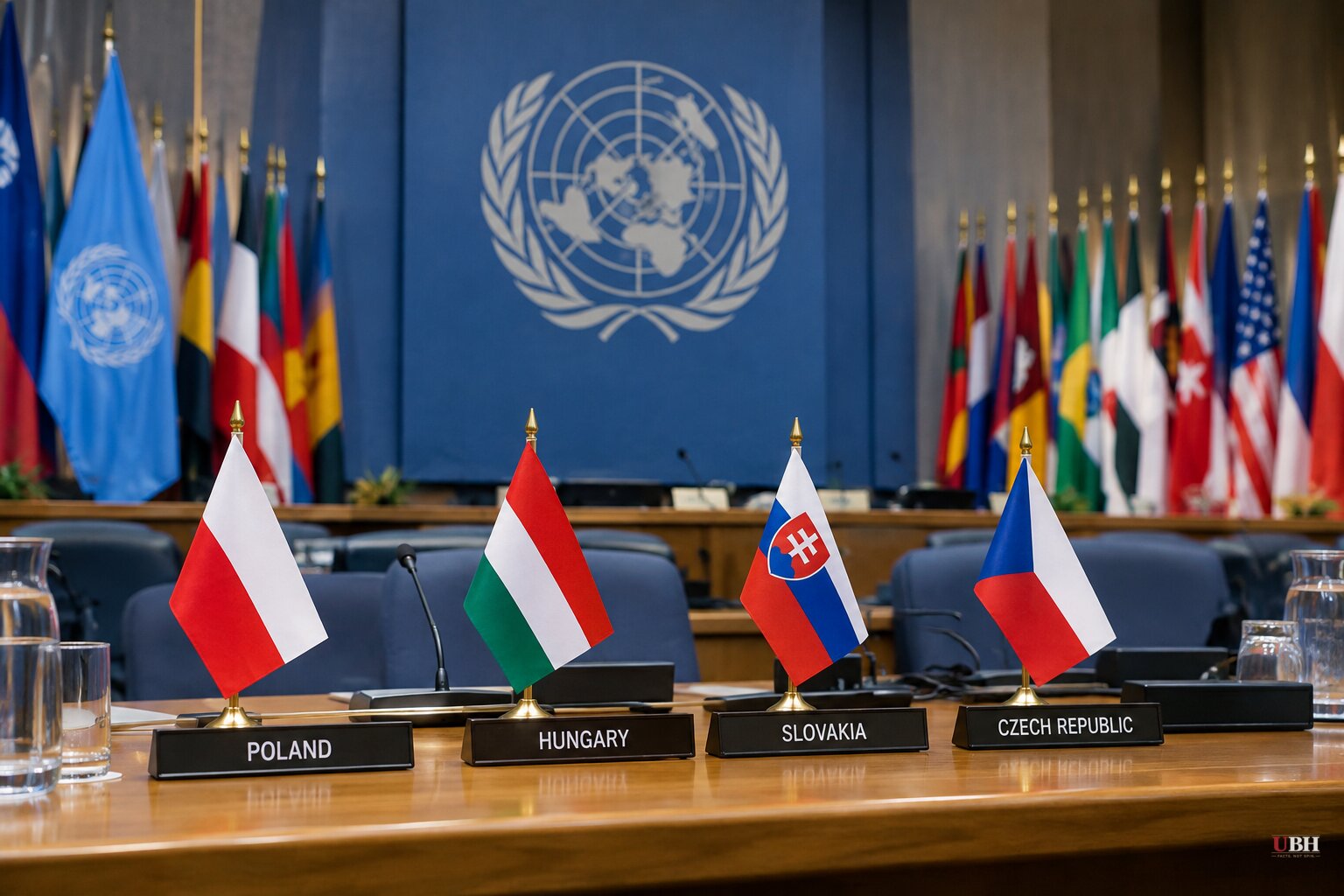
Poland, Hungary, Slovakia and the Czech Republic have publicly backed India's campaign for a permanent seat on the United Nations Security Council. The announcement came at the first-ever V4-India foreign ministers' meeting, held on the sidelines of the 81st UN General Assembly in New York, according to the Times of India and India Today.
Slovak Foreign Minister Juraj Blanár delivered the group's line after the sit-down with India's External Affairs Minister S. Jaishankar. "We all agree as V4 countries that India as a part of the Global South, upcoming superpower in the Indo-Pacific region, must be at the table as the permanent member of the UN Security Council," Blanár said, a quote carried across the Times of India, Business Standard, Times Now and India Today.
Jaishankar called the sit-down a "new historic occasion." The five countries agreed to hold annual foreign ministers' meetings and launch an annual business forum, and discussed cooperation on defense, technology, space and education, per Newsbytes and Times Now. The Ukraine war and the situation in the Gulf also came up, according to Newsbytes.
Why India Wants In
India's case isn't new. The Security Council's permanent membership, the US, Russia, China, France and the UK, was locked in place in 1945, when large chunks of Asia and Africa were still colonies, according to Mathrubhumi English. India argues that a body meant to reflect global power should actually reflect it. India has served eight terms as an elected, non-permanent Council member, most recently in 2021 and 2022, and points to its peacekeeping contributions and role on counterterrorism and maritime security.
India isn't going it alone. It's part of the G4 group with Brazil, Germany and Japan, which has floated expanding the Council from 15 to 25 or 26 seats, adding six new permanent members split across Africa, Asia-Pacific, Latin America and Western Europe, per Mathrubhumi. France and the UK already back India's bid. The US has said it supports India's inclusion in an expanded Council. Russia backs it too.
The China Question
Mathrubhumi English was the only outlet in this batch to flag a critical point directly: China, the fifth permanent member, has not endorsed India's bid. Any Security Council reform needs the consent of all five existing permanent members, each holding veto power over changes to the Council's own structure.
Poland, Hungary, Slovakia and Czechia don't hold vetoes. Their support is real and adds diplomatic weight to India's case heading into a UN General Assembly cycle where reform talk resurfaces every year. But it doesn't move the actual mechanism that decides whether reform happens.
The Security Council reform debate has dragged on for roughly three decades without a single new permanent seat added, and there's no scheduled vote or binding process on the table now. Diplomatic statements of support, however genuine, have piled up from dozens of countries over the years without producing a change in the Council's composition. Judged against that record, Monday's V4 statement is another data point in a long column rather than a breakthrough.
The counter to that skepticism is that stacking up endorsements, especially from a bloc like the V4 that has grown closer to China in trade terms in recent years, still narrows the field of holdouts and builds pressure on the remaining skeptics. Jaishankar's own framing, that India's relationship with the EU is "deepening" and that V4 states specifically see India as an "upcoming superpower," is the diplomatic groundwork for exactly that kind of pressure campaign.
What's Actually Unresolved
Two questions remain open and unanswered by any source here. First, whether the four V4 countries' endorsement changes Beijing's calculus at all. There's no indication from these reports that China has shifted its position. Second, whether new permanent members under any G4 plan would get full veto power, an issue Mathrubhumi notes remains contested even among reform supporters. Neither question has a scheduled resolution date. The next concrete marker to watch is whether Security Council reform gets any formal agenda movement during the remainder of the current UN General Assembly session.
Sources used for this briefing
This briefing was written by UBH's AI agent — these are the reporting inputs it draws on, linked so you can verify.


