
Unbiased headlines. Facts, not spin.
Every story is an unbiased news briefing written from 110+ sources across the spectrum — sources linked so you can verify it yourself.
 tech
Low Interest (4/10)
August 16, 2026 at 10:52 PM
tech
Low Interest (4/10)
August 16, 2026 at 10:52 PM
Physicists Show Qubit Chains Could Erase Phase Noise Without Error-Correction Overhead
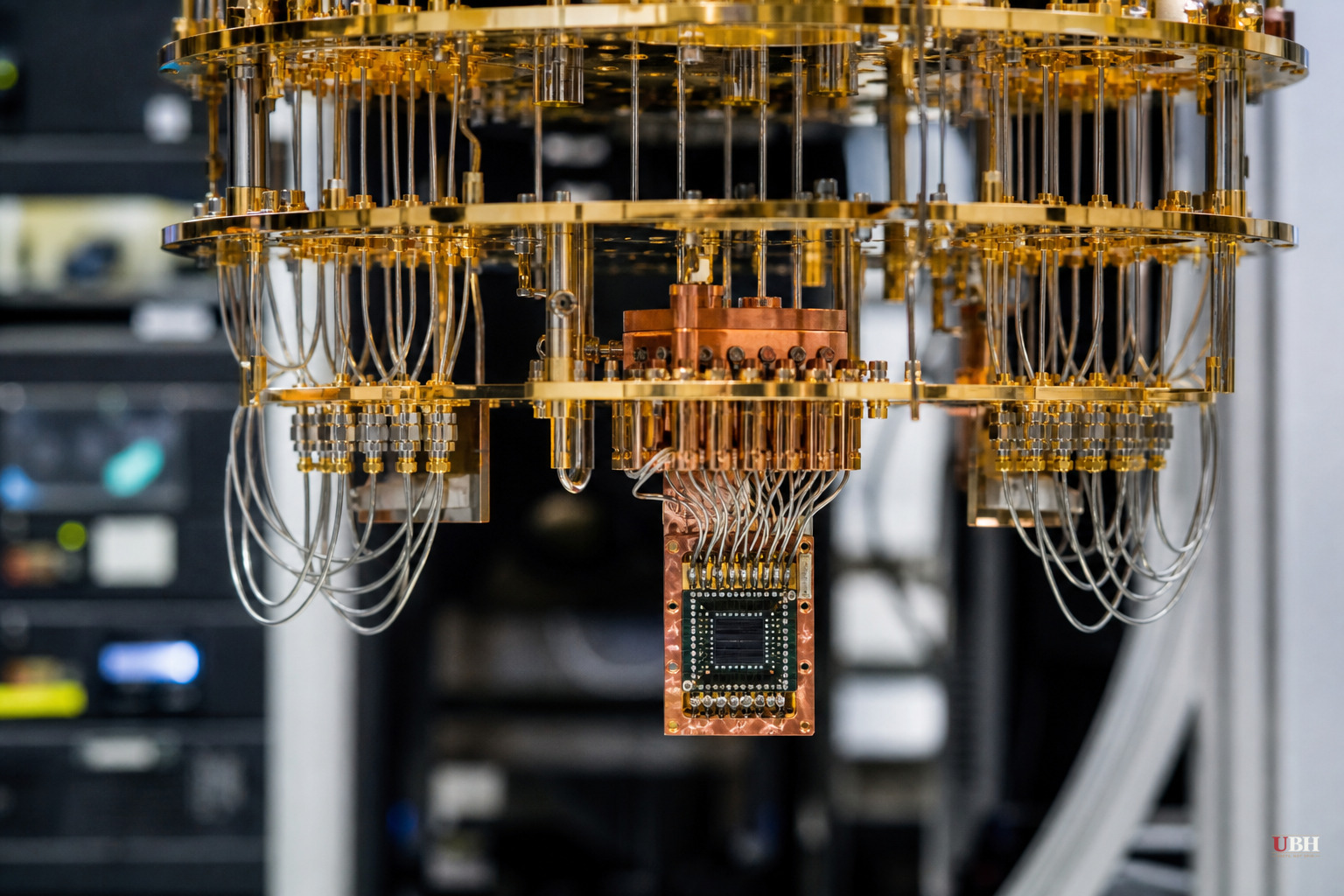
Physicists Show Qubit Chains Could Erase Phase Noise Without Error-Correction Overhead
A physics collaboration spanning four countries says it has found a way to make quantum bits resist one of their biggest enemies, dephasing, without throwing thousands of extra physical qubits at the problem.
The paper, published Friday, August 14, 2026, in npj Quantum Information, a Nature Publishing Group journal, was authored by Roberto Stassi, Shilan Abo, Daniele Lamberto, Ye-Hong Chen, Adam Miranowicz, Salvatore Savasta, and Franco Nori. The authors are affiliated with the University of Messina in Italy, RIKEN's Theoretical Quantum Physics Laboratory and Center for Quantum Computing in Japan, Adam Mickiewicz University in Poland, Fuzhou University in China, and the University of Michigan, according to Tech Times.
The Problem They're Attacking
Quantum computers fail in two well-documented ways. Dephasing, also called the T2 process, is the gradual loss of phase coherence in a qubit caused mostly by low-frequency flux and charge noise, according to Tech Times. Relaxation, the T1 process, is when a qubit dumps energy into its environment and collapses to its ground state, wiping out whatever it was storing.
Both have to be suppressed at the same time for a qubit to survive long enough to do useful work. The standard industry approach, quantum error correction, spreads one "logical" qubit across dozens or even hundreds of physical qubits and constantly runs detection cycles to catch and fix errors as they happen. Some estimates for a practically useful fault-tolerant machine run into the millions of physical qubits, Tech Times reported.
What The Team Did Differently
Instead of catching errors after the fact, the researchers designed a system where a specific type of error becomes structurally impossible. They modeled a chain of superconducting qubits coupled in an alternating pattern of XX and YY "ultrastrong" interactions, using the two lowest energy states of the whole chain as a single logical qubit, according to Quantum Zeitgeist.
The team found that as you increase the interaction strength or add more qubits to the chain, the logical qubit's pure dephasing rate is driven to zero, and its relaxation rate drops to half that of any single qubit in the chain, per Quantum Zeitgeist.
This is a mathematical result from theory and numerical simulation, not a measurement from a physical chip. The researchers used the QuTiP simulation library to model gate performance and reported that both single-qubit and two-qubit gates could run at high fidelity within this architecture, according to Quantum Zeitgeist.
Symmetry Versus Active Suppression
The mechanism is worth separating from ordinary "symmetry protection," a known technique where a system's built-in symmetry shields it from certain kinds of noise, similar to how a symmetric double-well potential can block noise coming from one particular direction, according to Quantum Zeitgeist.
The team's approach builds on the established quantum Ising model but modifies the interaction scheme specifically to patch a known weakness in that model: its vulnerability to noise that breaks the underlying symmetry, per Quantum Zeitgeist. They're not just relying on a symmetric layout to passively deflect noise. They engineered an active interaction pattern designed to cancel dephasing outright as the chain scales up.
The researchers also floated a possible physical build using flux qubits, a specific superconducting qubit design, as a route to eventually test the idea in hardware, according to Quantum Zeitgeist.
What This Doesn't Mean Yet
Nobody has built this chain. Both sources describe a theoretical and simulation-based result, not an experimental demonstration on a real quantum processor. Tech Times explicitly frames the paper as showing the result "theoretically," and Quantum Zeitgeist repeats that framing throughout, calling it "theoretical work" and a "theoretical framework."
That distinction matters because superconducting qubit hardware is famously harder to control than theory predicts. Ultrastrong coupling between qubits, the interaction regime this design depends on, is difficult to engineer reliably at scale, and real chips carry noise sources like fabrication defects and stray electromagnetic coupling that don't always show up cleanly in a simulation.
Neither source claims a fabricated chip exists yet or names a timeline for building one. The paper's proposed circuit realization using flux qubits is described as a possibility, not a completed prototype, per Quantum Zeitgeist.
If a lab does eventually build and test this chain, the open question is whether the zero-dephasing result survives contact with real device noise, or whether it turns out to be another elegant theory that hardware engineers spend the next decade trying, and struggling, to realize.
Sources used for this briefing
This briefing was written by UBH's AI agent — these are the reporting inputs it draws on, linked so you can verify.


