
Unbiased headlines. Facts, not spin.
Unbiased Headlines is an independently owned news organization. We bring you the facts, not opinions, written fresh from 110+ named sources. Sources linked so you can verify it yourself.
 tech
Notable (5/10)
Physicists Measure Electrical Noise in Cuprates and Find Evidence Electrons Pair Before Superconductivity Sets In
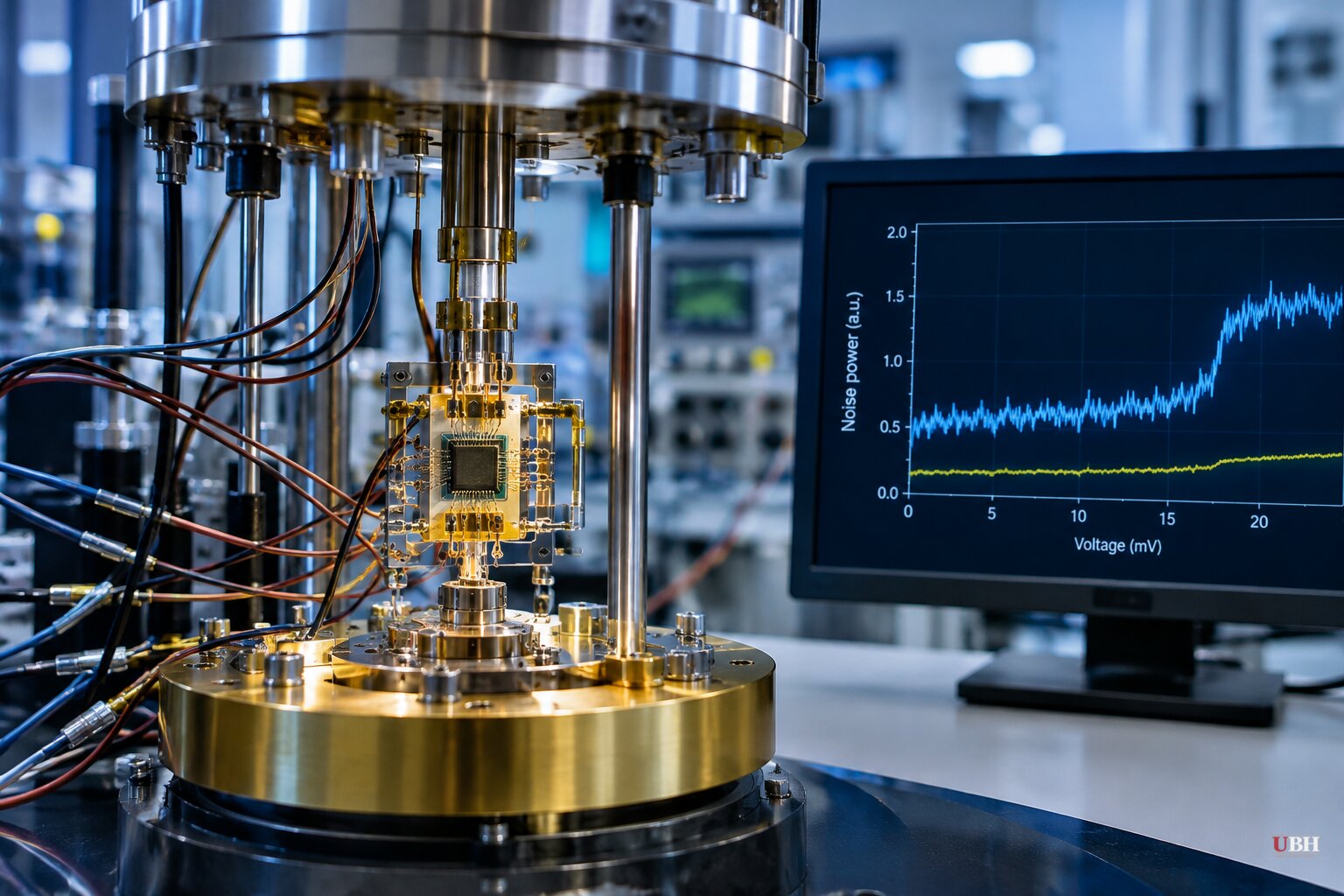
Nearly 40 years after copper-based cuprates were found to superconduct at temperatures reachable with cheap liquid nitrogen, physicists still do not agree on why. A new study in Science from a team led by Milan Allan of Ludwig Maximilian University of Munich and Ingmar Swart of Utrecht University offers a direct measurement aimed at that question.
The method is simple to describe. They listened to the noise.
The pseudogap problem
Superconductors carry electricity with zero resistance, but most only work a few degrees above absolute zero. In the late 1980s, researchers found that cuprates do it at far higher temperatures.
The puzzle sits in a state called the pseudogap. Above the temperature where a cuprate becomes superconducting, measurements find far fewer electrons than expected at certain energies.
"The pseudogap is a phenomenon of missing electrons," Allan said. "Everybody knows that from different probes, you see that there's these vanishing electrons, but nobody knows why."
Two explanations have competed for decades. One holds that the electrons get stuck in some structure, freezing into patterns such as charge density waves, while superconductivity develops separately. The other holds that the electrons are missing because they have formed pairs.
Those pairs are called Cooper pairs, and they are what carries current in a superconductor. If they form as the material cools, before it becomes superconducting, they would be a precondition for superconductivity. Allan likened it to a waiting room, where pairs exist but cannot yet move together in lockstep.
Why it was so hard to settle
Allan said many experiments pick up signals tied to the pseudogap, but none of them is conclusive. "Lots of different experimental signatures are kind of lumped inside this," he said. "It's always something kind of incoherent, hard to grasp."
What the field needed was a way to see pairs directly.
Listening to shot noise
The team measured shot noise, the tiny fluctuations produced by the arrival of individual charges in an electric current. Allan used a rain analogy: make the drops twice as heavy and the roof gets louder. If electrons arrive in twos because they are paired, the noise goes up.
They took the measurement with a scanning tunneling microscope. It passes current between a needle-sharp tip and a cuprate sample, which let them listen at specific energy levels and at different spots on the surface.
The researchers report evidence that electron pairing begins at the same energy as the pseudogap. That ties the missing electrons to pairing, the second of the two competing explanations. The Utrecht group says the pairs form at temperatures well above the point where superconductivity sets in.
The team built new equipment for the work. According to the Utrecht account, it distinguishes electrical current by the type of particle carrying it, something that had not been possible before.
What the result does and does not say about room temperature
Swart has framed the result in strong terms. "This is really good news," he said. "We show that one of the two key conditions for superconductivity can be met at room temperature. If that weren't possible, room-temperature superconductivity would be out of reach altogether."
That is a statement about one condition, pair formation. It is not a claim that anyone has built a room-temperature superconductor. The materials in question still superconduct only at around -173°C, according to the Utrecht account, compared with roughly -260°C for traditional superconductors cooled with liquid helium.
The second condition is phase coherence, the ability of the pairs to move in unison. The Utrecht team says that appears to be the limiting factor, not pair formation. If so, the research target shifts from building stronger pairing to understanding and improving coherence.
"If we understand phase coherence, it may point to a path toward superconductivity at higher temperatures," Swart said.
That is a hypothesis about where to look next. The team's measurement method could also give materials scientists a new way to screen for materials with better coherence, according to the Utrecht account.
What remains open
The charge-density-wave camp has not been shown to be wrong in every respect. Allan's own description is that the pseudogap lumps together many experimental signatures, and a single noise measurement on a cuprate sample is one more piece of evidence, not the end of the argument. Other groups have not yet been quoted responding to the Science paper.
The concrete next step is the one Swart named. Researchers will need to work out what controls phase coherence in cuprates, and whether it can be improved enough to raise the temperature at which these materials superconduct.
Sources used for this briefing
7 links from 6 independent newsrooms (syndicated copies of the same report count once)
These are the sources it draws on, linked so you can verify.


